AI News selected for Professionals and Decision Makers
AI General Updates

Into the Omniverse: How Open World Models Push the Frontier of Physical AI

15:00 · August 6, 2026 · NVIDIA
Into the Omniverse: How Open World Models Push the Frontier of Physical AI

In July, NVIDIA joined more than 200 companies and organizations in signing “Open Weights and American AI Leadership,” an open letter arguing that AI leadership will be measured not by any single frontier model but by whether an open ecosystem reaches every sector.

Summary

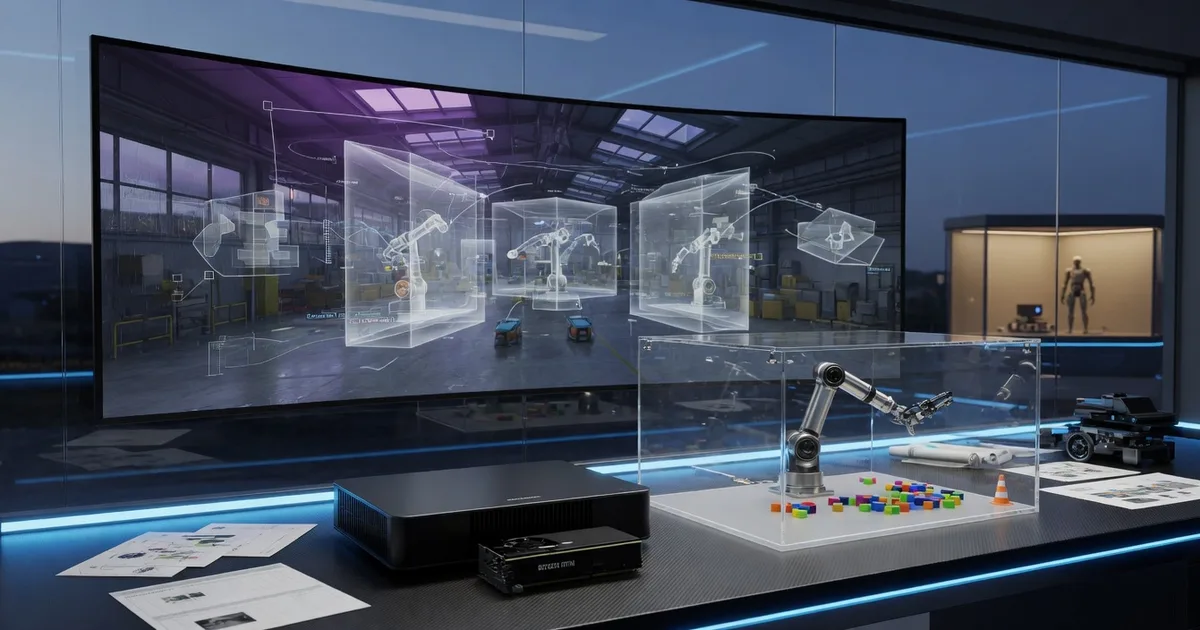
NVIDIA has released Cosmos 3, a family of open world models built on a mixture-of-transformers architecture that combines vision reasoning, world generation and action prediction in a single set of weights. The models are intended to give physical AI systems the ability to learn how environments behave, forecast subsequent states and generate synthetic training data that respects physical constraints. Three sizes are offered: Cosmos 3 Super at 64 billion parameters for high-fidelity simulation, Cosmos 3 Nano at 16 billion for efficient post-training, and Cosmos 3 Edge at 4 billion for on-device deployment on Jetson and RTX platforms.

Physical AI deployments require specialization to particular robots, sensors and operating conditions. Cosmos 3 is released under the Linux Foundation’s OpenMDW 1.1 license, allowing teams to inspect, modify and continue training the weights on their own data and hardware. This openness addresses the practical difficulty of collecting rare or hazardous scenarios at scale, because the models can produce diverse, physics-grounded synthetic data that varies lighting, weather, object placement and trajectories.

Complementary Omniverse libraries and the OpenUSD framework supply simulation-ready environments in which the models can be exercised before real-world deployment. Developers can therefore use a single model family as a vision-language system, a forward simulator or the backbone for learned robot policies, rather than maintaining separate networks for each function. Early adopters already include robotics firms such as Doosan and Skild AI, automotive teams at Li Auto and Xiaomi, and vision-AI integrators working on industrial monitoring.

NVIDIA positions Cosmos 3 within a broader physical-AI stack that also contains Isaac GR00T for humanoid robotics, Alpamayo for autonomous driving and Metropolis for spatial AI. The company has formed the NVIDIA Cosmos Coalition to coordinate further open model development and evaluation methods across these domains.

Why it matters

The release of open-weight physical AI models by a major player like NVIDIA significantly lowers the barrier to entry for developing advanced robotics and autonomous systems. This is highly relevant for the Dutch market, which features strong logistics, agriculture, and high-tech manufacturing sectors that can leverage these transparent, open-source tools for innovation.
More in this beat
Cosmos 3cosmos-3-edgenvidianvidia-omniversephysical-airoboticssynthetic-dataworld-models
NVIDIA Cosmos-H-Dreams: Bringing Real-Time Generative Simulation to Surgical Robotics

11:32 · July 27, 2026

NVIDIA Cosmos-H-Dreams: Bringing Real-Time Generative Simulation to Surgical Robotics

Provides concrete implementation details on distillation, autoregressive rollout stability, few-step diffusion, and low-latency serving that directly address production constraints for ML engineers. Includes actionable training recipes and quantitative performance gains applicable to Dutch teams working on generative models or robotics.

Relevance 78 · Audience 85

Introducing Cosmos 3 Edge

17:58 · July 20, 2026

Introducing Cosmos 3 Edge

This article provides ML Engineers with actionable, open-source tooling and checkpoints for deploying state-of-the-art vision-language and world models on edge hardware. It directly addresses implementation challenges like memory constraints and real-time latency, which are highly applicable to the strong Dutch logistics, agriculture, and smart infrastructure sectors.

Relevance 85 · Audience 95

The State of Simulation for Physical AI: An Overview

22:00 · July 21, 2026

The State of Simulation for Physical AI: An Overview

It offers ML Engineers a critical evaluation of modern simulation tools required for training physical AI and reinforcement learning models. Given the strong Dutch focus on robotics in agriculture, logistics, and high-tech manufacturing, understanding these GPU-accelerated simulation stacks is essential for local AI practitioners.

Relevance 85 · Audience 90

LeRobot v0.6.0: Imagine, Evaluate, Improve

02:00 · July 7, 2026

LeRobot v0.6.0: Imagine, Evaluate, Improve

Directly actionable tooling and research updates for ML engineers working on robotics policies, benchmarks, and deployment pipelines; addresses production constraints like GPU memory, latency via Real-Time Chunking, and human-in-the-loop data collection.

Relevance 75 · Audience 85

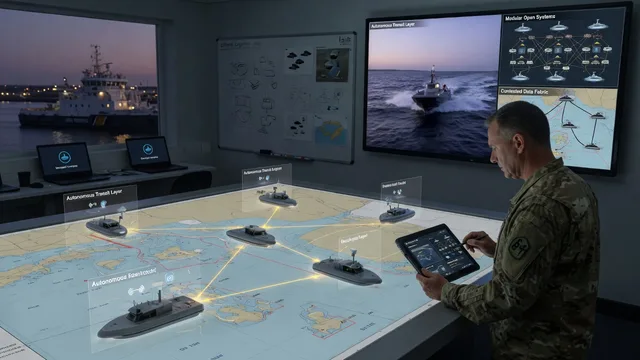
Army G-4 Charts the Course for Autonomous Watercraft

18:51 · July 28, 2026

Army G-4 Charts the Course for Autonomous Watercraft

Directly addresses military autonomous systems and AI integration for logistics, aligning with NATO defense priorities and dual-use technologies relevant to Dutch and European defense professionals.

Relevance 78 · Audience 82

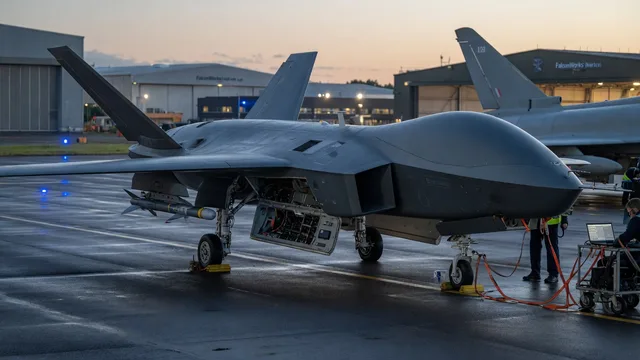
BAE Bets on Sovereignty, Unveils Brontanax Loyal Wingman to British Military in Search of 'Storm Fighter'

21:46 · July 27, 2026

BAE Bets on Sovereignty, Unveils Brontanax Loyal Wingman to British Military in Search of 'Storm Fighter'

This article is highly relevant as it details the development of autonomous combat drones and goal-based autonomy within the European defense sector. It provides critical insights into NATO-aligned CCA procurement strategies, competitive market dynamics, and the integration of AI-driven unmanned systems with existing fighter fleets, which are key interests for defense technologists and strategists.

Relevance 85 · Audience 95

Ukrainian-Danish Venture to Build 12,000 SAKER Military Drones Annually

15:19 · July 27, 2026

Ukrainian-Danish Venture to Build 12,000 SAKER Military Drones Annually

This article is relevant as it highlights the scaling of autonomous military systems and defense production within Europe, directly impacting NATO supply chains. It provides strategic insights for defense professionals regarding the integration and mass production of combat-proven Ukrainian drone technology in Western Europe.

Relevance 75 · Audience 85

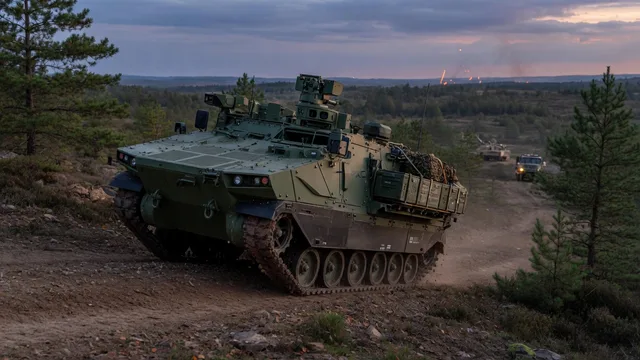
U.S. Army Selects Dire Wolf UGV for Autonomous Logistics in Contested Environments

10:06 · July 27, 2026

U.S. Army Selects Dire Wolf UGV for Autonomous Logistics in Contested Environments

This article is relevant for defense technologists and strategists as it highlights a major allied investment in autonomous logistics and robotic ground vehicles. Understanding U.S. Army procurement trends in AI-driven sustainment provides valuable insights for NATO interoperability and European defense modernization efforts.

Relevance 75 · Audience 85

Grabette: an open system to record robot-manipulation data

02:00 · July 21, 2026

Grabette: an open system to record robot-manipulation data

Grabette addresses the significant data bottleneck in robot learning by providing ML engineers with an accessible, open-source data collection pipeline. Dutch AI practitioners and robotics SMEs can leverage this low-cost hardware to rapidly build datasets and train manipulation models without investing in expensive teleoperation rigs.

Relevance 65 · Audience 70

NVIDIA Introduces New Jetson Thor Computers to Advance Mainstream Robotics and Edge AI

01:00 · July 16, 2026

NVIDIA Introduces New Jetson Thor Computers to Advance Mainstream Robotics and Edge AI

This article highlights crucial advancements in edge AI and robotics hardware, which are key growth areas for the Dutch AI market, particularly in logistics, agriculture, and smart retail. It provides a general AI audience with insights into how foundation models are transitioning from labs to real-world physical applications.

Relevance 85 · Audience 75