AI News selected for Professionals and Decision Makers
Hands On Model Tooling And Research Updates

NVIDIA Cosmos-H-Dreams: Bringing Real-Time Generative Simulation to Surgical Robotics

11:32 · July 27, 2026 · Hugging Face Blog
NVIDIA Cosmos-H-Dreams: Bringing Real-Time Generative Simulation to Surgical Robotics

Summary

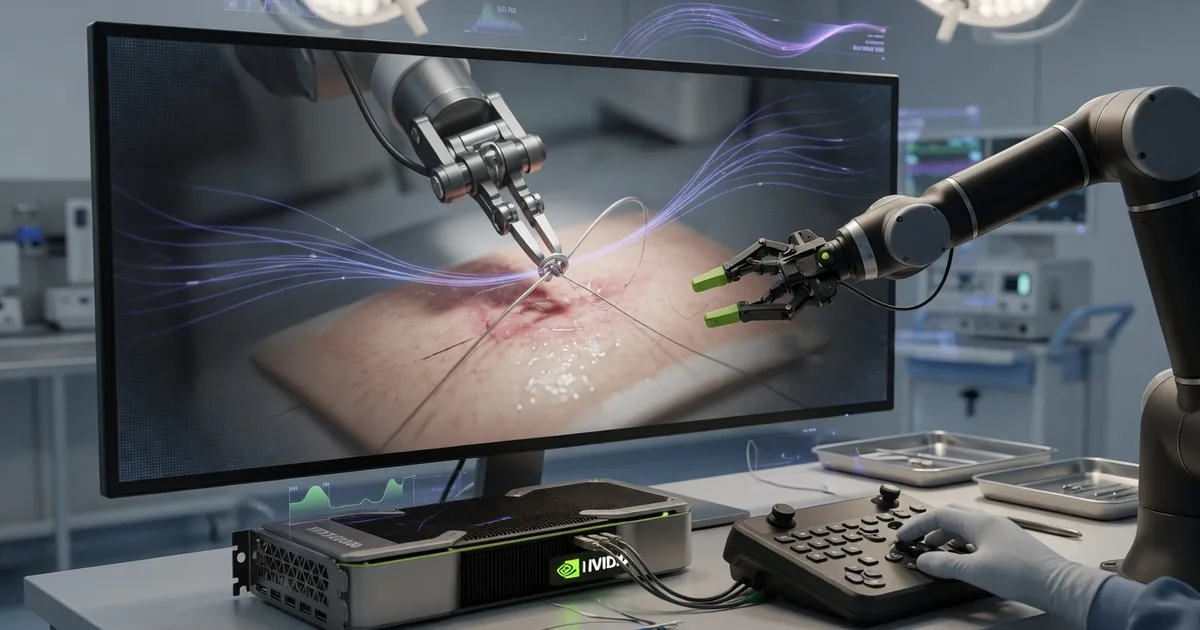
NVIDIA has introduced Cosmos-H-Dreams, a distilled causal student model that converts the offline capabilities of Cosmos-H-Surgical-Simulator into an interactive, action-conditioned generative environment for surgical robotics. The parent model, built on Cosmos-Predict2.5-2B and post-trained on the Open-H-Embodiment dataset, generates future video frames from an initial scene and a sequence of robot actions. Cosmos-H-Dreams retains these visual dynamics while enabling closed-loop control at interactive rates.

The distillation pipeline begins with a bidirectional teacher fine-tuned on JHU dVRK tabletop data that includes both successful demonstrations and failure cases such as needle drops or missed knot ties. Training proceeds through causal warmup followed by progressive extension of the temporal horizon from 12 to 72 frames. The teacher’s denoising trajectories are cached and used to train a causal student via self-forcing distillation, in which the student conditions on its own generated history rather than ground-truth frames. This step reduces the diffusion process to as few as two denoising steps per latent frame while preserving surgical dynamics.

FlashDreams supplies the inference engine that turns the distilled model into a streaming system. Streaming key-value caches, CUDA graph capture, and model compilation together raise throughput from roughly ten frames per second to approximately 160 frames per second on a single RTX PRO 6000 GPU. The resulting simulator accepts live robot kinematics and emits successive frame chunks, supporting both human interaction through browser or Meta Quest interfaces and direct coupling to learned policies.

The release includes training recipes for adapting the approach to new embodiments, a pre-trained dVRK tabletop checkpoint, and a set of closed-loop benchmarks that measure tool-tip accuracy, gripper fidelity, long-horizon drift, and agreement between simulated and real policy outcomes. Integration with the Versius surgeon controller has already demonstrated cross-platform versatility. The work positions real-time world models as shared environments for policy evaluation, synthetic data generation, and rehearsal without repeated use of physical hardware.

Why it matters

Provides concrete implementation details on distillation, autoregressive rollout stability, few-step diffusion, and low-latency serving that directly address production constraints for ML engineers. Includes actionable training recipes and quantitative performance gains applicable to Dutch teams working on generative models or robotics.


More in this beat
Cosmos-H-Dreamsembodied-agentsnvidiaphysical-airoboticssynthetic-dataworld-models
Into the Omniverse: How Open World Models Push the Frontier of Physical AI

15:00 · August 6, 2026

Into the Omniverse: How Open World Models Push the Frontier of Physical AI

The release of open-weight physical AI models by a major player like NVIDIA significantly lowers the barrier to entry for developing advanced robotics and autonomous systems. This is highly relevant for the Dutch market, which features strong logistics, agriculture, and high-tech manufacturing sectors that can leverage these transparent, open-source tools for innovation.

Relevance 75 · Audience 70

Introducing Cosmos 3 Edge

17:58 · July 20, 2026

Introducing Cosmos 3 Edge

This article provides ML Engineers with actionable, open-source tooling and checkpoints for deploying state-of-the-art vision-language and world models on edge hardware. It directly addresses implementation challenges like memory constraints and real-time latency, which are highly applicable to the strong Dutch logistics, agriculture, and smart infrastructure sectors.

Relevance 85 · Audience 95

The State of Simulation for Physical AI: An Overview

22:00 · July 21, 2026

The State of Simulation for Physical AI: An Overview

It offers ML Engineers a critical evaluation of modern simulation tools required for training physical AI and reinforcement learning models. Given the strong Dutch focus on robotics in agriculture, logistics, and high-tech manufacturing, understanding these GPU-accelerated simulation stacks is essential for local AI practitioners.

Relevance 85 · Audience 90

At SIGGRAPH, NVIDIA Advances Graphics and Simulation With Agentic and Physical AI

17:00 · July 20, 2026

At SIGGRAPH, NVIDIA Advances Graphics and Simulation With Agentic and Physical AI

The article showcases significant AI breakthroughs in creative workflows, robotics, and media verification. The Synthetic Video Detector is highly relevant to the Dutch market's focus on ethical and transparent AI, while the accessible agentic AI tools support the high rate of AI adoption among Dutch SMEs.

Relevance 85 · Audience 80

LeRobot v0.6.0: Imagine, Evaluate, Improve

02:00 · July 7, 2026

LeRobot v0.6.0: Imagine, Evaluate, Improve

Directly actionable tooling and research updates for ML engineers working on robotics policies, benchmarks, and deployment pipelines; addresses production constraints like GPU memory, latency via Real-Time Chunking, and human-in-the-loop data collection.

Relevance 75 · Audience 85

iFLYTEK-Embodied-Omni Technical Report

06:00 · July 7, 2026

iFLYTEK-Embodied-Omni Technical Report

This technical report is highly relevant for AI researchers and robotics engineers in the Netherlands, offering a novel, unified architecture for embodied AI that overcomes the limitations of cascaded pipelines. It provides advanced methodologies for integrating multimodal inputs into actionable robotic controls, directly applicable to Dutch R&D in autonomous systems.

Relevance 75 · Audience 90

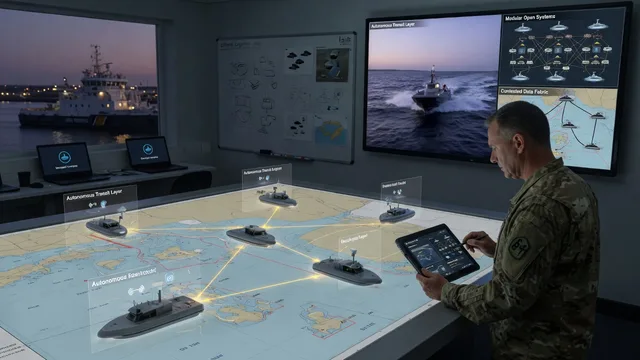
Army G-4 Charts the Course for Autonomous Watercraft

18:51 · July 28, 2026

Army G-4 Charts the Course for Autonomous Watercraft

Directly addresses military autonomous systems and AI integration for logistics, aligning with NATO defense priorities and dual-use technologies relevant to Dutch and European defense professionals.

Relevance 78 · Audience 82

BAE Bets on Sovereignty, Unveils Brontanax Loyal Wingman to British Military in Search of 'Storm Fighter'

21:46 · July 27, 2026

BAE Bets on Sovereignty, Unveils Brontanax Loyal Wingman to British Military in Search of 'Storm Fighter'

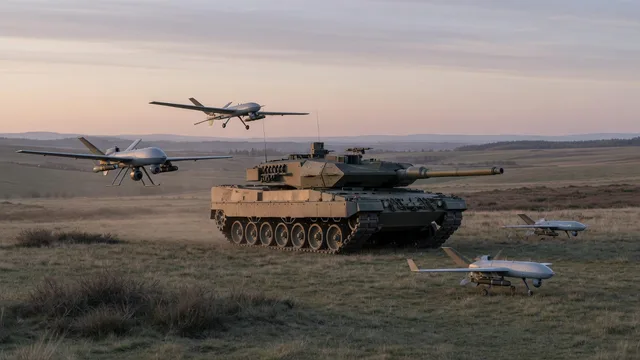
This article is highly relevant as it details the development of autonomous combat drones and goal-based autonomy within the European defense sector. It provides critical insights into NATO-aligned CCA procurement strategies, competitive market dynamics, and the integration of AI-driven unmanned systems with existing fighter fleets, which are key interests for defense technologists and strategists.

Relevance 85 · Audience 95

Ukrainian-Danish Venture to Build 12,000 SAKER Military Drones Annually

15:19 · July 27, 2026

Ukrainian-Danish Venture to Build 12,000 SAKER Military Drones Annually

This article is relevant as it highlights the scaling of autonomous military systems and defense production within Europe, directly impacting NATO supply chains. It provides strategic insights for defense professionals regarding the integration and mass production of combat-proven Ukrainian drone technology in Western Europe.

Relevance 75 · Audience 85

U.S. Army Selects Dire Wolf UGV for Autonomous Logistics in Contested Environments

10:06 · July 27, 2026

U.S. Army Selects Dire Wolf UGV for Autonomous Logistics in Contested Environments

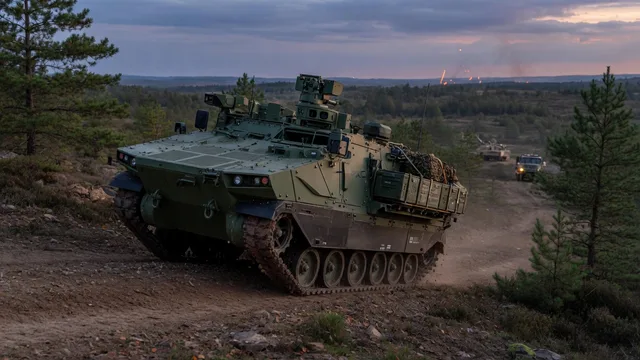
This article is relevant for defense technologists and strategists as it highlights a major allied investment in autonomous logistics and robotic ground vehicles. Understanding U.S. Army procurement trends in AI-driven sustainment provides valuable insights for NATO interoperability and European defense modernization efforts.

Relevance 75 · Audience 85