AI News selected for Professionals and Decision Makers
Hands On Model Tooling And Research Updates

LFM2.5 Q4\_0 Checkpoints from Quantization-Aware Distillation

15:48 · August 19, 2026 · Hugging Face Blog
LFM2.5 Q4\_0 Checkpoints from Quantization-Aware Distillation

Summary

Quantization-Aware Distillation produces Q4_0 checkpoints for the LFM2.5 family that close much of the accuracy gap left by conventional post-training quantization. On four model sizes ranging from 230 M to 2.6 B parameters, the resulting GGUF files retain between 96.5 % and 97.4 % of the corresponding BF16 baseline when evaluated on GPQA Diamond, MMLU-Pro, IFEval, IFBench, Multi-IF, BFCLv4 and a scale-appropriate math suite (GSM8K or AIME25). All scores are reported as means over five runs, with the BF16 GGUF serving as the in-format performance ceiling.

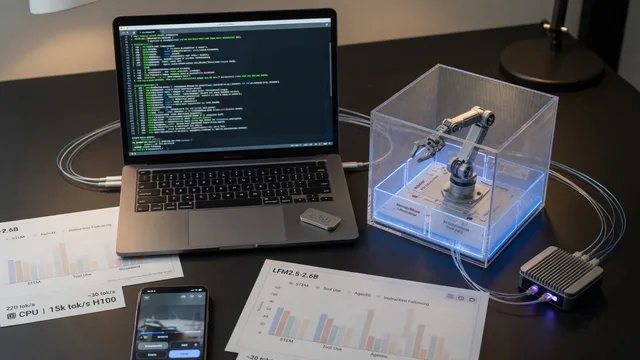
Decode throughput was measured on four representative edge platforms. MacBook Pro and NucBox EVO-X2 runs used GPU inference, while Samsung Galaxy S26 Ultra and Raspberry Pi 5 runs used Arm CPU inference. Under these conditions the 230 M and 350 M QAD checkpoints match the quality of Q5_K_M files while delivering 4–33 % higher tokens per second. The 1.2 B and 2.6 B checkpoints reach parity with Q4_K_M at a 3–14 % throughput advantage and also match the external Unsloth UD-Q4_K_XL reference where available.

The QAD artifacts are released as standard GGUF Q4_0 files and can be loaded directly by llama.cpp or any compatible runtime. They are hosted on Hugging Face under the LFM2.5-230M, LFM2.5-350M, LFM2.5-1.2B-Instruct and LFM2.5-2.6B repositories.

Why it matters

Directly addresses production quantization, throughput optimization, and benchmark-driven evaluation for efficient inference, enabling Dutch ML engineers to deploy high-quality small models under VRAM and latency constraints.


More in this beat
edge-devicesggufhugging-faceknowledge-distillationlfm2-5-2-6bllama-cppmmlu-prosmall-language-models
Up to 3.2x Faster Inference with LFM2.5-DSpark

18:52 · August 20, 2026

Up to 3.2x Faster Inference with LFM2.5-DSpark

Directly addresses production inference challenges like memory-bound decode latency and GPU/edge deployment for ML Engineers, with quantitative benchmarks and open implementations applicable in Dutch AI workflows.

Relevance 85 · Audience 90

Deploy local agents everywhere with LFM2.5-2.6B

15:58 · August 4, 2026

Deploy local agents everywhere with LFM2.5-2.6B

Strong focus on production inference constraints, latency, token throughput, and agent tooling directly addresses ML Engineer needs for efficient local deployment. Benchmarks and ecosystem support offer actionable data for Dutch teams building privacy-preserving on-device AI solutions aligned with EU priorities.

Relevance 78 · Audience 85

Chinese military researchers tap US AI models to train defense systems

14:34 · July 31, 2026

Chinese military researchers tap US AI models to train defense systems

Directly addresses military AI applications, dual-use model distillation, and NATO-relevant export control challenges, providing actionable insights for defense technologists and strategists on adversary capabilities and technology transfer risks.

Relevance 85 · Audience 90

LFM2.5-Encoders for Fast Long-Context Inference on CPU

17:01 · July 28, 2026

LFM2.5-Encoders for Fast Long-Context Inference on CPU

Strong match for ML Engineers: delivers concrete implementation details, latency benchmarks, CPU memory advantages, and actionable fine-tuning guidance for long-context encoders. Directly addresses accuracy-vs-cost trade-offs in high-volume inference workloads.

Relevance 82 · Audience 88

The Wiola Architecture for Efficient Small Language Models

06:00 · July 3, 2026

The Wiola Architecture for Efficient Small Language Models

This research is highly relevant for Dutch AI researchers and SMEs as it provides a novel, efficient, and open-source Small Language Model architecture. SLMs align perfectly with the Netherlands' focus on sustainable, cost-effective, and transparent AI solutions that can be easily deployed by local enterprises without massive compute resources.

Relevance 85 · Audience 95

Featuring Every Eval Ever Results on Hugging Face Model Pages

02:00 · June 30, 2026

Featuring Every Eval Ever Results on Hugging Face Model Pages

This article provides ML Engineers with a concrete, actionable MLOps tool to standardize model evaluation and benchmarking. By adopting the EEE schema, Dutch AI teams can ensure reproducibility and transparency in their model deployments, which is increasingly important for compliance with EU AI regulations and building trust in enterprise AI solutions.

Relevance 85 · Audience 95

ATOD: Annealed Turn-aware On-policy Distillation for Multi-turn Autonomous Agents

06:00 · June 29, 2026

ATOD: Annealed Turn-aware On-policy Distillation for Multi-turn Autonomous Agents

This research is highly relevant for Dutch AI researchers and developers focusing on efficient AI and autonomous agents. By enabling small language models to achieve teacher-level performance through a novel distillation and RL approach, it supports the development of cost-effective, high-performing AI solutions suitable for widespread SME adoption in the Netherlands.

Relevance 85 · Audience 95

OpenAI Pauses Frontier RL Training as It Tightens Defenses Against Unsafe AI Behavior

20:06 · August 19, 2026

OpenAI Pauses Frontier RL Training as It Tightens Defenses Against Unsafe AI Behavior

This article is highly relevant for security and privacy professionals as it highlights critical security vulnerabilities and the necessary defensive measures in frontier AI model training. Dutch enterprises relying on OpenAI models must understand these internal risks and governance challenges to ensure secure and compliant AI deployments under EU regulations.

Relevance 85 · Audience 95