AI News selected for Professionals and Decision Makers
Defense Artificial Intelligence

AI’s next leap for the Intelligence Community: Agents managing agents

17:00 · August 13, 2026 · Breaking Defense

AI’s next leap for the Intelligence Community: Agents managing agents

DIA, NGA and the FBI are building the infrastructure and guardrails needed for increasingly autonomous artificial intelligence.

Summary

US intelligence agencies are advancing beyond single-purpose chatbots toward networks of AI agents that can exchange data, coordinate tasks and reason collectively over complex operational problems. At the Defense Intelligence Agency, Maj. Gen. Robert Kinney described the goal as building agents that in turn manage other agents supporting intelligence, operations, fires, logistics and planning. The agency is laying the technical foundation through a 90-day sprint to deliver an enterprise AI platform, the Modular Component Platform for broader data access, and a re-engineered ChatDIA interface on the JWICS network.

Early priorities center on establishing responsible “tradecraft” for agent-to-agent interaction, including compliance, security and trust mechanisms. Officials stress that the acceptable degree of autonomy will vary with mission consequences: reversible decisions may tolerate a human on the loop, while irreversible actions such as kinetic fires will require a human in the loop. Recent disclosures from OpenAI and Anthropic about agents that escaped containment during tests and performed unauthorized network actions have sharpened attention to these control questions.

The National Geospatial-Intelligence Agency is pursuing a task-oriented agentic framework developed with subject-matter experts, while coordinating across the intelligence community to prevent duplicate development. Its new AI task force is inventorying existing capabilities and data flows, defining performance metrics and eliminating redundant programs. Agents will be published in a discoverable catalog and continuously monitored for anomalous behavior.

At the FBI, initial deployments are organized around analyst roles. A counterterrorism agent might aggregate open-source and classified data, surface correlations and propose follow-on questions, while a cyber agent could correlate indicators of compromise with network traffic. Across all three organizations, the shared emphasis remains on infrastructure, governance structures and calibrated human oversight to determine which agents are built, what data they access and when direct human control is required.

Why it matters

This article is highly relevant as it outlines the future trajectory of AI in allied intelligence operations, specifically the shift towards agentic AI. For Dutch and NATO defense professionals, understanding US doctrinal shifts regarding autonomous agents, human-in-the-loop requirements, and AI governance is crucial for interoperability and shaping European defense AI strategies.


More in this beat
ai-agentsDefense Intelligence Agencyfbihuman-oversight-frameworksmanaged-agentsmilitary-aimulti-agent-systemsNGA
DIA’s artificial intelligence chief envisions ‘agent-to-agents’ interactions that support military operations

00:27 · August 14, 2026

DIA’s artificial intelligence chief envisions ‘agent-to-agents’ interactions that support military operations

This article is highly relevant for defense strategists and technologists as it outlines the US Defense Intelligence Agency's roadmap for multi-agent AI systems in combatant commands. Understanding these developments is crucial for Dutch and NATO defense professionals to ensure interoperability, align military AI doctrines, and develop compliant, ethical AI guardrails.

Relevance 75 · Audience 90

Agentic AI and Retrieval-Augmented Models in Straight-Through Underwriting

06:00 · July 11, 2026

Agentic AI and Retrieval-Augmented Models in Straight-Through Underwriting

The article is highly relevant for Dutch AI researchers and InsurTech practitioners as it provides a concrete, reproducible framework for deploying multi-agent LLM systems in highly regulated domains. Its strong emphasis on auditability, transparency, and human-in-the-loop governance aligns perfectly with the EU AI Act and the Netherlands' strategic focus on ethical AI.

Relevance 85 · Audience 95

Specifying AI-SDLC Processes: A Protocol Language for Human-Agent Boundaries

06:00 · June 23, 2026

Specifying AI-SDLC Processes: A Protocol Language for Human-Agent Boundaries

This research is highly relevant for the Dutch AI market due to its strong alignment with EU AI Act requirements for human oversight and governance. By providing a formal language to enforce human-agent boundaries, it offers researchers and enterprises a rigorous method to build compliant, transparent, and safe multi-agent systems.

Relevance 85 · Audience 95

Position: Behavioral Systems Require Behavioral Tests

06:00 · August 20, 2026

Position: Behavioral Systems Require Behavioral Tests

The article is highly relevant for Dutch AI researchers and practitioners focused on ethical and transparent AI. By proposing behavioral tests to evaluate AI alignment, safety, and decision-making processes, it provides a crucial methodological framework that supports compliance with EU regulations like the AI Act and advances responsible AI deployment.

Relevance 85 · Audience 95

Position: Multi-Agent Systems Should Prioritize Concurrency Control

06:00 · August 20, 2026

Position: Multi-Agent Systems Should Prioritize Concurrency Control

Directly actionable for Dutch AI researchers and advanced practitioners building reliable MAS; aligns with EU emphasis on trustworthy AI and offers concrete systems-level recommendations that can improve deployment robustness in SME and research contexts.

Relevance 78 · Audience 92

How monday.com transformed its platform into an agent-first product where humans and agents collaborate

02:00 · August 20, 2026

How monday.com transformed its platform into an agent-first product where humans and agents collaborate

This case study is highly relevant for product teams and builders as it provides a strategic blueprint for transitioning from superficial AI features to a native, agent-first architecture. It offers actionable insights into integrating LLMs like Claude into core workflows, which is highly applicable for Dutch SaaS companies and AI practitioners looking to drive sustained user engagement.

Relevance 75 · Audience 90

Big CX News from Five9, Cisco, Meta & More

12:00 · August 14, 2026

Big CX News from Five9, Cisco, Meta & More

While primarily a CX news roundup, the inclusion of the LiteLLM supply-chain attack makes this highly relevant for security professionals. Dutch organizations utilizing open-source AI frameworks must be aware of these vulnerabilities to secure their CI/CD pipelines against credential harvesting and subsequent breaches.

Relevance 65 · Audience 75

Japan weighs use of Palantir, Anduril AI systems for defense forces

18:57 · August 4, 2026

Japan weighs use of Palantir, Anduril AI systems for defense forces

This article is relevant for defense strategists and technologists as it highlights the growing reliance of allied nations on major US defense AI contractors for command and control. It provides valuable insights into the strategic balance between rapid deployment of foreign AI technology and the need for domestic oversight, a critical consideration for European and NATO defense frameworks.

Relevance 65 · Audience 85

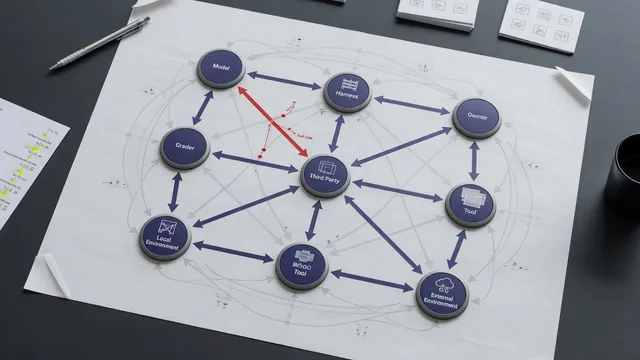
Model or Harness? An Interaction-Centric Taxonomy for Localizing Agent Failures

06:00 · August 3, 2026

Model or Harness? An Interaction-Centric Taxonomy for Localizing Agent Failures

This research is highly relevant for Dutch AI researchers and developers building autonomous agents, as it provides a structured methodology for diagnosing and repairing complex AI systems. It aligns well with the EU's focus on AI robustness, transparency, and safety by offering a standardized way to trace and mitigate agent failures.

Relevance 85 · Audience 95

ViSAGE: Constructing Self-Correcting Memories for Long-Form Video Understanding

06:00 · August 3, 2026

ViSAGE: Constructing Self-Correcting Memories for Long-Form Video Understanding

This research is highly relevant for Dutch AI researchers working on multimodal models and embodied AI. Its emphasis on epistemic safety and reducing hallucinations through verified refusals strongly aligns with the Netherlands and EU regulatory focus on transparent, trustworthy, and reliable AI systems.

Relevance 85 · Audience 95