AI News selected for Professionals and Decision Makers
Primary Research Stream

Model or Harness? An Interaction-Centric Taxonomy for Localizing Agent Failures

06:00 · August 3, 2026 · arXiv cs.AI RSS
Model or Harness? An Interaction-Centric Taxonomy for Localizing Agent Failures

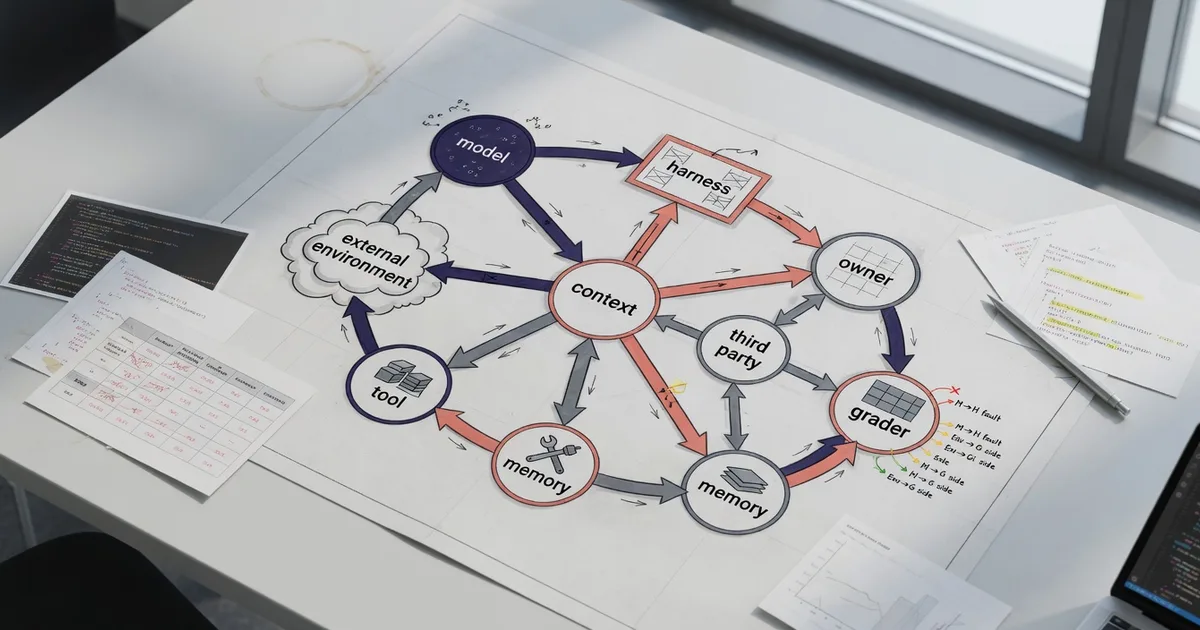
Existing evaluations often reduce agent failures to system-level outcomes, obscuring where the fault originated and which intervention would improve the agent system. This creates a repair-assignment problem: the same visible failure may call for model post-training, harness engineering, environment redesign, or benchmark repair depending on its source. Because agent behavior emerges from interactions among models, harnesses, users, tools, memory, and environments, outcome-level labels are often insufficient for improvement. Most failure taxonomies do little to resolve this problem because they are benchmark-specific and lack a shared structure. We introduce an interaction-centric taxonomy that localizes failures to the interactions in which they originate and identifies the responsible component. It organizes 41 failure modes by assigning each to an edge between two components and a fault side indicating where the repair belongs. This makes the taxonomy actionable: model-side failures identify targets for post-training, harness-side failures point to scaffolding and tool-integration fixes, and environment or grader failures reveal evaluation conditions requiring redesign. The schema applies across agent architectures, from coding assistants to long-horizon personal assistants and multi-agent systems. We ground the taxonomy in worked examples from public benchmarks, model system cards, published reports, and logged agent trajectories, and evaluate its reproducibility using independent reasoning agents as judges. Across four frontier models, the strongest judge reaches Cohen's $\kappa=0.76$ against human category labels, suggesting that the categories capture shared structure rather than annotator-specific preferences.

Summary

Existing evaluations of AI agents typically label failures only by their visible system-level outcomes, which obscures the originating component and the appropriate repair. The resulting repair-assignment problem means that identical observed errors may require model post-training, harness changes, environment redesign, or benchmark fixes depending on their source. Because agent behavior arises from repeated interactions among models, harnesses, users, tools, memory, and environments, outcome-level labels alone rarely indicate which intervention will improve performance.

The paper introduces an interaction-centric taxonomy that treats each failure as an edge between two components and assigns a fault side to indicate where responsibility lies. It defines nine core components—model, owner, grader, third party, context, memory, tool, local environment, and external environment—and organizes 41 failure modes along these edges. Model-side faults point to post-training targets, harness-side faults indicate scaffolding or tool-integration work, and environment or grader faults signal evaluation conditions that need redesign before they can reliably measure capability. The same vocabulary applies to single-model assistants, long-horizon personal agents, coding agents, and multi-agent systems.

The taxonomy is grounded in concrete trajectories drawn from public benchmarks, model system cards, and published reports. To test whether the categories reflect shared structure rather than individual annotator preference, the authors used independent reasoning agents as judges. Across four frontier models, the strongest judge recovered human-assigned labels with Cohen’s κ of 0.76, and pairwise agreement among judges reached 0.84, indicating that the distinctions are reproducible when the definitions and evidence are held constant.

Why it matters

This research is highly relevant for Dutch AI researchers and developers building autonomous agents, as it provides a structured methodology for diagnosing and repairing complex AI systems. It aligns well with the EU's focus on AI robustness, transparency, and safety by offering a standardized way to trace and mitigate agent failures.

More in this beat
agent-memoryai-agentscoding-agentsevaluation-benchmarksharness-engineeringllm-as-judgemulti-agent-systems
Position: Behavioral Systems Require Behavioral Tests

06:00 · August 20, 2026

Position: Behavioral Systems Require Behavioral Tests

The article is highly relevant for Dutch AI researchers and practitioners focused on ethical and transparent AI. By proposing behavioral tests to evaluate AI alignment, safety, and decision-making processes, it provides a crucial methodological framework that supports compliance with EU regulations like the AI Act and advances responsible AI deployment.

Relevance 85 · Audience 95

Position: Multi-Agent Systems Should Prioritize Concurrency Control

06:00 · August 20, 2026

Position: Multi-Agent Systems Should Prioritize Concurrency Control

Directly actionable for Dutch AI researchers and advanced practitioners building reliable MAS; aligns with EU emphasis on trustworthy AI and offers concrete systems-level recommendations that can improve deployment robustness in SME and research contexts.

Relevance 78 · Audience 92

Measuring Cross-Task Behavioral Consistency in Language Model Agents

06:00 · August 17, 2026

Measuring Cross-Task Behavioral Consistency in Language Model Agents

The article provides a novel, quantifiable method for assessing the reliability and behavioral consistency of AI agents, which is crucial for compliance with EU AI regulations and the Dutch focus on transparent AI. Researchers can directly apply the open-source BCM framework to evaluate and improve the predictability of enterprise AI deployments.

Relevance 85 · Audience 95

MobileMem: Learning from a Year of Mobile Experiences

06:00 · August 17, 2026

MobileMem: Learning from a Year of Mobile Experiences

This research is highly relevant for Dutch AI researchers and developers focusing on edge AI and personal assistants. Its emphasis on on-device, local-first memory processing aligns perfectly with the EU's strict GDPR privacy standards, offering a practical framework for building compliant, personalized AI systems.

Relevance 85 · Audience 95

Memory Reward Inflation in Self-Improving LLM Agents

06:00 · August 4, 2026

Memory Reward Inflation in Self-Improving LLM Agents

This research is highly relevant for Dutch AI researchers and developers building autonomous agents, as it addresses critical reliability and hallucination-reinforcement issues. It aligns strongly with the EU's focus on trustworthy and transparent AI by providing a mathematically grounded method to prevent self-improving models from compounding their own errors.

Relevance 85 · Audience 95

ViSAGE: Constructing Self-Correcting Memories for Long-Form Video Understanding

06:00 · August 3, 2026

ViSAGE: Constructing Self-Correcting Memories for Long-Form Video Understanding

This research is highly relevant for Dutch AI researchers working on multimodal models and embodied AI. Its emphasis on epistemic safety and reducing hallucinations through verified refusals strongly aligns with the Netherlands and EU regulatory focus on transparent, trustworthy, and reliable AI systems.

Relevance 85 · Audience 95

AgentLens: Production-Assessed Trajectory Reviews for Coding Agent Evaluation

06:00 · July 9, 2026

AgentLens: Production-Assessed Trajectory Reviews for Coding Agent Evaluation

AgentLens is highly relevant for Dutch AI researchers and developers as it provides a robust, open-source framework for evaluating the behavior and reliability of coding agents. Its focus on the entire trajectory rather than just the final output aligns well with the EU's emphasis on transparent, explainable, and trustworthy AI systems.

Relevance 85 · Audience 95

NVIDIA Nemotron Achieves Benchmark-Leading Performance With LangChain Deep Agents Harness

17:00 · July 8, 2026

NVIDIA Nemotron Achieves Benchmark-Leading Performance With LangChain Deep Agents Harness

This development is highly relevant as it offers a cost-effective, open-source alternative to closed AI models, which is crucial for driving AI adoption among Dutch SMEs. Furthermore, the ability to run these agents on proprietary infrastructure aligns perfectly with European data sovereignty and strict AI governance requirements.

Relevance 85 · Audience 75

Beyond the Leaderboard: A Synthesis of Tool-Use, Planning, and Reasoning Failures in Large Language Model Agents

06:00 · July 8, 2026

Beyond the Leaderboard: A Synthesis of Tool-Use, Planning, and Reasoning Failures in Large Language Model Agents

This synthesis is highly relevant for Dutch AI researchers and developers building autonomous agents, as it provides a structured understanding of current LLM limitations. Its focus on safety, security, and measurement validity aligns strongly with the Netherlands' and EU's regulatory emphasis on robust, transparent, and ethical AI systems.

Relevance 85 · Audience 95

Organizational Memory for Agentic Business Process Execution

06:00 · July 7, 2026

Organizational Memory for Agentic Business Process Execution

This research is highly relevant for Dutch AI practitioners and researchers focusing on enterprise AI adoption and multi-agent systems. It provides a scalable, governed architecture for integrating organization-specific knowledge into LLM agents, aligning well with the Dutch market's emphasis on reliable and transparent AI deployment in business contexts.

Relevance 85 · Audience 90