NVIDIA Alpamayo 2 Super, the Frontier Open Model for Robotaxis and Autonomous Vehicles, Now Available for Commercial Use
17:00 · August 4, 2026 · NVIDIA
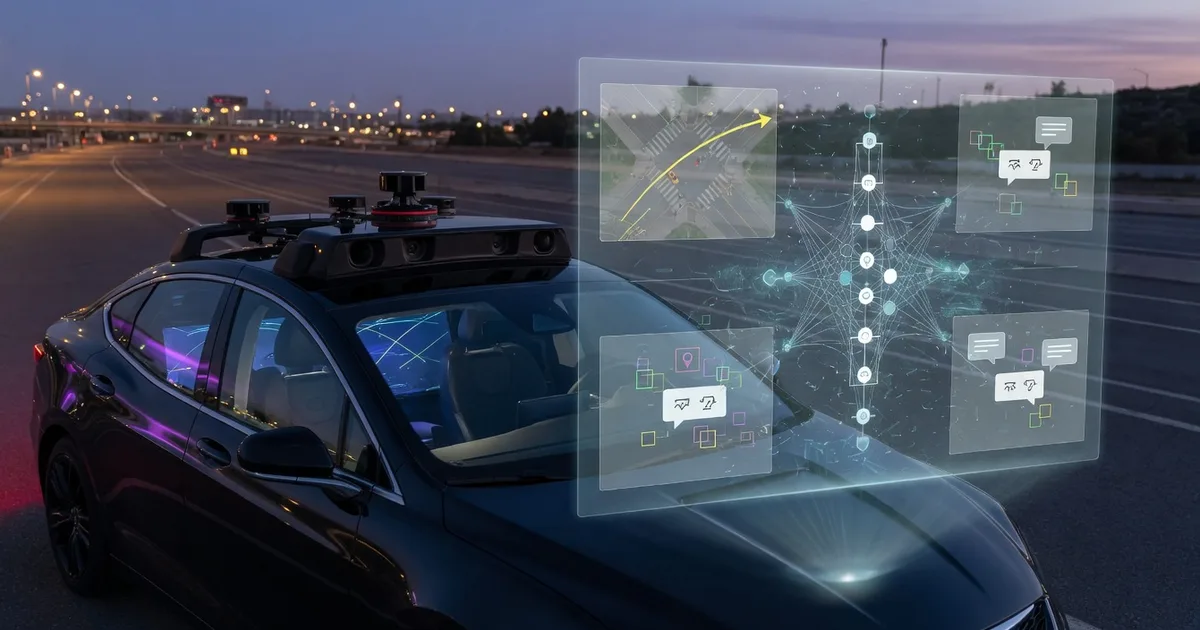
For robotaxis and other autonomous vehicles (AVs), the hardest problems aren’t the everyday scenarios. They’re the rare, complex situations that are difficult to anticipate and train for. Handling these long‑tail events takes more than just object detection and motion prediction. AVs must understand the situation, reason about cause and effect, choose the right action and […]
Summary
NVIDIA has made Alpamayo 2 Super available for commercial use as the largest member of its open reasoning model family for autonomous driving. The model targets the long-tail events that dominate safety risk in robotaxis and other AV deployments, where conventional perception and prediction pipelines often fall short. It processes full-surround camera input to produce five coupled outputs for each scene: a planned trajectory, a chain-of-causation trace that records the reasoning steps, a high-level meta-action, auto-generated reasoning labels, and visual question-answering responses with 2D grounding that link answers to image regions.
Built on the Cosmos 3 Super Reasoner and further trained with reinforcement learning, Alpamayo 2 Super delivers frontier-scale reasoning in cloud workflows while smaller siblings in the family support cost-efficient distillation for vehicle deployment. On the LingoQA benchmark it leads among nearly forty evaluated models, exceeding Qwen2.5-VL 72B by 17 points, Gemini 2.5 Pro by 15.1 points and GPT-4o by 23.2 points under NVIDIA’s Lingo-Judge metric, and it tops the company’s broader suite of autonomous-driving benchmarks.
The model is released under the Linux Foundation’s OpenMDW-1.1 license, which permits fine-tuning, creation of derivatives and commercial redistribution without additional approvals. This arrangement lets developers retain ownership of proprietary fleet data, driving policies and safety-validation pipelines while adapting the base weights to their own requirements. The resulting chain-of-causation traces integrate directly with NVIDIA’s Halos safety workflows and support alignment with ISO/PAS 8800 expectations, providing traceable evidence for regulatory and engineering review.
Beyond planning, Alpamayo 2 Super functions as an autolabeler that converts raw driving clips into annotated training data at scale, shortening annotation cycles from months to days. The same foundation model supports scene understanding, model critiquing and knowledge distillation, allowing a single set of weights to serve multiple stages of the cloud-to-car development pipeline. With more than 500,000 downloads on Hugging Face, the Alpamayo family has become the most widely adopted open reasoning resource for autonomous driving.
Why it matters
This article highlights a major leap in open-source AI for autonomous mobility, emphasizing explainable AI and safety validation. The model's transparent reasoning capabilities align strongly with the Dutch and broader European focus on ethical, trustworthy, and heavily regulated AI deployments.