AI News selected for Professionals and Decision Makers
Defense Artificial Intelligence

How the Ministry of Defense and the Bundeswehr plan to use artificial intelligence

05:00 · July 29, 2026 · RSS APP - Defense Artificial Intelligence
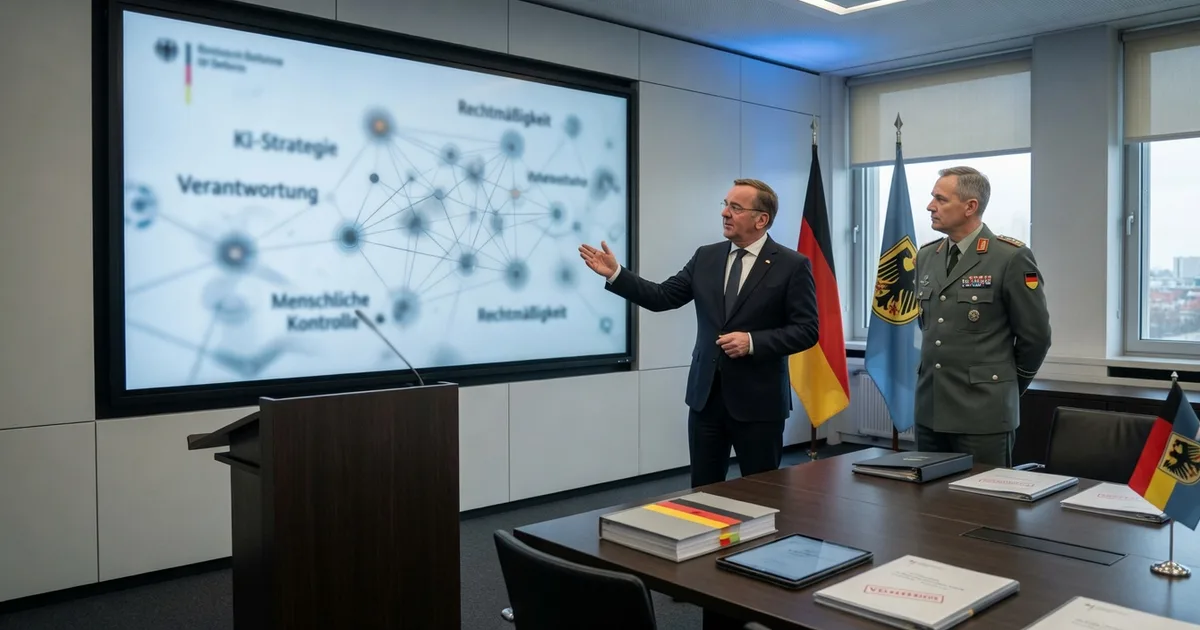
How the Ministry of Defense and the Bundeswehr plan to use artificial intelligence

On Tuesday, the Department of Defense presented its strategy for dealing with artificial intelligence. The guidelines focus on legal and ethical standards.

Summary

The German Ministry of Defence has presented a formal strategy for the integration of artificial intelligence into Bundeswehr operations and support functions. Minister Boris Pistorius and Lieutenant General Michael Vetter introduced the document, which outlines how AI capabilities are to be developed and fielded while remaining subject to German and international legal obligations.

The guidelines treat legal compliance and ethical review as core design constraints rather than supplementary checks. They require that any military AI application undergo assessment against existing rules on accountability, proportionality and human oversight before deployment.

Implementation will be coordinated centrally by the ministry, with the explicit goal of aligning technical development with Germany’s regulatory expectations for defence technology. The approach therefore prioritises traceable decision chains and documented ethical evaluation over rapid, unconstrained adoption of new tools.

Why it matters

Germany is a crucial NATO ally whose military is deeply integrated with the Dutch armed forces. The Bundeswehr's AI strategy and its focus on ethical standards will directly influence joint European defense initiatives, interoperability, and policy development for Dutch defense strategists and technologists.


More in this beat
ai-governanceBundeswehrhuman-oversight-frameworksmilitary-aipolicy-and-societal-impacttrustworthy-ai-practices
Constructive Alignment: Governing Preference Dynamics in Human-AI Interaction

06:00 · July 2, 2026

Constructive Alignment: Governing Preference Dynamics in Human-AI Interaction

This research aligns perfectly with the Dutch AI market's strong strategic focus on ethical, transparent, and human-centric AI. It provides advanced researchers with a rigorous, control-theoretic framework to address the long-term societal impacts and potential manipulative risks of adaptive AI systems.

Relevance 85 · Audience 95

DIA’s artificial intelligence chief envisions ‘agent-to-agents’ interactions that support military operations

00:27 · August 14, 2026

DIA’s artificial intelligence chief envisions ‘agent-to-agents’ interactions that support military operations

This article is highly relevant for defense strategists and technologists as it outlines the US Defense Intelligence Agency's roadmap for multi-agent AI systems in combatant commands. Understanding these developments is crucial for Dutch and NATO defense professionals to ensure interoperability, align military AI doctrines, and develop compliant, ethical AI guardrails.

Relevance 75 · Audience 90

US Navy Creates New Post to Oversee Robotic and Autonomous Systems Programs

14:14 · August 11, 2026

US Navy Creates New Post to Oversee Robotic and Autonomous Systems Programs

This article is relevant for defense strategists and industry professionals as it highlights a major shift in how the US military procures and manages autonomous systems. Understanding these structural changes is vital for NATO allies and European defense contractors aiming to align with US standards or enter the US defense market.

Relevance 65 · Audience 80

Japan weighs use of Palantir, Anduril AI systems for defense forces

18:57 · August 4, 2026

Japan weighs use of Palantir, Anduril AI systems for defense forces

This article is relevant for defense strategists and technologists as it highlights the growing reliance of allied nations on major US defense AI contractors for command and control. It provides valuable insights into the strategic balance between rapid deployment of foreign AI technology and the need for domestic oversight, a critical consideration for European and NATO defense frameworks.

Relevance 65 · Audience 85

Alignment Plausibility: A New Standard for Assuring AI in Healthcare

06:00 · July 11, 2026

Alignment Plausibility: A New Standard for Assuring AI in Healthcare

This research is highly relevant to the Dutch AI market's strong emphasis on ethical, transparent, and regulated AI, particularly in high-risk sectors like healthcare. It provides a structured framework that aligns well with EU AI Act compliance, offering researchers and policymakers a principled approach to AI safety and oversight.

Relevance 85 · Audience 90

Idiobionics: The Unification of Privacy and Intelligent Robotic Prostheses

06:00 · July 11, 2026

Idiobionics: The Unification of Privacy and Intelligent Robotic Prostheses

The article aligns strongly with the Dutch AI market's focus on ethical, transparent AI and healthcare innovation. It provides primary research on privacy vulnerabilities in AI-driven medical devices, which is highly pertinent for Dutch researchers navigating EU data protection standards (GDPR) and the AI Act.

Relevance 85 · Audience 95

Janus: a Playground for User-Involved Agentic Permission Management

06:00 · July 3, 2026

Janus: a Playground for User-Involved Agentic Permission Management

This research is highly relevant to the Dutch AI market's strong emphasis on ethical, transparent, and privacy-compliant AI. By providing an open-source framework to test agentic permission management, it offers Dutch researchers and developers practical tools to align autonomous agents with strict EU data protection and AI regulations.

Relevance 85 · Audience 95

PACE: A Neuro-Symbolic Framework for Plausible and Actionable Counterfactual Explanations

06:00 · July 3, 2026

PACE: A Neuro-Symbolic Framework for Plausible and Actionable Counterfactual Explanations

This research is highly relevant to the Dutch AI market's strong emphasis on ethical, transparent, and GDPR-compliant AI. The neuro-symbolic approach to explainable AI (XAI) provides researchers and advanced practitioners with actionable methodologies to build interpretable systems that respect real-world constraints.

Relevance 85 · Audience 95

The Clinician's Veto: Navigating Trust, Liability, and Uncertainty in Autonomous AI Prescribing

06:00 · June 25, 2026

The Clinician's Veto: Navigating Trust, Liability, and Uncertainty in Autonomous AI Prescribing

The article provides actionable architectural requirements for high-risk AI systems in healthcare, directly aligning with the Dutch and EU focus on ethical, transparent, and human-centric AI. Researchers can apply these insights into uncertainty communication and liability allocation to design compliant AI models for the European market.

Relevance 75 · Audience 85