AI News selected for Professionals and Decision Makers
Primary Research Stream

Managed Autonomy at Runtime: Gear-Based Safety and Governance for Single- and Multi-Agent Cyber-Physical Systems

06:00 · July 2, 2026 · arXiv cs.AI RSS

Managed Autonomy at Runtime: Gear-Based Safety and Governance for Single- and Multi-Agent Cyber-Physical Systems

Autonomous agents, whether LLM-driven software agents or robotic physical agents, face a common class of failure modes when operating without continuous human oversight: safety violations from unverified actions, behavioral instability from unconstrained loops, and continuity loss from unhandled error states. We develop \system{}, a discrete-time control system that combines five execution gears (\Gobs{}, \Gsug{}, \Gplan{}, \Gexec{}, \Gint{}) with utility-gated dispatch and event-driven fallback. For the single-agent case, we prove monotonic stability, execution safety, eventual stabilization, fallback completeness, and equivalence to a gear-constrained Markov decision process. For multi-agent cyber-physical systems (CPS), we apply the established \smart{} managed-autonomy lifecycle and map runtime evidence into its four governance states (\Stable{}/\Meta{}/\Assisted{}/\Regulated{}). Consensus gating, swarm-level Lyapunov analysis, per-agent gear authority, and rendezvous control provide distributed safety and stability guarantees, including zero collision under the stated assumptions. We evaluate the resulting runtime on a three-agent UR5 robotic assembly cell using fault magnitudes calibrated from the NIST \emph{Degradation Measurement of Robot Arm Position Accuracy} dataset across 10,000 Monte Carlo episodes. It achieves a 99.6\% anomaly detection rate versus 2.1\% for the single-agent baseline, reduces detection latency by $3.5\times$, and supplies a formal physical-workspace safety certificate. The execution gears act as micro-level permissions beneath the \smart{} runtime governance states, separating action control from autonomy governance.

Summary

Autonomous agents in both software and robotic settings encounter recurring failure modes when left without continuous oversight, including unverified actions that produce safety violations, oscillatory or looping behavior, and abrupt loss of operational continuity. EntropyRuntime addresses these issues through a discrete-time control architecture that interleaves five execution gears—Observe, Suggest, Plan, Execute, and Integrate—with utility-gated dispatch and event-driven fallback. Each gear restricts the permissible action scope at runtime, while the utility gate blocks any candidate whose expected value falls below a defined threshold.

For single-agent operation the framework supplies formal proofs of monotonic stability, execution safety (no negative-utility action is ever dispatched), eventual stabilization, and fallback completeness. It also establishes equivalence to a gear-constrained Markov decision process, allowing standard dynamic-programming techniques to be applied under the added constraints. These guarantees are obtained by treating gear transitions as a finite-state process whose invariants are preserved across cycles.

In multi-agent cyber-physical systems the same gear mechanism is placed beneath the SMARt managed-autonomy lifecycle. Runtime evidence is mapped into four governance states—Stable, Meta-Cognitive, Assisted, and Regulated—while a consensus utility gate, swarm-level Lyapunov analysis, per-agent gear authority, and rendezvous control together enforce distributed safety properties, including zero workspace collisions under the stated assumptions. The gears therefore function as micro-level permissions that realize the higher-level governance decisions without redefining the lifecycle itself.

The architecture was evaluated on a three-agent UR5 robotic assembly cell whose fault profiles were calibrated from the NIST robot-arm degradation dataset. Across 10,000 Monte Carlo episodes the system recorded a 99.6 % anomaly detection rate (against 2.1 % for the single-agent baseline), reduced detection latency by a factor of 3.5, and supplied a formal physical-workspace safety certificate. Ablation experiments confirmed that each component—gear abstraction, utility gating, and event-driven fallback—is necessary for the observed safety and stability properties.

Why it matters

This research is highly relevant to Dutch AI researchers and the high-tech systems sector (e.g., Brainport Eindhoven) as it provides formal safety and governance frameworks for autonomous cyber-physical systems. Its focus on verifiable safety and runtime governance aligns strongly with EU AI Act requirements for high-risk AI applications.


More in this beat
agent-safetycyber-physical-systemsEntropyRuntimehuman-oversight-frameworksmulti-agent-systemsrisk-and-limitationsstrategic-frameworkstrustworthy-ai-practices
Alignment Plausibility: A New Standard for Assuring AI in Healthcare

06:00 · July 11, 2026

Alignment Plausibility: A New Standard for Assuring AI in Healthcare

This research is highly relevant to the Dutch AI market's strong emphasis on ethical, transparent, and regulated AI, particularly in high-risk sectors like healthcare. It provides a structured framework that aligns well with EU AI Act compliance, offering researchers and policymakers a principled approach to AI safety and oversight.

Relevance 85 · Audience 90

Constructive Alignment: Governing Preference Dynamics in Human-AI Interaction

06:00 · July 2, 2026

Constructive Alignment: Governing Preference Dynamics in Human-AI Interaction

This research aligns perfectly with the Dutch AI market's strong strategic focus on ethical, transparent, and human-centric AI. It provides advanced researchers with a rigorous, control-theoretic framework to address the long-term societal impacts and potential manipulative risks of adaptive AI systems.

Relevance 85 · Audience 95

Revealing Safety-Critical Scenarios for UTM via Transformer

06:00 · July 1, 2026

Revealing Safety-Critical Scenarios for UTM via Transformer

This research is highly relevant for Dutch AI practitioners and researchers focusing on smart mobility, drone logistics, and AI safety. As the EU develops its U-space framework for drone management, advanced methods for validating the safety of high-risk autonomous systems align perfectly with the Netherlands' strategic focus on robust and trustworthy AI.

Relevance 85 · Audience 95

Specifying AI-SDLC Processes: A Protocol Language for Human-Agent Boundaries

06:00 · June 23, 2026

Specifying AI-SDLC Processes: A Protocol Language for Human-Agent Boundaries

This research is highly relevant for the Dutch AI market due to its strong alignment with EU AI Act requirements for human oversight and governance. By providing a formal language to enforce human-agent boundaries, it offers researchers and enterprises a rigorous method to build compliant, transparent, and safe multi-agent systems.

Relevance 85 · Audience 95

DIA’s artificial intelligence chief envisions ‘agent-to-agents’ interactions that support military operations

00:27 · August 14, 2026

DIA’s artificial intelligence chief envisions ‘agent-to-agents’ interactions that support military operations

This article is highly relevant for defense strategists and technologists as it outlines the US Defense Intelligence Agency's roadmap for multi-agent AI systems in combatant commands. Understanding these developments is crucial for Dutch and NATO defense professionals to ensure interoperability, align military AI doctrines, and develop compliant, ethical AI guardrails.

Relevance 75 · Audience 90

AI’s next leap for the Intelligence Community: Agents managing agents

17:00 · August 13, 2026

AI’s next leap for the Intelligence Community: Agents managing agents

This article is highly relevant as it outlines the future trajectory of AI in allied intelligence operations, specifically the shift towards agentic AI. For Dutch and NATO defense professionals, understanding US doctrinal shifts regarding autonomous agents, human-in-the-loop requirements, and AI governance is crucial for interoperability and shaping European defense AI strategies.

Relevance 85 · Audience 95

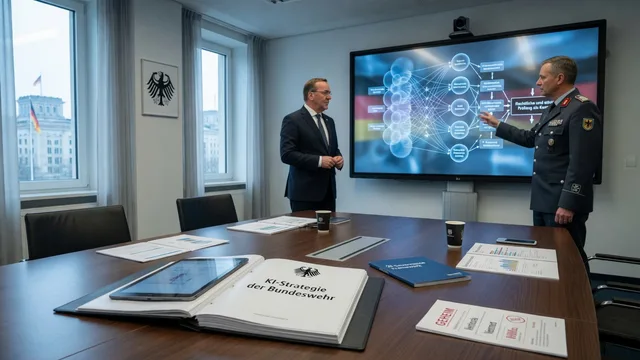
How the Ministry of Defense and the Bundeswehr plan to use artificial intelligence

05:00 · July 29, 2026

How the Ministry of Defense and the Bundeswehr plan to use artificial intelligence

Germany is a crucial NATO ally whose military is deeply integrated with the Dutch armed forces. The Bundeswehr's AI strategy and its focus on ethical standards will directly influence joint European defense initiatives, interoperability, and policy development for Dutch defense strategists and technologists.

Relevance 80 · Audience 90

PlanFlip: Attacking Multi-Agent LLM Systems via Planning-Phase Prompt Injection

06:00 · July 21, 2026

PlanFlip: Attacking Multi-Agent LLM Systems via Planning-Phase Prompt Injection

This research is highly relevant for Dutch AI researchers and security practitioners focused on building robust, EU AI Act-compliant autonomous systems. It provides actionable insights into structural vulnerabilities of multi-agent architectures and offers concrete defensive mechanisms to mitigate planning-phase prompt injections.

Relevance 85 · Audience 95