AI News selected for Professionals and Decision Makers
Primary Research Stream

Multi-Agent Planning with Spatio-Temporal and Topological Constraints using STL-GO

06:00 · August 3, 2026 · arXiv cs.AI RSS
Multi-Agent Planning with Spatio-Temporal and Topological Constraints using STL-GO

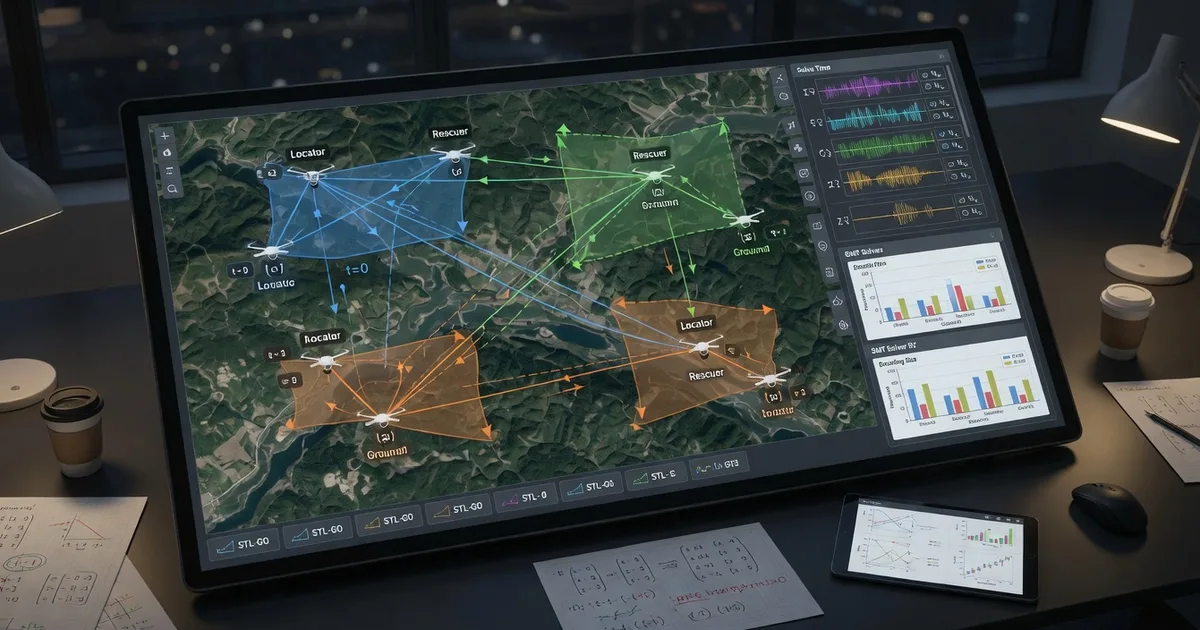
Multi-agent planning problems arise in a variety of engineering applications, such as multi-robot wildfire fighting and unmanned aerial inspection in factories. A particular challenge is the existence of spatio-temporal (i.e., when and/or where an agent should do what) and topological constraints (i.e., how agents should interact), as typically formalized via the notion of graphs. Over the last years, various frameworks have been proposed that can capture such constraints via spatio-temporal logics. We focus here on spatio-temporal logic with graph operators (STL-GO), a recent formalism that supports reasoning about multiple agents and their topologies, such as sensing, communication, and task topologies. In this paper, we consider the problem of planning multi-agent paths that satisfy constraints written in STL-GO. This problem is particularly challenging due to the need of encoding multiple, potentially time-varying graphs via the graph operators inherent to STL-GO. We present two encodings of this problem, one based on mixed-integer programming (MIP) and another based on satisfiability modulo theory (SMT), with soundness guarantees. We provide a unified interface for specifying agent constraints, their graph topologies, and the STL-GO specification, enabling seamless use of both methods and facilitating direct comparison between them. We evaluate both encodings on a multi-UAV search-and-rescue benchmark, ablating over team size and graph complexity, highlighting the expressiveness of the proposed encodings under dynamic multi- graph interactions.

Summary

Multi-agent planning often requires satisfying both spatio-temporal requirements, such as when and where each agent must act, and topological constraints that govern how agents interact through sensing, communication, or task-assignment relations. These interactions are naturally modeled as multiple directed or undirected graphs whose edges can change over time. Spatio-Temporal Logic with Graph Operators (STL-GO) provides a compact way to express such specifications by combining standard signal-temporal operators with explicit quantification over neighborhoods in several distinct, time-varying graphs.

The paper introduces two sound encodings that translate STL-GO specifications into centralized, bounded-horizon planning problems. One formulation uses mixed-integer programming (MIP) while the other relies on satisfiability modulo theories (SMT). Both encodings explicitly represent the joint state of the agents, the evolution of multiple weighted interaction graphs, and the neighborhood-cardinality predicates that appear in STL-GO formulas. A single interface accepts agent dynamics, graph definitions, and the STL-GO specification, allowing the same problem to be solved with either backend and enabling direct comparison of their performance.

The approach is demonstrated on a multi-UAV search-and-rescue scenario in which locator and rescuer agents must coordinate over sensing, communication, and task-assignment graphs. Experiments vary team size and graph complexity, measuring solve time and encoding size with Gurobi for MIP and Z3 for SMT. An additional grid-world benchmark adapted from prior hyperproperty work further illustrates how STL-GO avoids the quantifier alternation or formula blow-up that arises when the same relational requirements are expressed in HyperLTL.

Why it matters

This paper provides foundational research in formal methods for multi-agent systems, highly applicable to the Dutch robotics, logistics, and agri-tech sectors. It offers advanced readers rigorous mathematical frameworks to guarantee the safety and coordination of autonomous swarms.


More in this beat
Gurobimodel-based-planningmulti-agent-systemsroboticssmt-solversSTL-GOz3
US tech helps unmanned surface vessel spot target autonomously

03:52 · August 3, 2026

US tech helps unmanned surface vessel spot target autonomously

This demonstrates advanced autonomous maritime capabilities and multi-agent coordination, which are critical for modern naval operations and NATO defense strategies. It provides valuable insights for defense technologists and military strategists in the Netherlands looking to integrate AI into maritime security and unmanned naval systems.

Relevance 85 · Audience 90

EZSMT Version 3, Matured

06:00 · July 16, 2026

EZSMT Version 3, Matured

This primary research is highly relevant for AI researchers in the Netherlands focusing on symbolic AI, automated reasoning, and formal methods. EZSMTV3 provides a transparent, logic-based approach to solving complex combinatorial problems, aligning well with the European push for explainable and verifiable AI systems.

Relevance 75 · Audience 95

Position: Behavioral Systems Require Behavioral Tests

06:00 · August 20, 2026

Position: Behavioral Systems Require Behavioral Tests

The article is highly relevant for Dutch AI researchers and practitioners focused on ethical and transparent AI. By proposing behavioral tests to evaluate AI alignment, safety, and decision-making processes, it provides a crucial methodological framework that supports compliance with EU regulations like the AI Act and advances responsible AI deployment.

Relevance 85 · Audience 95

Self-Evolving Agents as Dynamic Graph Transformation: A Survey and New Perspective

06:00 · August 20, 2026

Self-Evolving Agents as Dynamic Graph Transformation: A Survey and New Perspective

The paper provides foundational research on making autonomous AI agents auditable, safe, and transparent through dynamic graph modeling. This aligns strongly with the Dutch and EU focus on ethical AI and regulatory compliance, offering advanced researchers actionable frameworks for building governable agentic systems.

Relevance 85 · Audience 95

Position: Multi-Agent Systems Should Prioritize Concurrency Control

06:00 · August 20, 2026

Position: Multi-Agent Systems Should Prioritize Concurrency Control

Directly actionable for Dutch AI researchers and advanced practitioners building reliable MAS; aligns with EU emphasis on trustworthy AI and offers concrete systems-level recommendations that can improve deployment robustness in SME and research contexts.

Relevance 78 · Audience 92

How monday.com transformed its platform into an agent-first product where humans and agents collaborate

02:00 · August 20, 2026

How monday.com transformed its platform into an agent-first product where humans and agents collaborate

This case study is highly relevant for product teams and builders as it provides a strategic blueprint for transitioning from superficial AI features to a native, agent-first architecture. It offers actionable insights into integrating LLMs like Claude into core workflows, which is highly applicable for Dutch SaaS companies and AI practitioners looking to drive sustained user engagement.

Relevance 75 · Audience 90

KernelArc: A Multi-Agent Framework for GPU Kernel Optimization

06:00 · August 19, 2026

KernelArc: A Multi-Agent Framework for GPU Kernel Optimization

High technical depth and novelty in multi-agent kernel search; directly actionable for Dutch AI/HPC teams working on performance engineering; IMEC affiliation adds EU relevance for advanced GPU workloads.

Relevance 78 · Audience 85

How US military funding propelled China’s robot dogs

18:01 · August 18, 2026

How US military funding propelled China’s robot dogs

Directly addresses military and dual-use quadruped robots, US-China technology competition, and supply-chain vulnerabilities that affect NATO defense planners, AI engineers, and Dutch defense industry stakeholders focused on autonomous systems.

Relevance 82 · Audience 88

DIA’s artificial intelligence chief envisions ‘agent-to-agents’ interactions that support military operations

00:27 · August 14, 2026

DIA’s artificial intelligence chief envisions ‘agent-to-agents’ interactions that support military operations

This article is highly relevant for defense strategists and technologists as it outlines the US Defense Intelligence Agency's roadmap for multi-agent AI systems in combatant commands. Understanding these developments is crucial for Dutch and NATO defense professionals to ensure interoperability, align military AI doctrines, and develop compliant, ethical AI guardrails.

Relevance 75 · Audience 90