AI News selected for Professionals and Decision Makers
Hands On Model Tooling And Research Updates

Up to 3.2x Faster Inference with LFM2.5-DSpark

18:52 · August 20, 2026 · Hugging Face Blog
Up to 3.2x Faster Inference with LFM2.5-DSpark

Summary

Speculative decoding mitigates the memory-bound character of the decode phase in large language model inference, where most latency stems from repeated weight transfers between DRAM and SRAM. DSpark implements this by pairing a target model with a compact draft model that proposes blocks of candidate tokens; the target then verifies the entire block in one forward pass, amortizing the cost of loading its parameters.

The draft models released for the LFM2.5 series follow the DSpark architecture but use a simplified attention-only design with five layers and a block size of nine. Each draft contains roughly 300 million parameters and was trained for up to fifteen epochs on a broad mixture of supervised fine-tuning, chat, code, and function-calling data. The epoch with the highest token acceptance rate was retained for each model rather than the one with lowest training loss.

Because acceptance is determined by exact match with the target model’s output distribution under greedy decoding, rejected tokens are replaced by the target’s own prediction. The final sequence is therefore identical to standard greedy generation, preserving benchmark metrics such as pass@1 or exact match without modification.

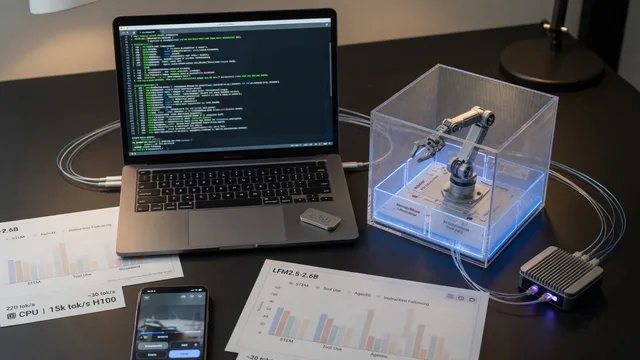
Integration support is provided for both llama.cpp with experimental Metal kernels on Apple silicon and the official SGLang implementation. Throughput measurements on an M4 Max MacBook Pro (FP16 GGUF) and a single H100 80 GB (BF16) show consistent gains across five evaluation sets, reaching a peak of 3.2 times higher tokens per second. Latency reductions average 57 percent for the 2.6 B model in multi-turn tool-use scenarios, while the 1.2 B and 8 B mixture-of-experts variants exhibit dataset-dependent improvements limited in the latter case by current MoE kernel behavior.

Setup requires the corresponding patched builds (llama.cpp PR 27383, SGLang PR 31041) together with the draft checkpoints published on Hugging Face in both Safetensors and GGUF formats. The block size is read automatically from the draft configuration, and the same command without the speculative flags serves as the baseline.

Why it matters

Directly addresses production inference challenges like memory-bound decode latency and GPU/edge deployment for ML Engineers, with quantitative benchmarks and open implementations applicable in Dutch AI workflows.

More in this beat
ggufhugging-faceinference-performancelfm2-5-2-6bllama-cppllm-inferencesglangspeculative-decoding
Deploy local agents everywhere with LFM2.5-2.6B

15:58 · August 4, 2026

Deploy local agents everywhere with LFM2.5-2.6B

Strong focus on production inference constraints, latency, token throughput, and agent tooling directly addresses ML Engineer needs for efficient local deployment. Benchmarks and ecosystem support offer actionable data for Dutch teams building privacy-preserving on-device AI solutions aligned with EU priorities.

Relevance 78 · Audience 85

Smaller, faster, safer: running Kimi and GLM at scale

15:00 · August 3, 2026

Smaller, faster, safer: running Kimi and GLM at scale

Provides actionable security measures (integrity checks) and efficiency techniques applicable to Dutch AI teams running inference workloads, with direct relevance to secure multi-user GPU serving.

Relevance 65 · Audience 70

Hugging Face and Cerebras bring Gemma 4 to real-time voice AI

02:00 · July 1, 2026

Hugging Face and Cerebras bring Gemma 4 to real-time voice AI

This article is highly relevant for ML Engineers as it provides a practical, open-source architecture for solving critical latency bottlenecks in real-time voice AI. Dutch AI teams can directly implement this modular stack using the provided repositories to build responsive conversational agents and embodied AI solutions.

Relevance 80 · Audience 90

Run a vLLM Server on HF Jobs in One Command

02:00 · June 26, 2026

Run a vLLM Server on HF Jobs in One Command

Directly actionable for ML engineers needing quick, production-adjacent model serving setups with explicit handling of VRAM constraints, distributed GPU configs, and pay-per-second costs; relevant for Dutch teams using HF tooling.

Relevance 72 · Audience 88

The Price of Thinking: Reasoning Effort as a Model-Specific API Contract

06:00 · August 19, 2026

The Price of Thinking: Reasoning Effort as a Model-Specific API Contract

This research is highly relevant for Dutch AI researchers and MLOps practitioners focused on cost-efficient AI deployment. Understanding the hidden costs and stochastic nature of reasoning API contracts enables Dutch SMEs and enterprises to optimize their AI infrastructure and routing strategies.

Relevance 85 · Audience 95

A Year in LLM Serving: Workload Evolution, Caching and Load-Balancing

06:00 · August 17, 2026

A Year in LLM Serving: Workload Evolution, Caching and Load-Balancing

This research provides a rare, large-scale dataset and analysis of real-world LLM serving workloads, which is crucial for Dutch AI infrastructure researchers and cloud providers aiming to optimize model deployment, caching, and load-balancing. The release of the full trace enables reproducible benchmarking for local AI systems engineering.

Relevance 85 · Audience 95

Request-Level Energy Attribution for Batched LLM Serving

06:00 · August 4, 2026

Request-Level Energy Attribution for Batched LLM Serving

Directly actionable for Dutch AI teams optimizing sustainable LLM inference under EU energy-reporting rules; provides measured fairness baselines and reproducible protocols relevant to ethical AI and data-center efficiency goals.

Relevance 82 · Audience 88

GPU Management: Why Idle GPUs Are the New Grounded Aircraft

17:09 · July 30, 2026

GPU Management: Why Idle GPUs Are the New Grounded Aircraft

It addresses critical MLOps and production challenges faced by ML Engineers, specifically GPU utilization, workload scheduling, and compute cost optimization. For Dutch enterprises and SMEs scaling AI, mastering these orchestration strategies is essential to remain cost-effective without relying on massive hardware budgets.

Relevance 75 · Audience 85

LFM2.5-Encoders for Fast Long-Context Inference on CPU

17:01 · July 28, 2026

LFM2.5-Encoders for Fast Long-Context Inference on CPU

Strong match for ML Engineers: delivers concrete implementation details, latency benchmarks, CPU memory advantages, and actionable fine-tuning guidance for long-context encoders. Directly addresses accuracy-vs-cost trade-offs in high-volume inference workloads.

Relevance 82 · Audience 88