How Cloudflare detects MCP traffic and helps secure it
15:12 · August 14, 2026 · Cloudflare AI Blog
Cloudflare Gateway identifies MCP requests using protocol-level heuristics. Security teams can use that signal to find shadow MCP traffic, enforce Portal-only access for approved servers, and block direct connections on managed network paths.
Summary
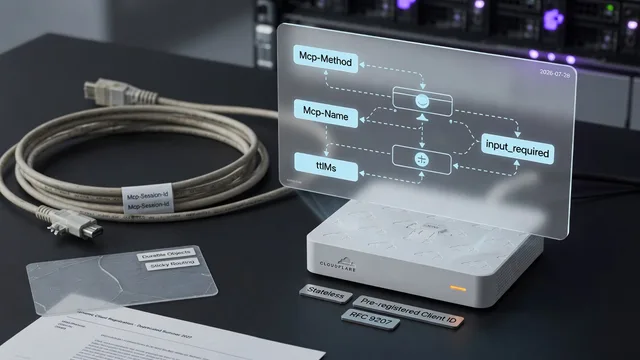
Cloudflare Gateway now inspects Model Context Protocol traffic at the protocol level to give security teams visibility into AI-agent activity that traditional network controls miss. MCP lets agents discover and invoke tools exposed by SaaS products, internal applications, and APIs, but the resulting HTTPS requests carry no fixed hostname or path, so they can resemble ordinary API calls. The new detection relies on headers required by recent MCP specifications—MCP-Protocol-Version on every request after initialization, plus Mcp-Method and Mcp-Name on stateless Streamable HTTP calls—to classify traffic without depending on URL patterns.
The article contrasts three enforcement points. Client-side hooks can block unapproved servers or strip sensitive arguments before serialization, yet they require consistent deployment across every agent harness an organization uses. Network inspection through Gateway with TLS decryption offers the broadest view of remote connections on managed paths; it can flag shadow MCP servers that employees add directly and can block Portal bypasses that skip Access policies and audit logging. Server-side middleware, such as Cloudflare’s WriteGuard, supplies the richest context because it has already authenticated the caller and validated arguments against the tool schema, allowing risk-tiered decisions before any tool executes.
Because AI agents act nondeterministically and at machine speed, the same privileges that were once bounded by human judgment and fatigue now require controls at all three layers. Gateway’s classification feeds into existing data-loss-prevention rules and access policies, letting administrators report on or deny connections that do not route through approved MCP Portals. The approach acknowledges its limits: local stdio transports and legacy clients remain invisible to the network, and only servers that implement the checks can enforce them at the point of execution.
Why it matters
Directly addresses AI security risks from agent-driven tool calls via MCP, with actionable network controls usable by Dutch enterprises on managed paths. Strong EU relevance through privacy controls, logging, and compliance with data protection needs. Targets security professionals managing AI deployments.