AI News selected for Professionals and Decision Makers
Defense Artificial Intelligence

Building a predictive defense industrial base begins with artificial intelligence

16:04 · July 29, 2026 · Breaking Defense
Building a predictive defense industrial base begins with artificial intelligence

AI-enabled workflows accelerate production, but cybersecurity and governance remain central.

Summary

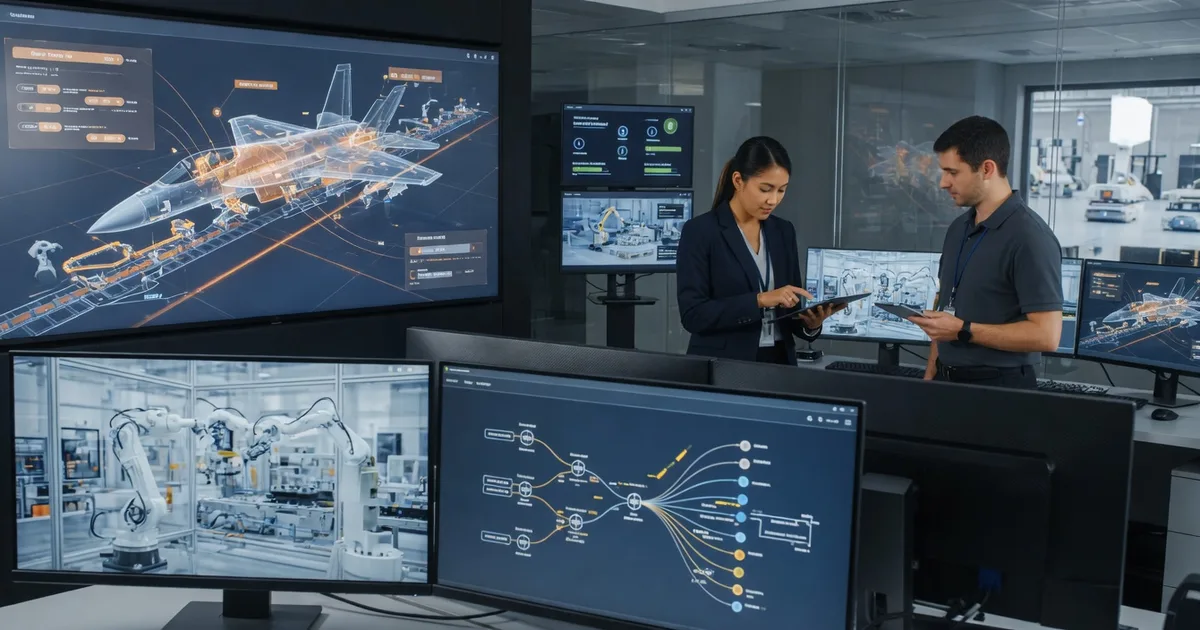
The US defense industrial base is shifting from protracted, multi-year acquisition cycles toward software-defined operations that prioritize speed and adaptability. Executives from Accenture Federal Services describe how digital engineering practices—high-fidelity digital twins, IoT sensors, and robotics on factory floors—create a continuous digital thread from requirements to production. This thread supplies real-time visibility across distributed teams and compresses engineering timelines while automating documentation that has historically delayed programs.

Predictive supply-chain capabilities form a central element of the transformation. By integrating agentic AI with robotics and digital twins, planners move from reactive inventory management to systems that anticipate demand and route assets where seconds matter. Secure, cloud-hosted environments already support hundreds of concurrent classified workloads under zero-trust controls, enabling cross-domain data sharing and high-performance simulation at commercial speeds.

Concrete returns are emerging. One defense client achieved a 76 percent reduction in front-end ordering cycle time, a 51 percent productivity increase, and $53.5 million in first-year savings after redesigning its ordering workflow with these tools. Such outcomes rest on redesigned processes that place humans at the decision point rather than inserting them only for validation.

Workforce constraints receive equal attention. Instead of lengthy offline training, operators receive task-focused microlearning and AI systems that surface procedures and fixes in real time, keeping production lines moving. Blended peer mentorship and virtual simulations further allow incremental upskilling without halting operations.

Smaller suppliers, however, face persistent barriers. Many lack resources for dedicated security leadership or lengthy facility-clearance processes, limiting their ability to meet CMMC requirements or integrate dual-use commercial technologies. Automated governance embedded in the infrastructure and streamlined access pathways are presented as necessary conditions for scaling the ecosystem while preserving resilience.

Why it matters

Directly addresses AI for defense manufacturing, predictive logistics, and secure digital engineering—core concerns for European/NATO defense professionals seeking agile DIB capabilities aligned with ethical and operational priorities.


More in this beat
accentureagentic-workflowsbusiness-adoption-trendsCMMCdefense-industrial-basedigital-twinindustry-breakthroughs
Eco Wave Power Turns Waves Into Watts With NVIDIA AI Infrastructure and Digital Twins

15:00 · June 22, 2026

Eco Wave Power Turns Waves Into Watts With NVIDIA AI Infrastructure and Digital Twins

This article addresses the critical issue of AI's growing energy consumption with a novel, sustainable solution. For a coastal nation like the Netherlands, which faces severe data center grid constraints, wave-powered AI infrastructure presents a compelling use case for future sustainable AI deployment.

Relevance 75 · Audience 85

Working at the frontier: How Rakuten builds agents overnight with Claude Fable 5

02:00 · July 20, 2026

Working at the frontier: How Rakuten builds agents overnight with Claude Fable 5

This article provides product teams and builders with insights into deploying long-running, autonomous AI agents using Claude Fable 5. It highlights practical enterprise strategies for balancing model intelligence with cost and managing human-in-the-loop constraints, which are highly applicable to Dutch AI practitioners scaling agentic workflows.

Relevance 75 · Audience 85

UST is bringing Claude to physical AI

02:00 · July 9, 2026

UST is bringing Claude to physical AI

This case study provides product teams and builders with concrete examples of integrating LLMs into complex engineering workflows, such as hardware validation and digital twin comparisons. It is highly applicable to the Dutch high-tech and manufacturing sectors (e.g., semiconductors, healthcare tech) looking to operationalize AI with human-in-the-loop governance.

Relevance 75 · Audience 85

How Businesses Are Building Specialized AI They Can Trust

15:00 · June 23, 2026

How Businesses Are Building Specialized AI They Can Trust

This article is highly relevant as it addresses the shift towards specialized, trustworthy AI agents, aligning perfectly with the Dutch AI market's focus on ethical AI and practical business adoption. It provides a clear view of how enterprises can securely integrate autonomous AI into their existing workflows.

Relevance 85 · Audience 75

Coinbase reduces time from idea to production by 90% with Cursor

02:00 · June 23, 2026

Coinbase reduces time from idea to production by 90% with Cursor

This case study provides a proven blueprint for product teams and builders to integrate AI coding agents into their workflows. Dutch engineering teams can apply these agent-first strategies to accelerate development cycles and optimize resource allocation.

Relevance 75 · Audience 90

How monday.com transformed its platform into an agent-first product where humans and agents collaborate

02:00 · August 20, 2026

How monday.com transformed its platform into an agent-first product where humans and agents collaborate

This case study is highly relevant for product teams and builders as it provides a strategic blueprint for transitioning from superficial AI features to a native, agent-first architecture. It offers actionable insights into integrating LLMs like Claude into core workflows, which is highly applicable for Dutch SaaS companies and AI practitioners looking to drive sustained user engagement.

Relevance 75 · Audience 90

Turning conversation into knowledge: how Slack builds human-agent teams

02:00 · August 19, 2026

Turning conversation into knowledge: how Slack builds human-agent teams

This article provides actionable organizational strategies for product teams looking to integrate AI agents into their daily workflows. While it lacks specific Dutch market data or deep technical code, the best practices for AI adoption, context sharing, and productivity measurement are highly applicable to Dutch SMEs and enterprise product builders.

Relevance 65 · Audience 85

How US military funding propelled China’s robot dogs

18:01 · August 18, 2026

How US military funding propelled China’s robot dogs

Directly addresses military and dual-use quadruped robots, US-China technology competition, and supply-chain vulnerabilities that affect NATO defense planners, AI engineers, and Dutch defense industry stakeholders focused on autonomous systems.

Relevance 82 · Audience 88

Position: AI Lock-In Is in Progress, and We Must Be Prepared

06:00 · August 18, 2026

Position: AI Lock-In Is in Progress, and We Must Be Prepared

The article aligns strongly with the Dutch and EU focus on responsible, ethical AI and human oversight. Its proposed frameworks for mitigating systemic AI dependency offer actionable insights for Dutch policymakers, AI safety researchers, and enterprise leaders navigating AI adoption.

Relevance 85 · Audience 90