AI News selected for Professionals and Decision Makers
Primary Research Stream

Request-Level Energy Attribution for Batched LLM Serving

06:00 · August 4, 2026 · arXiv cs.AI RSS
Request-Level Energy Attribution for Batched LLM Serving

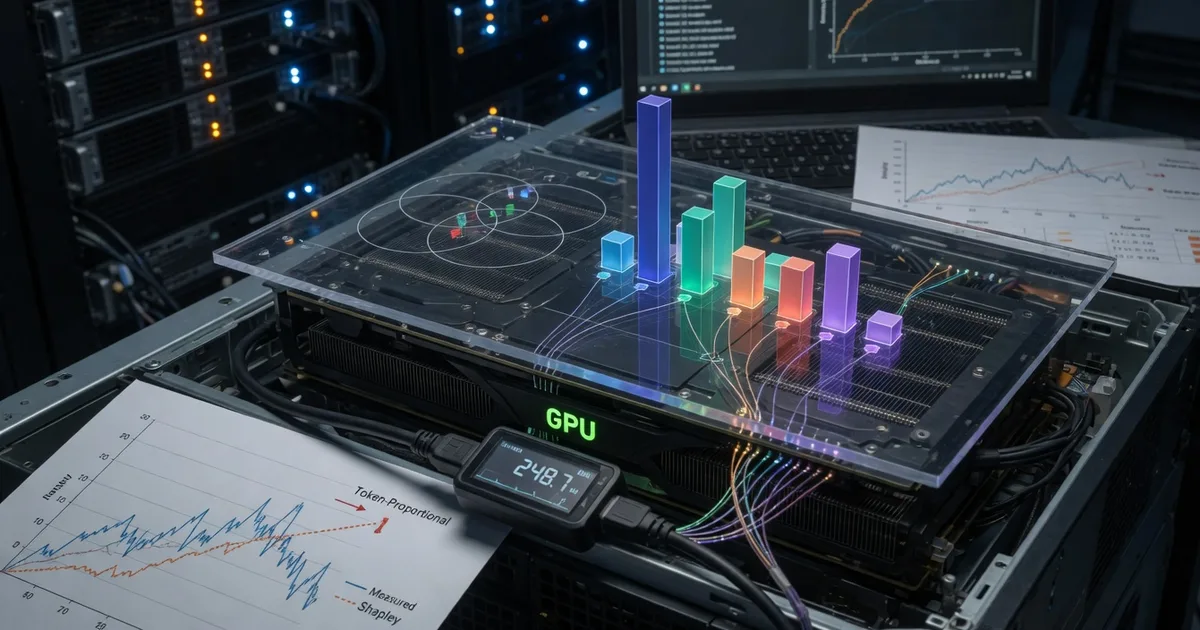
Batched LLM serving improves throughput but complicates energy accounting. GPU power telemetry is aggregate, whereas sustainability reporting, chargeback, and workload analysis often require request-level energy charges. Existing inference-energy benchmarks report model-, phase-, or token-level energy, and recent carbon-accounting work motivates Shapley fairness conceptually. Neither provides measured request-level ground truth, so how far the accounting rules used in practice deviate from a fair allocation has remained unknown. We present JouleShare, an attribution framework with two components. An offline harness establishes this ground truth by replaying request subsets under vLLM with a reproducible protocol, integrating GPU power telemetry, and computing exact Shapley energy for each request. A lightweight calibration model, JCalib, then learns to predict Shapley shares from cheap request features for use at serving time. Across 16 model/workload runs, token-proportional attribution differs from exact Shapley by 0.440 normalized L1 on average under static batching and by 0.458 under continuous batching, a gap that reproduces across three data-center GPUs. JCalib reduces this error to 0.116 under static batching and 0.177 under continuous batching, below even a standalone-measurement baseline that is unavailable online, while preserving exact batch-energy efficiency. Sampled Shapley extends the measured reference to larger group sizes, where the gap persists and a single offline calibration remains the most accurate deployable rule. The results show that token attribution is not a reliable proxy for marginal energy under batched execution, and that measured Shapley ground truth can calibrate low-cost request features toward fairer attribution.

Summary

Batched LLM serving improves GPU utilization by processing multiple requests together, yet this interaction makes it difficult to assign energy consumption accurately to individual requests. GPU power telemetry provides only aggregate measurements, while sustainability reporting, chargeback mechanisms, and workload analysis require request-level attribution that reflects each request’s marginal contribution. Token-proportional allocation, a common practical rule, divides batch energy according to token counts but ignores how requests interact during prefill and decode phases under shared execution.

JouleShare addresses this gap with an offline measurement harness and a lightweight predictor. The harness replays every subset of a request group on vLLM under a fixed protocol, records active GPU energy via power telemetry, and computes exact Shapley values for each request. These measured values serve as ground truth. A calibration model called JCalib is then trained on cheap request features to approximate the Shapley shares for online use without repeating the full subset measurements.

Across 16 model and workload combinations covering static and continuous batching, token-proportional attribution deviates from the measured Shapley allocation by an average normalized L1 error of 0.440 under static batching and 0.458 under continuous batching. The discrepancy persists across three data-center GPUs and model scales up to 14B parameters. JCalib reduces the error to 0.116 and 0.177 respectively, with negligible added latency, while still summing exactly to the observed batch energy. Sampled Shapley evaluations confirm that the gap remains at larger group sizes and that a single offline calibration continues to outperform simpler rules in practice.

Why it matters

Directly actionable for Dutch AI teams optimizing sustainable LLM inference under EU energy-reporting rules; provides measured fairness baselines and reproducible protocols relevant to ethical AI and data-center efficiency goals.


More in this beat
gpu-utilizationinference-performanceJCalibJouleSharellm-inferenceshapley-valuesvllm
Smaller, faster, safer: running Kimi and GLM at scale

15:00 · August 3, 2026

Smaller, faster, safer: running Kimi and GLM at scale

Provides actionable security measures (integrity checks) and efficiency techniques applicable to Dutch AI teams running inference workloads, with direct relevance to secure multi-user GPU serving.

Relevance 65 · Audience 70

GPU Management: Why Idle GPUs Are the New Grounded Aircraft

17:09 · July 30, 2026

GPU Management: Why Idle GPUs Are the New Grounded Aircraft

It addresses critical MLOps and production challenges faced by ML Engineers, specifically GPU utilization, workload scheduling, and compute cost optimization. For Dutch enterprises and SMEs scaling AI, mastering these orchestration strategies is essential to remain cost-effective without relying on massive hardware budgets.

Relevance 75 · Audience 85

Native-speed vLLM transformers modeling backend

02:00 · July 8, 2026

Native-speed vLLM transformers modeling backend

Directly addresses production inference challenges (latency, VRAM, distributed parallelism, fused kernels) with quantitative benchmarks and immediately actionable commands for ML engineers serving LLMs at scale.

Relevance 85 · Audience 90

Run a vLLM Server on HF Jobs in One Command

02:00 · June 26, 2026

Run a vLLM Server on HF Jobs in One Command

Directly actionable for ML engineers needing quick, production-adjacent model serving setups with explicit handling of VRAM constraints, distributed GPU configs, and pay-per-second costs; relevant for Dutch teams using HF tooling.

Relevance 72 · Audience 88

We got local models to triage the OpenClaw repo for FREE!*

02:00 · June 22, 2026

We got local models to triage the OpenClaw repo for FREE!*

It provides a practical, hands-on guide to deploying local models for agentic tasks, addressing critical production concerns like inference optimization, secure tool execution, and cost-efficiency. This aligns well with the EU's focus on data sovereignty and local AI deployment.

Relevance 85 · Audience 95

DiffusionGemma: 4x faster text generation

02:00 · June 1, 2026

DiffusionGemma: 4x faster text generation

Directly addresses production latency, VRAM constraints, and parallel decoding for ML engineers building interactive local applications; provides quantitative benchmarks and tooling guidance applicable to Dutch SME and research deployments.

Relevance 85 · Audience 90

Up to 3.2x Faster Inference with LFM2.5-DSpark

18:52 · August 20, 2026

Up to 3.2x Faster Inference with LFM2.5-DSpark

Directly addresses production inference challenges like memory-bound decode latency and GPU/edge deployment for ML Engineers, with quantitative benchmarks and open implementations applicable in Dutch AI workflows.

Relevance 85 · Audience 90

The Price of Thinking: Reasoning Effort as a Model-Specific API Contract

06:00 · August 19, 2026

The Price of Thinking: Reasoning Effort as a Model-Specific API Contract

This research is highly relevant for Dutch AI researchers and MLOps practitioners focused on cost-efficient AI deployment. Understanding the hidden costs and stochastic nature of reasoning API contracts enables Dutch SMEs and enterprises to optimize their AI infrastructure and routing strategies.

Relevance 85 · Audience 95

Same Cluster, 33 Points More Utilization: What Changed Was the Order

21:46 · August 17, 2026

Same Cluster, 33 Points More Utilization: What Changed Was the Order

Directly addresses production GPU orchestration challenges (contention, reservations, contiguous blocks, churn) with quantitative benchmarks and implementation details relevant to ML engineers running mixed training/inference workloads on shared hardware.

Relevance 78 · Audience 85

A Year in LLM Serving: Workload Evolution, Caching and Load-Balancing

06:00 · August 17, 2026

A Year in LLM Serving: Workload Evolution, Caching and Load-Balancing

This research provides a rare, large-scale dataset and analysis of real-world LLM serving workloads, which is crucial for Dutch AI infrastructure researchers and cloud providers aiming to optimize model deployment, caching, and load-balancing. The release of the full trace enables reproducible benchmarking for local AI systems engineering.

Relevance 85 · Audience 95

Making Knowledge Distillation Cheap Enough to Run at Scale

12:05 · August 10, 2026

Making Knowledge Distillation Cheap Enough to Run at Scale

Directly addresses ML Engineer pain points in LLM distillation: VRAM constraints, distributed vs single-GPU setups, and loss implementation efficiency with concrete metrics and code. Actionable for Dutch teams iterating on model compression under compute limits.

Relevance 85 · Audience 90