AI News selected for Professionals and Decision Makers
Hands On Model Tooling And Research Updates

GPU Management: Why Idle GPUs Are the New Grounded Aircraft

17:09 · July 30, 2026 · Hugging Face Blog
GPU Management: Why Idle GPUs Are the New Grounded Aircraft

Summary

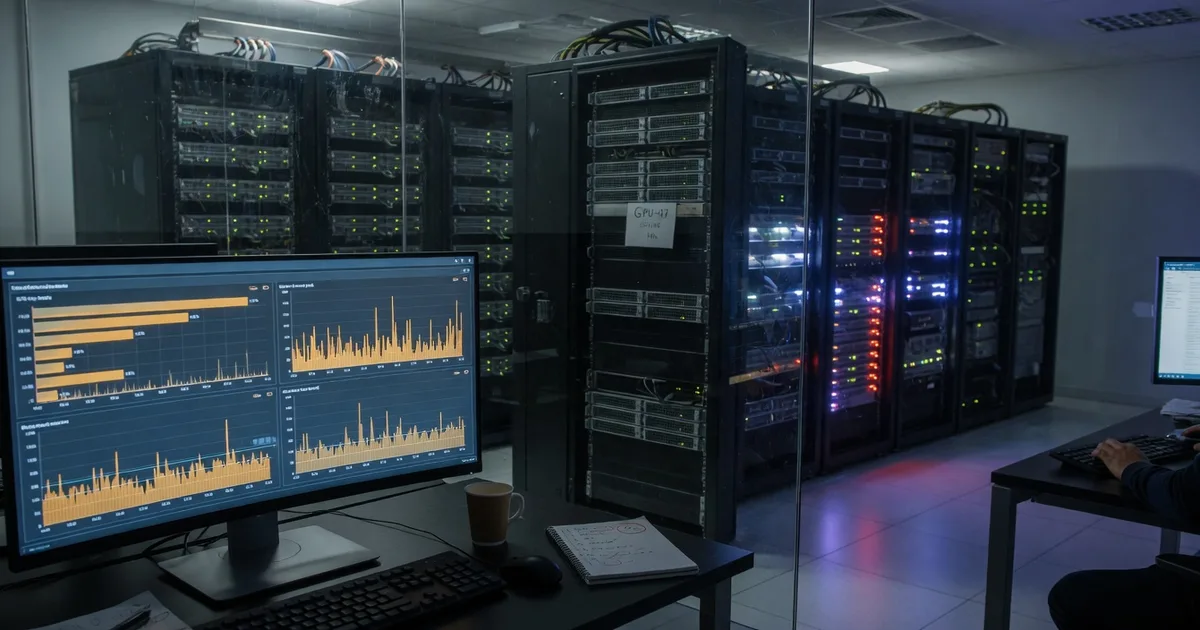
Enterprise GPU clusters now face the same structural economics that shaped commercial aviation: hardware incurs fixed costs around the clock through financing, power, cooling, and depreciation, yet it generates value only while executing useful work. The article maps this directly to utilization rates, noting that two organizations with comparable GPU fleets can achieve markedly different returns depending on how consistently their accelerators stay matched to actual demand rather than sitting idle outside peak windows.

The constraint has shifted from model capability to sustained compute efficiency. Early enterprise AI efforts focused on larger models and benchmark performance, but production workloads now span training, fine-tuning, quantization, real-time inference, batch processing, and embedding generation on the same hardware. Each task imposes distinct requirements for latency, throughput, memory footprint, and duration, so a scheduler optimized for one workload routinely leaves capacity stranded for the others. High average occupancy metrics can therefore mask substantial lost opportunity when queued jobs wait for GPUs of the right shape.

Specialized, smaller models reduce the resource footprint of individual tasks, freeing capacity that generalist models would otherwise occupy for long stretches. This gain, however, only materializes when an orchestration layer continuously decides which workload runs on which accelerator, at what priority, and for how long. Because allocation decisions recur with every job completion and every new request, the function must operate automatically rather than through manual oversight. The result is a distinct operational discipline—GPU management—that treats infrastructure intelligence as an ongoing process rather than a one-time provisioning choice.

Why it matters

It addresses critical MLOps and production challenges faced by ML Engineers, specifically GPU utilization, workload scheduling, and compute cost optimization. For Dutch enterprises and SMEs scaling AI, mastering these orchestration strategies is essential to remain cost-effective without relying on massive hardware budgets.


More in this beat
cluster-orchestrationcudagpu-managementgpu-utilizationinference-performancellm-inferencenvidia
Same Cluster, 33 Points More Utilization: What Changed Was the Order

21:46 · August 17, 2026

Same Cluster, 33 Points More Utilization: What Changed Was the Order

Directly addresses production GPU orchestration challenges (contention, reservations, contiguous blocks, churn) with quantitative benchmarks and implementation details relevant to ML engineers running mixed training/inference workloads on shared hardware.

Relevance 78 · Audience 85

A Year in LLM Serving: Workload Evolution, Caching and Load-Balancing

06:00 · August 17, 2026

A Year in LLM Serving: Workload Evolution, Caching and Load-Balancing

This research provides a rare, large-scale dataset and analysis of real-world LLM serving workloads, which is crucial for Dutch AI infrastructure researchers and cloud providers aiming to optimize model deployment, caching, and load-balancing. The release of the full trace enables reproducible benchmarking for local AI systems engineering.

Relevance 85 · Audience 95

Request-Level Energy Attribution for Batched LLM Serving

06:00 · August 4, 2026

Request-Level Energy Attribution for Batched LLM Serving

Directly actionable for Dutch AI teams optimizing sustainable LLM inference under EU energy-reporting rules; provides measured fairness baselines and reproducible protocols relevant to ethical AI and data-center efficiency goals.

Relevance 82 · Audience 88

Smaller, faster, safer: running Kimi and GLM at scale

15:00 · August 3, 2026

Smaller, faster, safer: running Kimi and GLM at scale

Provides actionable security measures (integrity checks) and efficiency techniques applicable to Dutch AI teams running inference workloads, with direct relevance to secure multi-user GPU serving.

Relevance 65 · Audience 70

Hugging Face and Cerebras bring Gemma 4 to real-time voice AI

02:00 · July 1, 2026

Hugging Face and Cerebras bring Gemma 4 to real-time voice AI

This article is highly relevant for ML Engineers as it provides a practical, open-source architecture for solving critical latency bottlenecks in real-time voice AI. Dutch AI teams can directly implement this modular stack using the provided repositories to build responsive conversational agents and embodied AI solutions.

Relevance 80 · Audience 90

How NVIDIA’s Inference Software Stack Powers the Lowest Token Cost

17:00 · June 30, 2026

How NVIDIA’s Inference Software Stack Powers the Lowest Token Cost

This article is relevant because it addresses a critical bottleneck in AI adoption: inference costs. For Dutch enterprises and SMEs scaling AI from pilots to production, understanding how software optimizations lower the cost per token is essential for sustainable AI deployment.

Relevance 75 · Audience 65

We got local models to triage the OpenClaw repo for FREE!*

02:00 · June 22, 2026

We got local models to triage the OpenClaw repo for FREE!*

It provides a practical, hands-on guide to deploying local models for agentic tasks, addressing critical production concerns like inference optimization, secure tool execution, and cost-efficiency. This aligns well with the EU's focus on data sovereignty and local AI deployment.

Relevance 85 · Audience 95

DiffusionGemma: 4x faster text generation

02:00 · June 1, 2026

DiffusionGemma: 4x faster text generation

Directly addresses production latency, VRAM constraints, and parallel decoding for ML engineers building interactive local applications; provides quantitative benchmarks and tooling guidance applicable to Dutch SME and research deployments.

Relevance 85 · Audience 90

Up to 3.2x Faster Inference with LFM2.5-DSpark

18:52 · August 20, 2026

Up to 3.2x Faster Inference with LFM2.5-DSpark

Directly addresses production inference challenges like memory-bound decode latency and GPU/edge deployment for ML Engineers, with quantitative benchmarks and open implementations applicable in Dutch AI workflows.

Relevance 85 · Audience 90

The Price of Thinking: Reasoning Effort as a Model-Specific API Contract

06:00 · August 19, 2026

The Price of Thinking: Reasoning Effort as a Model-Specific API Contract

This research is highly relevant for Dutch AI researchers and MLOps practitioners focused on cost-efficient AI deployment. Understanding the hidden costs and stochastic nature of reasoning API contracts enables Dutch SMEs and enterprises to optimize their AI infrastructure and routing strategies.

Relevance 85 · Audience 95

KernelArc: A Multi-Agent Framework for GPU Kernel Optimization

06:00 · August 19, 2026

KernelArc: A Multi-Agent Framework for GPU Kernel Optimization

High technical depth and novelty in multi-agent kernel search; directly actionable for Dutch AI/HPC teams working on performance engineering; IMEC affiliation adds EU relevance for advanced GPU workloads.

Relevance 78 · Audience 85