AI News selected for Professionals and Decision Makers
Hands On Model Tooling And Research Updates

Meta is back with Muse Glimmer: local, agentic, multimodal, and open source

02:00 · August 10, 2026 · Hugging Face Blog

Meta is back with Muse Glimmer: local, agentic, multimodal, and open source

Summary

Muse Glimmer is a 30B-parameter dense multimodal vision-language model released by Meta with day-0 support across major inference and training libraries. It pairs a 2B-parameter ViT-style vision encoder, derived from Meta’s earlier Perception Encoder work, with a text decoder that employs alternating window and full attention layers, 2D rotary position embeddings, and a pixel-shuffle projection step that reduces visual token count by a factor of four. The same encoder processes both still images and video frames at two frames per second, up to a 96-frame limit, inserting timestamped placeholders that allow interleaved text and visual tokens.

The model ships with an optional DFlash speculative-decoding drafter that trades modest extra memory for faster generation, particularly on structured outputs such as code. Integrations cover transformers via AutoModelForMultimodalLM and AutoProcessor, llama.cpp with pre-calibrated GGUF weights, vLLM through the transformers backend, and managed Inference Endpoints that expose an OpenAI-compatible API. Quantized variants and hardware-specific optimizations for CUDA, ROCm, and XPU are provided out of the box.

Fine-tuning is supported through TRL on 80 GB Hopper GPUs, with published examples covering supervised fine-tuning on structured image tasks and asynchronous GRPO on coding environments. Additional utilities include multimodal tool calling, open-ended object detection, and video question answering without audio.

Beyond conventional inference, the release highlights agentic workflows in which the model can inspect its own weights on the Hub, produce a quantized GGUF variant, launch a local llama-server, deploy itself to Inference Endpoints, and iteratively benchmark hardware-specific serving configurations while retaining only correctness-preserving changes. These demonstrations illustrate how a locally runnable 30B VLM can manage parts of its own deployment and optimization pipeline.

Why it matters

Directly actionable for ML Engineers: concrete architecture specs, latency/memory trade-offs via speculative decoding, cross-vendor GPU support, fine-tuning recipes, and MLOps patterns that Dutch teams can apply immediately to local/agentic multimodal systems.


More in this beat
agentic-workflowscudahugging-facemetamultimodal-llmsmuse-glimmervllm
NVIDIA and Local AI Community Fuel Open Source Models and Intelligent Agents

15:00 · August 11, 2026

NVIDIA and Local AI Community Fuel Open Source Models and Intelligent Agents

This article highlights significant advancements in local AI and open-source models, which are crucial for businesses looking to deploy cost-effective, privacy-preserving AI solutions. However, the heavy use of technical jargon makes it less accessible to a general audience.

Relevance 65 · Audience 40

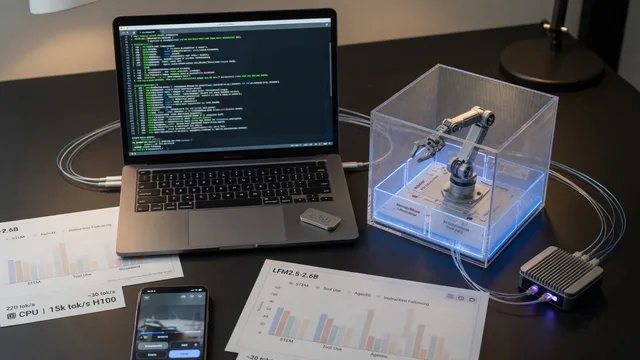
Deploy local agents everywhere with LFM2.5-2.6B

15:58 · August 4, 2026

Deploy local agents everywhere with LFM2.5-2.6B

Strong focus on production inference constraints, latency, token throughput, and agent tooling directly addresses ML Engineer needs for efficient local deployment. Benchmarks and ecosystem support offer actionable data for Dutch teams building privacy-preserving on-device AI solutions aligned with EU priorities.

Relevance 78 · Audience 85

🤗 Kernels: Major Updates

02:00 · July 6, 2026

🤗 Kernels: Major Updates

Provides actionable implementation guidance on kernel tooling, security, compatibility, and benchmarking that ML Engineers can apply to optimize models under latency and hardware constraints. Strong focus on MLOps practices and production deployment aligns with the category.

Relevance 82 · Audience 91

Run a vLLM Server on HF Jobs in One Command

02:00 · June 26, 2026

Run a vLLM Server on HF Jobs in One Command

Directly actionable for ML engineers needing quick, production-adjacent model serving setups with explicit handling of VRAM constraints, distributed GPU configs, and pay-per-second costs; relevant for Dutch teams using HF tooling.

Relevance 72 · Audience 88

Beyond LoRA: Can you beat the most popular fine-tuning technique?

02:00 · June 18, 2026

Beyond LoRA: Can you beat the most popular fine-tuning technique?

Directly addresses ML Engineers' needs for parameter-efficient fine-tuning with concrete benchmarks on accuracy-vs-memory trade-offs, VRAM constraints, and MLOps considerations that Dutch teams can apply immediately via the open-source PEFT library.

Relevance 85 · Audience 90

GLM-5.2: Built for Long-Horizon Tasks

11:01 · June 17, 2026

GLM-5.2: Built for Long-Horizon Tasks

Provides concrete architectural details, ablation studies, production inference challenges, and benchmark comparisons directly usable by ML engineers deploying or fine-tuning long-context agents.

Relevance 85 · Audience 90

Up to 3.2x Faster Inference with LFM2.5-DSpark

18:52 · August 20, 2026

Up to 3.2x Faster Inference with LFM2.5-DSpark

Directly addresses production inference challenges like memory-bound decode latency and GPU/edge deployment for ML Engineers, with quantitative benchmarks and open implementations applicable in Dutch AI workflows.

Relevance 85 · Audience 90

Large Language Models in Mental Health: A Systematic Review of Applications, Innovations, and Ethical Challenges

06:00 · August 20, 2026

Large Language Models in Mental Health: A Systematic Review of Applications, Innovations, and Ethical Challenges

The review directly aligns with the Dutch AI market's strong emphasis on ethical, transparent AI and its robust HealthTech sector. It provides researchers with a comprehensive overview of state-of-the-art multimodal techniques and regulatory frameworks necessary for deploying AI in sensitive domains like mental health under EU standards.

Relevance 85 · Audience 90

How monday.com transformed its platform into an agent-first product where humans and agents collaborate

02:00 · August 20, 2026

How monday.com transformed its platform into an agent-first product where humans and agents collaborate

This case study is highly relevant for product teams and builders as it provides a strategic blueprint for transitioning from superficial AI features to a native, agent-first architecture. It offers actionable insights into integrating LLMs like Claude into core workflows, which is highly applicable for Dutch SaaS companies and AI practitioners looking to drive sustained user engagement.

Relevance 75 · Audience 90

OpenAI Pauses Frontier RL Training as It Tightens Defenses Against Unsafe AI Behavior

20:06 · August 19, 2026

OpenAI Pauses Frontier RL Training as It Tightens Defenses Against Unsafe AI Behavior

This article is highly relevant for security and privacy professionals as it highlights critical security vulnerabilities and the necessary defensive measures in frontier AI model training. Dutch enterprises relying on OpenAI models must understand these internal risks and governance challenges to ensure secure and compliant AI deployments under EU regulations.

Relevance 85 · Audience 95