AI News selected for Professionals and Decision Makers
Hands On Model Tooling And Research Updates

How to Become a Graph Architect With Zero Experience (Full Course)

21:12 · August 2, 2026 · X (Twitter)
How to Become a Graph Architect With Zero Experience (Full Course)

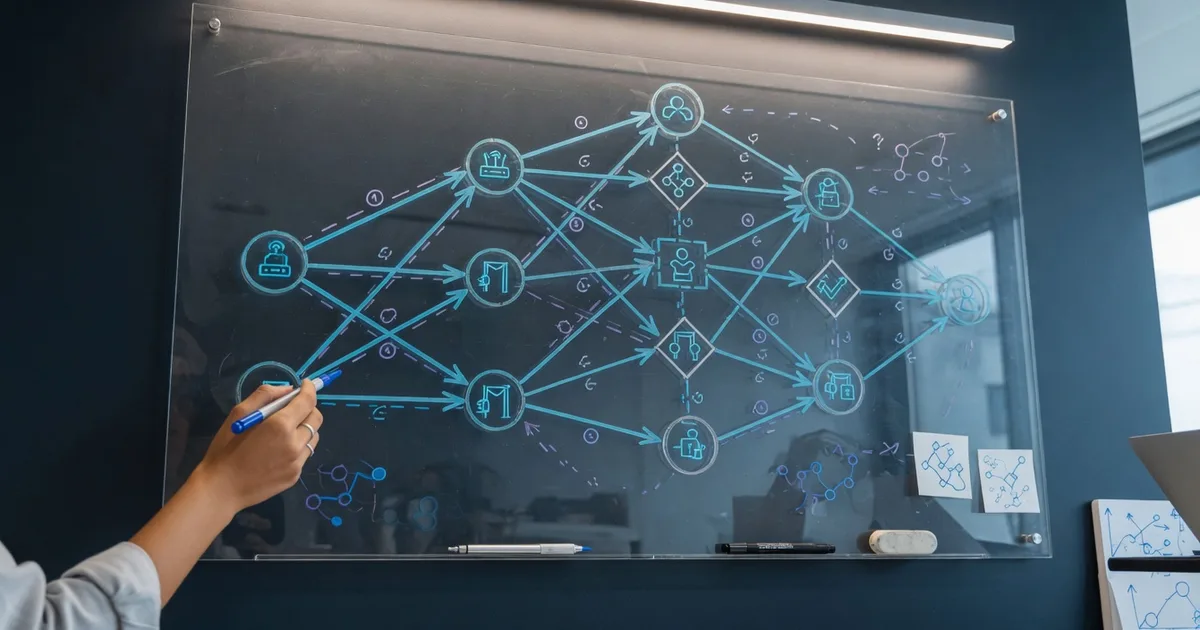
Detailed 20-step roadmap teaching how to design reliable AI agent graphs from zero experience. Focuses on loops, nodes/edges/state, core patterns like routers and orchestrators, plus reliability practices. Positions graph architecture as the next edge of practical AI engineering.

Summary

The post by Khairallah AL-Awady (@eng_khairallah1) presents a comprehensive 20-step learning path titled 'How to Become a Graph Architect With Zero Experience'. It claims that mastering graph-based agent systems is the current frontier of AI engineering and offers a structured curriculum divided into five phases, starting with single loops and progressing to complex, reliable graphs. The author emphasizes practical exercises at each step rather than abstract theory.

Key technical points include distinguishing loops from graphs, the primitives of nodes/edges/state, conditional routing, core patterns such as router, orchestrator-worker, parallel fan-out, evaluator-optimizer, and human-in-the-loop gates. Later phases stress production concerns: validation gates, recovery paths, state persistence, observability, and the critical judgment of when a graph is unnecessary. The content repeatedly references LangGraph as a primary framework while stressing that concepts transfer across tools.

For Dutch and EU AI practitioners this matters because agentic workflows and graph orchestration are rapidly moving from research into regulated, production environments. Engineers who can design reliable, auditable multi-agent systems gain a competitive edge in sectors from logistics to public services. The post supplies a concrete, zero-to-production skill map that aligns with the growing demand for verifiable AI tooling across the European market.

Why it matters

Provides hands-on guidance on agentic systems and graph orchestration frameworks such as LangGraph, directly applicable to AI engineers building production multi-agent applications in the Netherlands and EU.


More in this beat
agentic-workflowsai-agentsgraph-orchestrationlanggraphllm-agentsmulti-agent-systems
Organizational Memory for Agentic Business Process Execution

06:00 · July 7, 2026

Organizational Memory for Agentic Business Process Execution

This research is highly relevant for Dutch AI practitioners and researchers focusing on enterprise AI adoption and multi-agent systems. It provides a scalable, governed architecture for integrating organization-specific knowledge into LLM agents, aligning well with the Dutch market's emphasis on reliable and transparent AI deployment in business contexts.

Relevance 85 · Audience 90

Building effective human-agent teams

02:00 · June 24, 2026

Building effective human-agent teams

Provides actionable workflows, role definitions, and verification practices for Product Teams and Builders integrating agentic AI into real team processes, directly supporting implementation of new Claude capabilities.

Relevance 78 · Audience 85

Windsurf 2.0: Introducing the Agent Command Center and Devin in Windsurf

14:00 · April 15, 2026

Windsurf 2.0: Introducing the Agent Command Center and Devin in Windsurf

This update is highly relevant for product teams and builders as it represents a major shift in AI-assisted software engineering, moving from single-agent pairing to multi-agent orchestration. Dutch tech teams can leverage these tools to significantly accelerate development cycles, though they must evaluate cloud agent data handling for EU compliance.

Relevance 85 · Audience 95

Harness design for long-running application development

01:00 · March 24, 2026

Harness design for long-running application development

This article provides highly actionable architectural patterns for product teams and builders developing autonomous AI agents. It offers concrete solutions to common LLM limitations like context degradation and self-evaluation bias, which are critical for Dutch AI engineering teams building robust, long-running applications.

Relevance 85 · Audience 95

Building a C compiler with a team of parallel Claudes

01:00 · February 5, 2026

Building a C compiler with a team of parallel Claudes

Directly demonstrates actionable agent-team workflows, test harness patterns, and parallelism techniques that Product Teams and Builders can adapt for complex software projects using current Claude APIs.

Relevance 85 · Audience 90

Self-Evolving Agents as Dynamic Graph Transformation: A Survey and New Perspective

06:00 · August 20, 2026

Self-Evolving Agents as Dynamic Graph Transformation: A Survey and New Perspective

The paper provides foundational research on making autonomous AI agents auditable, safe, and transparent through dynamic graph modeling. This aligns strongly with the Dutch and EU focus on ethical AI and regulatory compliance, offering advanced researchers actionable frameworks for building governable agentic systems.

Relevance 85 · Audience 95

How monday.com transformed its platform into an agent-first product where humans and agents collaborate

02:00 · August 20, 2026

How monday.com transformed its platform into an agent-first product where humans and agents collaborate

This case study is highly relevant for product teams and builders as it provides a strategic blueprint for transitioning from superficial AI features to a native, agent-first architecture. It offers actionable insights into integrating LLMs like Claude into core workflows, which is highly applicable for Dutch SaaS companies and AI practitioners looking to drive sustained user engagement.

Relevance 75 · Audience 90

Agentic AI and Retrieval-Augmented Models in Straight-Through Underwriting

06:00 · July 11, 2026

Agentic AI and Retrieval-Augmented Models in Straight-Through Underwriting

The article is highly relevant for Dutch AI researchers and InsurTech practitioners as it provides a concrete, reproducible framework for deploying multi-agent LLM systems in highly regulated domains. Its strong emphasis on auditability, transparency, and human-in-the-loop governance aligns perfectly with the EU AI Act and the Netherlands' strategic focus on ethical AI.

Relevance 85 · Audience 95