AI News selected for Professionals and Decision Makers
Hands On Model Tooling And Research Updates

Graph Engineering explained: what it is, when to use it and when not to

14:59 · August 2, 2026 · X (Twitter)
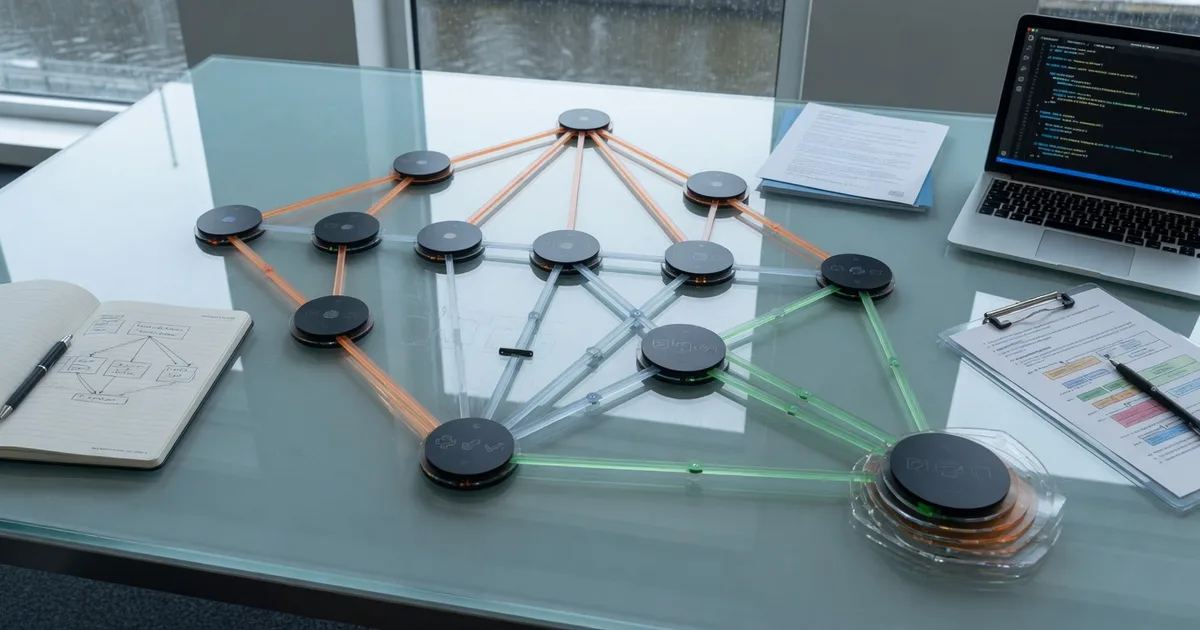
Graph Engineering explained: what it is, when to use it and when not to

Thread explains graph engineering for AI agent workflows, contrasting it with simple loops and promoting fan-out/reduce patterns, verifier nodes, and practical implementation tips.

Summary

The X thread by Anatoli Kopadze presents an in-depth explanation of graph engineering as a method for designing AI agent systems. The author describes graphs as networks of nodes and edges that represent tasks and dependencies, moving beyond simple sequential loops to enable parallel execution, verification, and synthesis. The post draws from the author's academic background in Denmark and positions the technique as a mature pattern now being rediscovered in AI engineering discussions.

Key technical points include the diamond pattern (fan-out, reduce, synthesize), the importance of strict node contracts with defined schemas, fresh-context verifiers to avoid self-grading bias, and mitigations for common failure modes such as context collapse and false independence. Concrete code examples illustrate how to implement these structures, including parallel execution, deduplication, and layered fan-in to stay within context limits.

For Dutch and EU AI practitioners the thread is relevant because it offers immediately usable patterns for scaling agentic systems in production. Companies and research groups across the Netherlands and Europe working on reliable multi-agent applications can adopt the described techniques to reduce latency and improve robustness without relying on unproven hype. The content aligns with the ongoing European focus on practical, auditable AI tooling rather than purely theoretical advances.

Why it matters

Provides practical guidance on structuring multi-agent systems that Dutch and EU AI engineers can apply to production workflows.
More in this beat
agentic-workflowsai-agentscontext-managementgraph-engineeringmulti-agent-systems
How monday.com transformed its platform into an agent-first product where humans and agents collaborate

02:00 · August 20, 2026

How monday.com transformed its platform into an agent-first product where humans and agents collaborate

This case study is highly relevant for product teams and builders as it provides a strategic blueprint for transitioning from superficial AI features to a native, agent-first architecture. It offers actionable insights into integrating LLMs like Claude into core workflows, which is highly applicable for Dutch SaaS companies and AI practitioners looking to drive sustained user engagement.

Relevance 75 · Audience 90

Agentic AI and Retrieval-Augmented Models in Straight-Through Underwriting

06:00 · July 11, 2026

Agentic AI and Retrieval-Augmented Models in Straight-Through Underwriting

The article is highly relevant for Dutch AI researchers and InsurTech practitioners as it provides a concrete, reproducible framework for deploying multi-agent LLM systems in highly regulated domains. Its strong emphasis on auditability, transparency, and human-in-the-loop governance aligns perfectly with the EU AI Act and the Netherlands' strategic focus on ethical AI.

Relevance 85 · Audience 95

Organizational Memory for Agentic Business Process Execution

06:00 · July 7, 2026

Organizational Memory for Agentic Business Process Execution

This research is highly relevant for Dutch AI practitioners and researchers focusing on enterprise AI adoption and multi-agent systems. It provides a scalable, governed architecture for integrating organization-specific knowledge into LLM agents, aligning well with the Dutch market's emphasis on reliable and transparent AI deployment in business contexts.

Relevance 85 · Audience 90

Building effective human-agent teams

02:00 · June 24, 2026

Building effective human-agent teams

Provides actionable workflows, role definitions, and verification practices for Product Teams and Builders integrating agentic AI into real team processes, directly supporting implementation of new Claude capabilities.

Relevance 78 · Audience 85

Windsurf 2.0: Introducing the Agent Command Center and Devin in Windsurf

14:00 · April 15, 2026

Windsurf 2.0: Introducing the Agent Command Center and Devin in Windsurf

This update is highly relevant for product teams and builders as it represents a major shift in AI-assisted software engineering, moving from single-agent pairing to multi-agent orchestration. Dutch tech teams can leverage these tools to significantly accelerate development cycles, though they must evaluate cloud agent data handling for EU compliance.

Relevance 85 · Audience 95

Harness design for long-running application development

01:00 · March 24, 2026

Harness design for long-running application development

This article provides highly actionable architectural patterns for product teams and builders developing autonomous AI agents. It offers concrete solutions to common LLM limitations like context degradation and self-evaluation bias, which are critical for Dutch AI engineering teams building robust, long-running applications.

Relevance 85 · Audience 95

Long-Context Isn't the Answer

01:00 · March 23, 2026

Long-Context Isn't the Answer

It provides actionable insights for ML Engineers on managing LLM context windows in production, highlighting the hidden costs of long-context models. The proposed architectural solutions, like sub-agent orchestration, are highly relevant for Dutch enterprises building reliable and efficient AI systems.

Relevance 85 · Audience 95

Building a C compiler with a team of parallel Claudes

01:00 · February 5, 2026

Building a C compiler with a team of parallel Claudes

Directly demonstrates actionable agent-team workflows, test harness patterns, and parallelism techniques that Product Teams and Builders can adapt for complex software projects using current Claude APIs.

Relevance 85 · Audience 90

Code execution with MCP: Building more efficient agents

01:00 · November 4, 2025

Code execution with MCP: Building more efficient agents

Highly actionable for Product Teams and Builders with concrete implementation patterns, code snippets, and measurable efficiency gains (e.g., 98.7% token reduction). Directly addresses model/product updates in agent tooling and context management.

Relevance 85 · Audience 90

Equipping agents for the real world with Agent Skills

02:00 · October 16, 2025

Equipping agents for the real world with Agent Skills

Directly actionable for Product Teams and Builders: provides concrete implementation patterns, evaluation guidelines, and code patterns for building specialized agents. Addresses lifecycle, observability via progressive loading, and risks like malicious skills.

Relevance 78 · Audience 85