AI News selected for Professionals and Decision Makers
Hands On Model Tooling And Research Updates

Long-Context Isn't the Answer

01:00 · March 23, 2026 · HumanLayer Blog

Long-Context Isn't the Answer

Summary

The article examines why simply enlarging an LLM’s context window often fails to improve performance on complex tasks. In practice, Anthropic’s switch to a 1-million-token Opus 4.6 model produced noticeably weaker instruction adherence, even at token counts well below the previous 200 k limit. The model began to overlook design documents, misinterpret straightforward directives, and occasionally ignore them outright.

The root cause lies in the separation between context length and what the authors term the model’s “instruction budget.” Extending the context window is typically achieved through positional scaling methods such as YaRN rather than by increasing parameter count. Because instruction-following capacity scales primarily with model size and the quality of instruction tuning, the budget remains fixed while the volume of surrounding tokens grows. The result is a larger haystack in which the critical instructions become proportionally harder to locate.

The authors therefore advocate stricter context-management practices. Sub-agents are used to isolate subtasks so that only concise, relevant summaries return to the main context. This approach prevents the accumulation of intermediate tool outputs and stale documents that otherwise dilute attention. In their tooling they have also lowered the warning threshold for long-context models to 100 k tokens, encouraging earlier compaction or delegation rather than continued accumulation.

Taken together, the observations suggest that architectural techniques for context isolation remain more effective than raw window size for maintaining reliable agent behavior on large codebases.

Why it matters

It provides actionable insights for ML Engineers on managing LLM context windows in production, highlighting the hidden costs of long-context models. The proposed architectural solutions, like sub-agent orchestration, are highly relevant for Dutch enterprises building reliable and efficient AI systems.

More in this beat
ai-agentsanthropicclaudecontext-managementlarge-language-modelsmulti-agent-systems
How monday.com transformed its platform into an agent-first product where humans and agents collaborate

02:00 · August 20, 2026

How monday.com transformed its platform into an agent-first product where humans and agents collaborate

This case study is highly relevant for product teams and builders as it provides a strategic blueprint for transitioning from superficial AI features to a native, agent-first architecture. It offers actionable insights into integrating LLMs like Claude into core workflows, which is highly applicable for Dutch SaaS companies and AI practitioners looking to drive sustained user engagement.

Relevance 75 · Audience 90

Scaling Managed Agents: Decoupling the brain from the hands

02:00 · April 8, 2026

Scaling Managed Agents: Decoupling the brain from the hands

Highly actionable for Product Teams and Builders implementing agent workflows with Claude, including code-level interface patterns, security mitigations, and performance gains like reduced TTFT. Directly addresses model updates, harness evolution, and production observability.

Relevance 80 · Audience 85

Harness design for long-running application development

01:00 · March 24, 2026

Harness design for long-running application development

This article provides highly actionable architectural patterns for product teams and builders developing autonomous AI agents. It offers concrete solutions to common LLM limitations like context degradation and self-evaluation bias, which are critical for Dutch AI engineering teams building robust, long-running applications.

Relevance 85 · Audience 95

Building a C compiler with a team of parallel Claudes

01:00 · February 5, 2026

Building a C compiler with a team of parallel Claudes

Directly demonstrates actionable agent-team workflows, test harness patterns, and parallelism techniques that Product Teams and Builders can adapt for complex software projects using current Claude APIs.

Relevance 85 · Audience 90

Effective harnesses for long-running agents

01:00 · November 26, 2025

Effective harnesses for long-running agents

Highly actionable for Product Teams and Builders with concrete implementation guidance, exact model references (Opus 4.5), and workflow strategies directly applicable to agent development and observability.

Relevance 82 · Audience 88

Equipping agents for the real world with Agent Skills

02:00 · October 16, 2025

Equipping agents for the real world with Agent Skills

Directly actionable for Product Teams and Builders: provides concrete implementation patterns, evaluation guidelines, and code patterns for building specialized agents. Addresses lifecycle, observability via progressive loading, and risks like malicious skills.

Relevance 78 · Audience 85

Turning conversation into knowledge: how Slack builds human-agent teams

02:00 · August 19, 2026

Turning conversation into knowledge: how Slack builds human-agent teams

This article provides actionable organizational strategies for product teams looking to integrate AI agents into their daily workflows. While it lacks specific Dutch market data or deep technical code, the best practices for AI adoption, context sharing, and productivity measurement are highly applicable to Dutch SMEs and enterprise product builders.

Relevance 65 · Audience 85

Claude Tag now reads even more of the room

02:00 · August 13, 2026

Claude Tag now reads even more of the room

This update is highly relevant for product teams and builders as it demonstrates advanced context-aware AI integration within daily collaboration tools like Slack. Dutch AI practitioners and SMEs can leverage this to streamline engineering workflows and improve team productivity without incurring extra usage limits.

Relevance 85 · Audience 95

Bringing MCP 2026-07-28 to Claude

02:00 · July 28, 2026

Bringing MCP 2026-07-28 to Claude

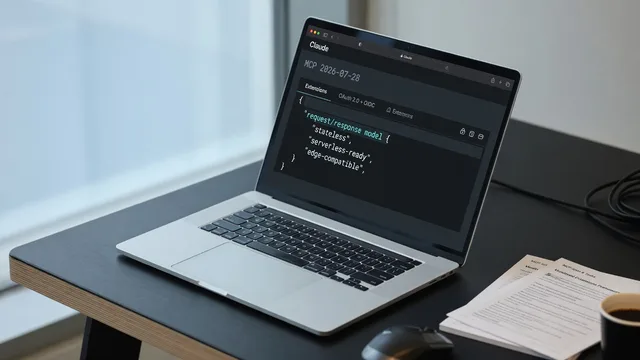
This update is highly relevant for product teams and builders as it fundamentally changes how MCP servers are deployed and secured. The shift to a stateless architecture and enterprise-grade authorization directly supports scalable, compliant AI agent integrations crucial for Dutch enterprises.

Relevance 85 · Audience 95