AI News selected for Professionals and Decision Makers
Primary Research Stream

AI-Assisted Discovery of Convex Relaxations via Dual Agents

06:00 · July 1, 2026 · arXiv cs.AI RSS

AI-Assisted Discovery of Convex Relaxations via Dual Agents

Recent work shows that LLM agents can improve sharp-constant inequalities by searching for extremal constructions, which yield upper bounds. We address the complementary side: a lower bound holds for every admissible function and follows from a convex relaxation of the nonconvex problem, with tighter relaxations giving stronger bounds. We instantiate the autoresearch paradigm to discover such relaxations: a coding agent proposes valid tightening constraints, a theory agent verifies each one and searches for counterexamples, and every reported bound is certified by an explicit dual-feasible point checked in rigorous interval arithmetic. On two optimization constants studied by \citet{tao2025alphaevolve} - the first autocorrelation inequality ($C_{6.2}$) and the Erd\H{o}s minimum-overlap constant ($C_{6.5}$) - we improve the certified lower bounds from $1.28$ to $1.2937$ and from $0.379005$ to $0.37912$, respectively.

Summary

Recent work has shown that LLM agents can tighten upper bounds on sharp constants by searching for explicit extremal functions. This paper addresses the complementary task of strengthening lower bounds, which must hold for every admissible function and are obtained by constructing successively tighter convex relaxations of the underlying nonconvex optimization problem. The authors implement an autoresearch loop in which a coding agent proposes additional valid constraints while a paired theory agent checks each proposal for correctness and attempts to find counterexamples. Only constraints that survive this verification step are retained, and every accepted relaxation is certified by an explicit dual-feasible point whose objective value is confirmed with rigorous interval arithmetic.

The method is applied to two constants previously studied through extremal-search techniques. For the first autocorrelation inequality (C6.2), the certified lower bound is raised from 1.28 to 1.2937. For the Erdős minimum-overlap constant (C6.5), the bound improves from 0.379005 to 0.37912. In both cases the new relaxations remain valid over the infinite-dimensional function spaces involved, and the reported values are accompanied by machine-checkable dual certificates rather than numerical solver output alone.

By shifting the search from candidate functions to candidate programs that encode convex relaxations, the dual-agent framework exploits the complementary strengths of code generation and formal verification. The resulting bounds are the first improvements on these particular constants achieved through an automated, self-refining research loop, illustrating how LLM agents can contribute to certified results in functional analysis and continuous optimization.

Why it matters

This fundamental research is highly relevant for AI researchers and optimization specialists in the Netherlands, showcasing a novel application of LLM agents in automated mathematical discovery. It provides advanced methodologies that Dutch R&D institutions can leverage for complex problem-solving and algorithm development.


More in this beat
ai-agentsconvex relaxationsformal-verificationmulti-agent-systemsscientific-discovery
Physics-Audited Agentic Discovery in Scientific Machine Learning

06:00 · July 9, 2026

Physics-Audited Agentic Discovery in Scientific Machine Learning

This research is highly relevant for the Dutch AI market, particularly for its strong high-tech engineering and manufacturing sectors that rely heavily on scientific machine learning and digital twins. The focus on verifiable, physics-compliant AI aligns with the EU's emphasis on trustworthy AI and provides actionable methodologies for researchers at Dutch technical universities.

Relevance 85 · Audience 95

Hypothesis-Disciplined Multi-Agent Automated Formalization of Asymptotic Statistical Theory

06:00 · June 23, 2026

Hypothesis-Disciplined Multi-Agent Automated Formalization of Asymptotic Statistical Theory

This research is highly relevant for Dutch AI researchers specializing in formal methods, logic, and statistical learning. The multi-agent approach to automated theorem proving in Lean 4 offers actionable methodologies for academic institutions and R&D centers in the Netherlands focused on transparent and verifiable AI.

Relevance 85 · Audience 95

Specifying AI-SDLC Processes: A Protocol Language for Human-Agent Boundaries

06:00 · June 23, 2026

Specifying AI-SDLC Processes: A Protocol Language for Human-Agent Boundaries

This research is highly relevant for the Dutch AI market due to its strong alignment with EU AI Act requirements for human oversight and governance. By providing a formal language to enforce human-agent boundaries, it offers researchers and enterprises a rigorous method to build compliant, transparent, and safe multi-agent systems.

Relevance 85 · Audience 95

Position: Behavioral Systems Require Behavioral Tests

06:00 · August 20, 2026

Position: Behavioral Systems Require Behavioral Tests

The article is highly relevant for Dutch AI researchers and practitioners focused on ethical and transparent AI. By proposing behavioral tests to evaluate AI alignment, safety, and decision-making processes, it provides a crucial methodological framework that supports compliance with EU regulations like the AI Act and advances responsible AI deployment.

Relevance 85 · Audience 95

Position: Multi-Agent Systems Should Prioritize Concurrency Control

06:00 · August 20, 2026

Position: Multi-Agent Systems Should Prioritize Concurrency Control

Directly actionable for Dutch AI researchers and advanced practitioners building reliable MAS; aligns with EU emphasis on trustworthy AI and offers concrete systems-level recommendations that can improve deployment robustness in SME and research contexts.

Relevance 78 · Audience 92

How monday.com transformed its platform into an agent-first product where humans and agents collaborate

02:00 · August 20, 2026

How monday.com transformed its platform into an agent-first product where humans and agents collaborate

This case study is highly relevant for product teams and builders as it provides a strategic blueprint for transitioning from superficial AI features to a native, agent-first architecture. It offers actionable insights into integrating LLMs like Claude into core workflows, which is highly applicable for Dutch SaaS companies and AI practitioners looking to drive sustained user engagement.

Relevance 75 · Audience 90

DIA’s artificial intelligence chief envisions ‘agent-to-agents’ interactions that support military operations

00:27 · August 14, 2026

DIA’s artificial intelligence chief envisions ‘agent-to-agents’ interactions that support military operations

This article is highly relevant for defense strategists and technologists as it outlines the US Defense Intelligence Agency's roadmap for multi-agent AI systems in combatant commands. Understanding these developments is crucial for Dutch and NATO defense professionals to ensure interoperability, align military AI doctrines, and develop compliant, ethical AI guardrails.

Relevance 75 · Audience 90

AI’s next leap for the Intelligence Community: Agents managing agents

17:00 · August 13, 2026

AI’s next leap for the Intelligence Community: Agents managing agents

This article is highly relevant as it outlines the future trajectory of AI in allied intelligence operations, specifically the shift towards agentic AI. For Dutch and NATO defense professionals, understanding US doctrinal shifts regarding autonomous agents, human-in-the-loop requirements, and AI governance is crucial for interoperability and shaping European defense AI strategies.

Relevance 85 · Audience 95

ViSAGE: Constructing Self-Correcting Memories for Long-Form Video Understanding

06:00 · August 3, 2026

ViSAGE: Constructing Self-Correcting Memories for Long-Form Video Understanding

This research is highly relevant for Dutch AI researchers working on multimodal models and embodied AI. Its emphasis on epistemic safety and reducing hallucinations through verified refusals strongly aligns with the Netherlands and EU regulatory focus on transparent, trustworthy, and reliable AI systems.

Relevance 85 · Audience 95

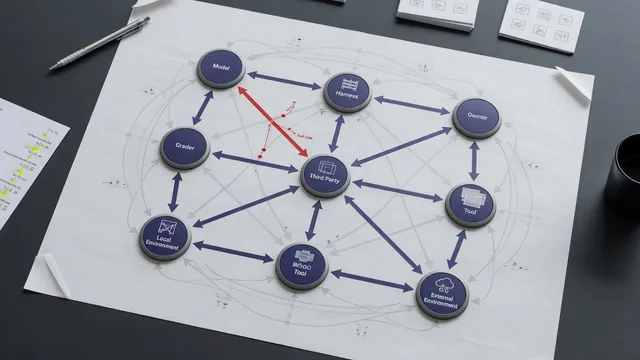
Model or Harness? An Interaction-Centric Taxonomy for Localizing Agent Failures

06:00 · August 3, 2026

Model or Harness? An Interaction-Centric Taxonomy for Localizing Agent Failures

This research is highly relevant for Dutch AI researchers and developers building autonomous agents, as it provides a structured methodology for diagnosing and repairing complex AI systems. It aligns well with the EU's focus on AI robustness, transparency, and safety by offering a standardized way to trace and mitigate agent failures.

Relevance 85 · Audience 95