AI News selected for Professionals and Decision Makers
Primary Research Stream

WorldClaw: Agentic 3D Open-World Generation at Scale

06:00 · August 7, 2026 · arXiv cs.AI RSS
WorldClaw: Agentic 3D Open-World Generation at Scale

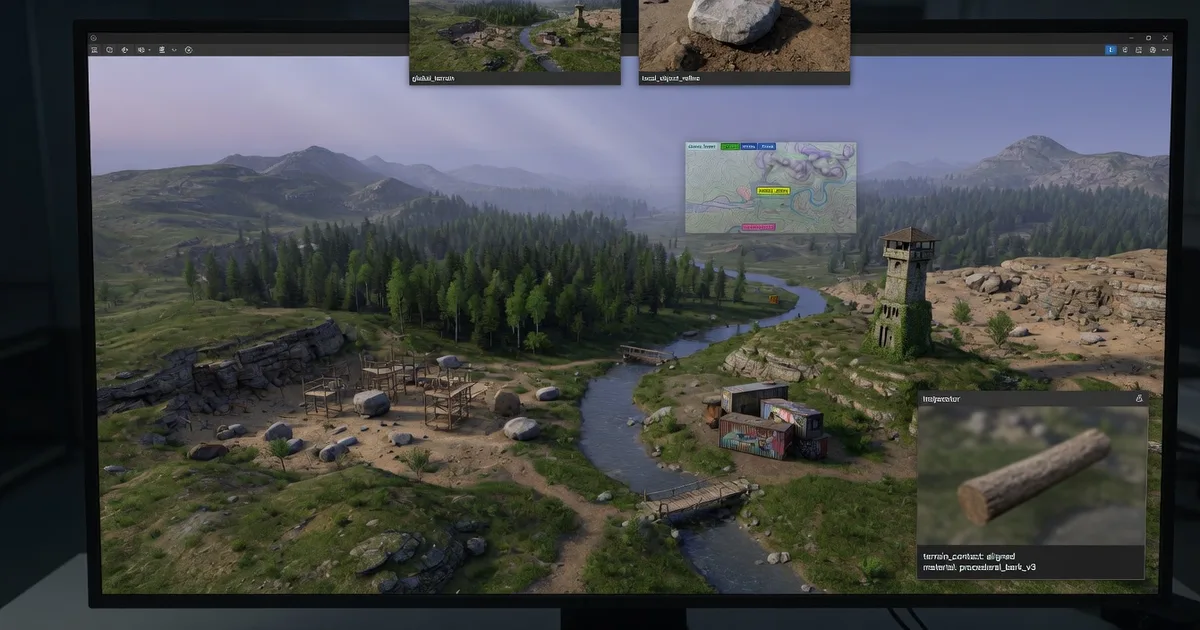
Generating large-scale, freely explorable 3D worlds from open-ended text remains challenging because a system must jointly maintain global spatial coherence, rich local content, and explicit assets suitable for downstream editing and reuse. We present WorldClaw, a fully agentic, coarse-to-fine framework for open-world 3D scene generation. Planning agents translate a text prompt into a structured specification of regions, terrain, assets, materials, and spatial relations. WorldClaw then builds a globally coherent terrain foundation from semantic layouts, reusable assets, generative or procedural materials, and a region-aware height field. For detail-demanding regions, it generates terrain-conditioned compositions, reconstructs editable textured meshes, and recovers their placement on the terrain; render-based agents further refine terrain, objects, appearance, and contacts. Across diverse open-world prompts, WorldClaw produces large-scale scenes with coherent spatial organization, visually compelling local content, and editable instance-level assets while preserving a consistent global terrain structure.

Summary

WorldClaw addresses the longstanding difficulty of turning open-ended text prompts into large-scale, freely explorable 3D environments that remain spatially coherent, visually detailed, and explicitly editable. Unlike prior approaches that either rely on rigid procedural rules, lift images or videos into 3D with limited consistency, or diffuse directly over 3D representations constrained by scarce training data, the system adopts a fully agentic, coarse-to-fine pipeline. Planning agents first translate a user prompt into a structured specification that defines regions, terrain characteristics, object categories, materials, and spatial relations.

A global terrain stage then instantiates this specification as a region-aware height field augmented by semantic layouts, reusable assets, and generative or procedural materials. Render-based agents subsequently refine geometry, appearance, and surface contacts across the entire foundation, establishing a consistent spatial scaffold without attempting to synthesize every detail at once.

In regions that require richer content, the framework renders local terrain views, employs image-editing models conditioned on both global context and terrain cues to compose object layouts, reconstructs the inserted elements as textured meshes via image-to-3D conversion, and recovers their placement on the terrain. A final agentic refinement loop corrects scale, pose, and object–terrain contacts. The resulting scene is represented as independently editable textured meshes with explicit terrain placements, supporting free-viewpoint navigation and conventional downstream pipelines in gaming, simulation, and virtual environments.

Why it matters

This research is highly relevant for Dutch AI researchers and practitioners in the creative industries, gaming (e.g., Guerrilla Games), and digital twin sectors. It provides a novel, scalable approach to 3D environment generation using LLM agents and foundation models, offering actionable methodologies for advanced simulation development.

More in this beat
agentic-workflowsai-agentssimulation-modelstext-to-imageWorldClawworld-models
COMFYCLAW: Self-Evolving Skill Harnesses for Image Generation Workflows

06:00 · July 3, 2026

COMFYCLAW: Self-Evolving Skill Harnesses for Image Generation Workflows

This research is highly relevant for AI researchers and advanced practitioners in the Netherlands focusing on generative AI and autonomous agents. The proposed self-evolving skill framework offers actionable methodologies for Dutch tech SMEs and creative industries looking to optimize and automate complex image generation workflows.

Relevance 75 · Audience 90

How monday.com transformed its platform into an agent-first product where humans and agents collaborate

02:00 · August 20, 2026

How monday.com transformed its platform into an agent-first product where humans and agents collaborate

This case study is highly relevant for product teams and builders as it provides a strategic blueprint for transitioning from superficial AI features to a native, agent-first architecture. It offers actionable insights into integrating LLMs like Claude into core workflows, which is highly applicable for Dutch SaaS companies and AI practitioners looking to drive sustained user engagement.

Relevance 75 · Audience 90

Introducing Kitesurf: The agent-first browser that runs in V8 isolates on Cloudflare Workers

15:00 · August 6, 2026

Introducing Kitesurf: The agent-first browser that runs in V8 isolates on Cloudflare Workers

Kitesurf introduces a secure-by-design, isolated browsing environment for AI agents, addressing the critical security risks of autonomous web interaction. For Dutch security professionals, it offers a scalable, stateless architecture that aligns with strict EU data protection and security standards for enterprise AI deployments.

Relevance 85 · Audience 80

How Outtake built a cyber investigator on Claude

02:00 · July 22, 2026

How Outtake built a cyber investigator on Claude

This article provides a practical use case for Product Teams and Builders on how to leverage Claude Code and the Agent SDK to build long-running, autonomous AI agents. It offers valuable architectural insights for Dutch AI practitioners developing cybersecurity solutions or complex agentic workflows.

Relevance 75 · Audience 85

At SIGGRAPH, NVIDIA Advances Graphics and Simulation With Agentic and Physical AI

17:00 · July 20, 2026

At SIGGRAPH, NVIDIA Advances Graphics and Simulation With Agentic and Physical AI

The article showcases significant AI breakthroughs in creative workflows, robotics, and media verification. The Synthetic Video Detector is highly relevant to the Dutch market's focus on ethical and transparent AI, while the accessible agentic AI tools support the high rate of AI adoption among Dutch SMEs.

Relevance 85 · Audience 80

SeerGuard: A Safety Framework for Mobile GUI Agents via World Model Prediction

06:00 · July 20, 2026

SeerGuard: A Safety Framework for Mobile GUI Agents via World Model Prediction

This research is highly relevant for Dutch AI researchers and developers focusing on agentic AI and AI safety. It aligns with the EU's stringent regulatory emphasis on safe, transparent, and risk-aware AI systems by offering a proactive mechanism to prevent harmful autonomous actions before they occur.

Relevance 85 · Audience 95

Working at the frontier: How Rakuten builds agents overnight with Claude Fable 5

02:00 · July 20, 2026

Working at the frontier: How Rakuten builds agents overnight with Claude Fable 5

This article provides product teams and builders with insights into deploying long-running, autonomous AI agents using Claude Fable 5. It highlights practical enterprise strategies for balancing model intelligence with cost and managing human-in-the-loop constraints, which are highly applicable to Dutch AI practitioners scaling agentic workflows.

Relevance 75 · Audience 85

Working with Claude Fable 5 in Claude Cowork

02:00 · July 16, 2026

Working with Claude Fable 5 in Claude Cowork

This article is highly relevant for product teams and builders as it provides actionable insights on integrating Anthropic's latest agentic model into complex workflows. Dutch AI practitioners can use these updates to enhance productivity, automate multi-step processes, and understand the operational nuances of Claude Cowork.

Relevance 85 · Audience 95