AI News selected for Professionals and Decision Makers
Primary Research Stream

Transferable Latency Prediction for Fast LLM Screening on Heterogeneous Edge Devices

06:00 · July 27, 2026 · arXiv cs.AI RSS
Transferable Latency Prediction for Fast LLM Screening on Heterogeneous Edge Devices

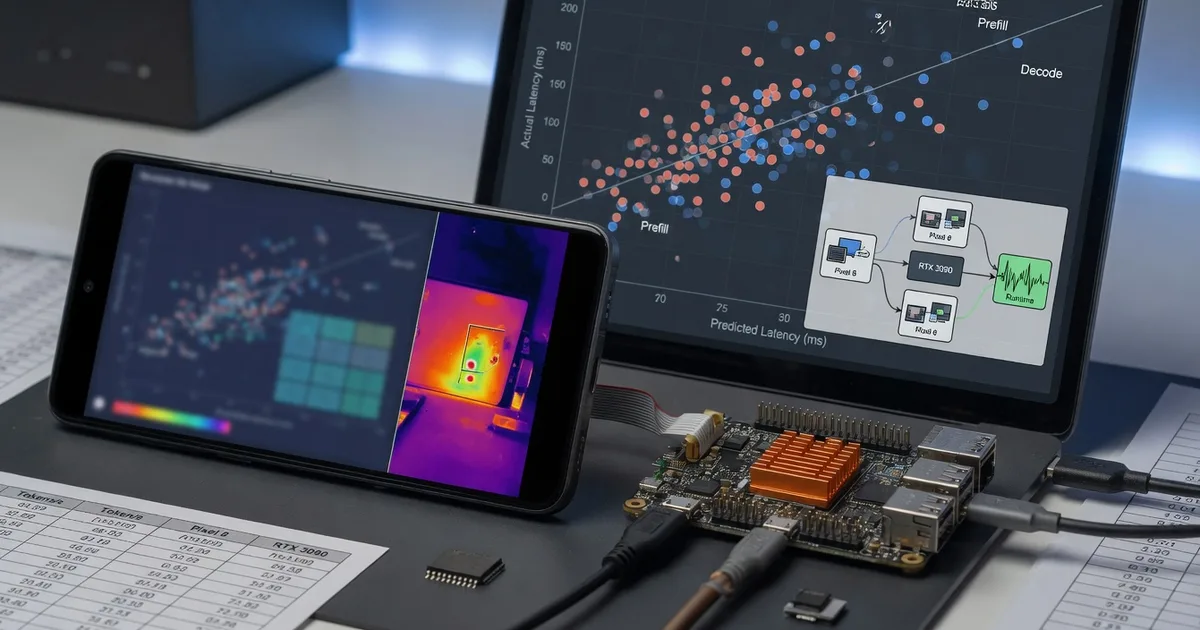
Accurate latency prediction is critical for deploying large language models (LLMs) on heterogeneous edge devices, where inference latency is affected by model architecture, prompt behavior, runtime backend, hardware utilization, dynamic voltage and frequency scaling (DVFS), and thermal variation. This paper presents a runtime-aware latency prediction framework for deployment-oriented LLM selection. The framework represents each inference request as a hardware-runtime-model-prompt configuration, separates inference into prefill and decode phases, and adaptively fuses static descriptors with dynamic hardware telemetry through a gated prediction model. We evaluate the framework using Pixel mobile devices and validate the profiling pipeline on Jetson Nano, Orange Pi 5 Pro, and an RTX 3090-class GPU platform. On Pixel 8, the full predictor improves total-latency R-squared from 0.953 to 0.960 and decode-latency R-squared from 0.957 to 0.973 over a static-only baseline. On Pixel 8 Pro, it improves prefill-latency R-squared from -1.383 to 0.966. For cross-device transfer, calibration improves Pixel 8 Pro to Pixel 8 total-latency R-squared from -0.974 to 0.940 and decode-latency R-squared from -1.085 to 0.927. Heterogeneous profiling further shows that latency is highly device- and runtime-dependent: the same SmolLM2 model family reaches 8.42 tokens/s on Orange Pi 5 Pro but 64.38 tokens/s on an RTX 3090-class GPU. These results demonstrate that runtime-aware prediction with lightweight calibration can reduce profiling cost and support latency-aware LLM deployment across heterogeneous edge platforms.

Summary

Accurate latency prediction remains essential for selecting large language models suitable for heterogeneous edge hardware, where inference speed varies with model architecture, prompt characteristics, runtime backend, hardware utilization, dynamic voltage and frequency scaling, and thermal throttling. The presented framework addresses this by modeling each inference request as a combined hardware-runtime-model-prompt configuration. It separates the prefill phase, which processes the input prompt and builds the key-value cache, from the decode phase, which generates tokens autoregressively, and employs a gated fusion module to integrate static descriptors of devices and models with dynamic telemetry collected at runtime.

Evaluations on Pixel mobile devices show measurable gains over static-only baselines. On the Pixel 8 the full predictor raises total-latency R² from 0.953 to 0.960 and decode-latency R² from 0.957 to 0.973; on the Pixel 8 Pro it lifts prefill-latency R² from −1.383 to 0.966. Lightweight calibration further enables cross-device transfer, improving Pixel 8 Pro to Pixel 8 total-latency R² from −0.974 to 0.940 and decode-latency R² from −1.085 to 0.927. Profiling across additional platforms confirms that performance is strongly device- and runtime-dependent: the same SmolLM2 model family achieves 8.42 tokens per second on an Orange Pi 5 Pro yet reaches 64.38 tokens per second on an RTX 3090-class GPU.

By supplying calibrated latency estimates before exhaustive device-side execution, the approach supports efficient candidate screening and subsequent Pareto analysis that balances predicted responsiveness against model quality. The resulting workflow reduces profiling overhead while remaining applicable across mobile, embedded GPU, and single-board edge platforms.

Why it matters

Directly actionable for Dutch researchers and SMEs developing on-device LLMs; addresses EU-relevant privacy and edge constraints with novel, reproducible technical methods that advance AI systems research.


More in this beat
deployment-readinessedge-devicesinference-performancelarge-language-modelsllm-inferencesmollm2
How NVIDIA’s Inference Software Stack Powers the Lowest Token Cost

17:00 · June 30, 2026

How NVIDIA’s Inference Software Stack Powers the Lowest Token Cost

This article is relevant because it addresses a critical bottleneck in AI adoption: inference costs. For Dutch enterprises and SMEs scaling AI from pilots to production, understanding how software optimizations lower the cost per token is essential for sustainable AI deployment.

Relevance 75 · Audience 65

Up to 3.2x Faster Inference with LFM2.5-DSpark

18:52 · August 20, 2026

Up to 3.2x Faster Inference with LFM2.5-DSpark

Directly addresses production inference challenges like memory-bound decode latency and GPU/edge deployment for ML Engineers, with quantitative benchmarks and open implementations applicable in Dutch AI workflows.

Relevance 85 · Audience 90

The Price of Thinking: Reasoning Effort as a Model-Specific API Contract

06:00 · August 19, 2026

The Price of Thinking: Reasoning Effort as a Model-Specific API Contract

This research is highly relevant for Dutch AI researchers and MLOps practitioners focused on cost-efficient AI deployment. Understanding the hidden costs and stochastic nature of reasoning API contracts enables Dutch SMEs and enterprises to optimize their AI infrastructure and routing strategies.

Relevance 85 · Audience 95

A Year in LLM Serving: Workload Evolution, Caching and Load-Balancing

06:00 · August 17, 2026

A Year in LLM Serving: Workload Evolution, Caching and Load-Balancing

This research provides a rare, large-scale dataset and analysis of real-world LLM serving workloads, which is crucial for Dutch AI infrastructure researchers and cloud providers aiming to optimize model deployment, caching, and load-balancing. The release of the full trace enables reproducible benchmarking for local AI systems engineering.

Relevance 85 · Audience 95

Deploy local agents everywhere with LFM2.5-2.6B

15:58 · August 4, 2026

Deploy local agents everywhere with LFM2.5-2.6B

Strong focus on production inference constraints, latency, token throughput, and agent tooling directly addresses ML Engineer needs for efficient local deployment. Benchmarks and ecosystem support offer actionable data for Dutch teams building privacy-preserving on-device AI solutions aligned with EU priorities.

Relevance 78 · Audience 85

Request-Level Energy Attribution for Batched LLM Serving

06:00 · August 4, 2026

Request-Level Energy Attribution for Batched LLM Serving

Directly actionable for Dutch AI teams optimizing sustainable LLM inference under EU energy-reporting rules; provides measured fairness baselines and reproducible protocols relevant to ethical AI and data-center efficiency goals.

Relevance 82 · Audience 88

Smaller, faster, safer: running Kimi and GLM at scale

15:00 · August 3, 2026

Smaller, faster, safer: running Kimi and GLM at scale

Provides actionable security measures (integrity checks) and efficiency techniques applicable to Dutch AI teams running inference workloads, with direct relevance to secure multi-user GPU serving.

Relevance 65 · Audience 70

GPU Management: Why Idle GPUs Are the New Grounded Aircraft

17:09 · July 30, 2026

GPU Management: Why Idle GPUs Are the New Grounded Aircraft

It addresses critical MLOps and production challenges faced by ML Engineers, specifically GPU utilization, workload scheduling, and compute cost optimization. For Dutch enterprises and SMEs scaling AI, mastering these orchestration strategies is essential to remain cost-effective without relying on massive hardware budgets.

Relevance 75 · Audience 85