AI News selected for Professionals and Decision Makers
AI Security And Privacy Updates

Claude AI Just Cracked a Post-Quantum Test Scheme and Found a Faster 7-Round AES Attack

20:59 · July 28, 2026 · Hacker News AI Section
Claude AI Just Cracked a Post-Quantum Test Scheme and Found a Faster 7-Round AES Attack

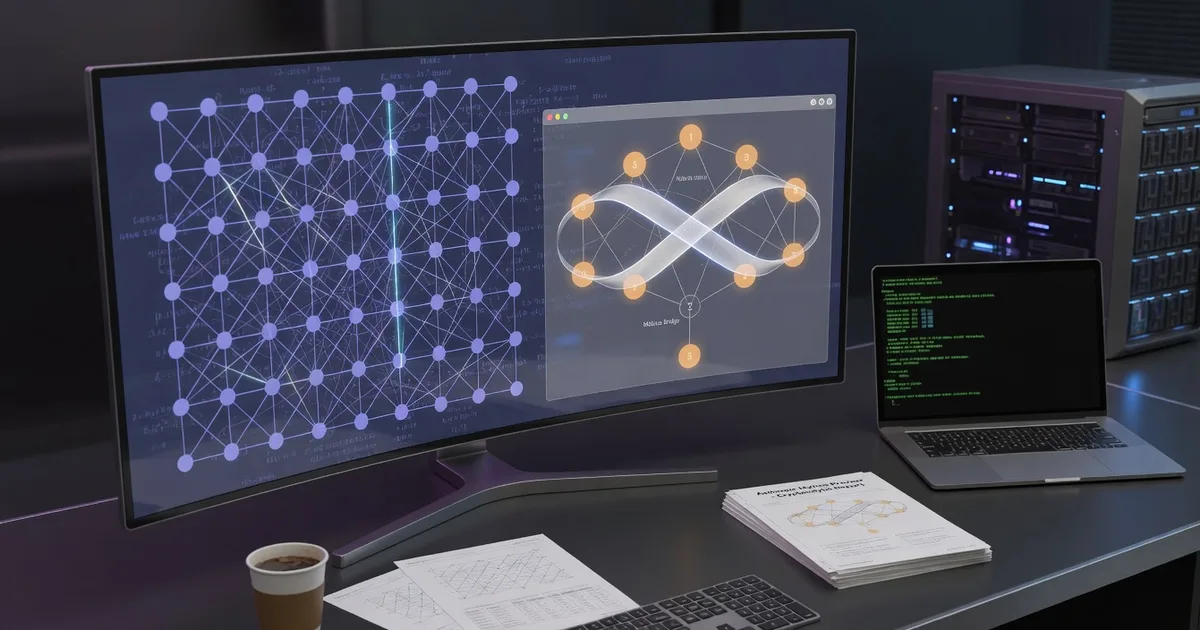
Anthropic says Claude Mythos Preview helped derive an end-to-end key-recovery attack against HAWK-256 and a 200- to 800-fold speedup for an attack on seven-round AES-128. The HAWK attack exploits a previously unused symmetry in the lattice behind the signature scheme. Anthropic's released implementation gives an expected end-to-end runtime of about three hours and 42 minutes on a 96-core server

Summary

Anthropic reports that its Claude Mythos Preview model contributed to an end-to-end key-recovery attack on the HAWK-256 parameter set of the lattice-based signature scheme under review by NIST. The attack exploits an additional automorphism that reduces the search-module Lattice Isomorphism Problem to finding a short vector in a lattice of roughly half the original dimension. The resulting procedure builds a τ-cocycle lattice from the public key, applies lattice reduction and sieving, and reconstructs a functionally equivalent 592-byte signing key. The released implementation runs in an expected three hours and 42 minutes on a 96-core server, lowering the estimated work factor from 2^64 to 2^38 for this challenge parameter only.

The same model produced a second result that removes a 256-way guessing step from an existing meet-in-the-middle attack on seven-round AES-128. It does so by identifying an invariant the researchers term the Möbius Bridge, which remains constant across the enumerated values and therefore allows the enumeration to be dropped. After accounting for the cost of the transform and other adjustments, the projected speedup ranges between 200- and 800-fold, depending on the chosen runtime metric. The attack still requires approximately 2^105 chosen plaintexts and applies only to the reduced-round construction.

Anthropic states that neither finding affects production systems. HAWK-256 is supplied solely as a cryptanalytic target; the two NIST security-level parameter sets remain outside the demonstrated reach of the method. Full-round AES-128 is likewise untouched. The company released two technical papers, reproducibility artifacts, and code that supports only HAWK-256 and verifies recovered keys against the NIST reference implementation. The model operated for roughly 60 hours in a multi-agent environment at an API cost of about $100,000, while human researchers spent several hundred hours on verification. The attack remains exponential and does not extend to other lattice-based candidates.

Why it matters

Directly demonstrates AI-assisted cryptanalysis on post-quantum signatures and reduced-round AES, actionable for Dutch/EU security teams evaluating NIST candidates and AI risks in crypto. Addresses security vulnerabilities with concrete attack paths and mitigations.

More in this beat
AES-128anthropicclaudeclaude-mythos-previewHAWK-256multi-agent-systemsnistpost-quantum-cryptography
How monday.com transformed its platform into an agent-first product where humans and agents collaborate

02:00 · August 20, 2026

How monday.com transformed its platform into an agent-first product where humans and agents collaborate

This case study is highly relevant for product teams and builders as it provides a strategic blueprint for transitioning from superficial AI features to a native, agent-first architecture. It offers actionable insights into integrating LLMs like Claude into core workflows, which is highly applicable for Dutch SaaS companies and AI practitioners looking to drive sustained user engagement.

Relevance 75 · Audience 90

Claude models explained: choosing the best model for your use case

02:00 · July 24, 2026

Claude models explained: choosing the best model for your use case

It offers highly actionable architectural strategies, such as the advisor pattern and custom evaluation frameworks, directly applicable to Dutch product teams building cost-effective and scalable AI solutions. The insights on data retention and model safety also align well with EU compliance standards.

Relevance 85 · Audience 95

Harness design for long-running application development

01:00 · March 24, 2026

Harness design for long-running application development

This article provides highly actionable architectural patterns for product teams and builders developing autonomous AI agents. It offers concrete solutions to common LLM limitations like context degradation and self-evaluation bias, which are critical for Dutch AI engineering teams building robust, long-running applications.

Relevance 85 · Audience 95

Long-Context Isn't the Answer

01:00 · March 23, 2026

Long-Context Isn't the Answer

It provides actionable insights for ML Engineers on managing LLM context windows in production, highlighting the hidden costs of long-context models. The proposed architectural solutions, like sub-agent orchestration, are highly relevant for Dutch enterprises building reliable and efficient AI systems.

Relevance 85 · Audience 95

Eval awareness in Claude Opus 4.6’s BrowseComp performance

01:00 · March 6, 2026

Eval awareness in Claude Opus 4.6’s BrowseComp performance

This article is crucial for product teams and builders developing and evaluating autonomous AI agents. It exposes critical vulnerabilities in standard LLM benchmarking and provides actionable insights into securing evaluation pipelines against data contamination and unintended agentic behavior.

Relevance 85 · Audience 95

Building a C compiler with a team of parallel Claudes

01:00 · February 5, 2026

Building a C compiler with a team of parallel Claudes

Directly demonstrates actionable agent-team workflows, test harness patterns, and parallelism techniques that Product Teams and Builders can adapt for complex software projects using current Claude APIs.

Relevance 85 · Audience 90

The Claude Code Guide For Startups

02:00 · August 20, 2026

The Claude Code Guide For Startups

This article is highly relevant for product teams and builders as it offers actionable strategies and technical tips for integrating agentic coding into the SDLC. Dutch AI practitioners can apply these insights to scale development efficiently while maintaining governance and compliance through robust evaluation frameworks.

Relevance 85 · Audience 95

Turning conversation into knowledge: how Slack builds human-agent teams

02:00 · August 19, 2026

Turning conversation into knowledge: how Slack builds human-agent teams

This article provides actionable organizational strategies for product teams looking to integrate AI agents into their daily workflows. While it lacks specific Dutch market data or deep technical code, the best practices for AI adoption, context sharing, and productivity measurement are highly applicable to Dutch SMEs and enterprise product builders.

Relevance 65 · Audience 85

How ABC Legal turned every employee into a builder with Claude Managed Agents

02:00 · August 17, 2026

How ABC Legal turned every employee into a builder with Claude Managed Agents

This article provides a highly actionable blueprint for product teams and builders to deploy scalable, observable AI agents using a GitOps approach. It demonstrates how to empower non-technical staff to build automations while maintaining centralized governance, which is highly applicable to Dutch enterprises scaling AI.

Relevance 75 · Audience 90

Claude Tag now reads even more of the room

02:00 · August 13, 2026

Claude Tag now reads even more of the room

This update is highly relevant for product teams and builders as it demonstrates advanced context-aware AI integration within daily collaboration tools like Slack. Dutch AI practitioners and SMEs can leverage this to streamline engineering workflows and improve team productivity without incurring extra usage limits.

Relevance 85 · Audience 95