Beyond Memory: A Templated Substrate for Heterogeneous Collaborative Knowledge Work with LLM Agents
06:00 · July 29, 2026 · arXiv cs.AI RSS
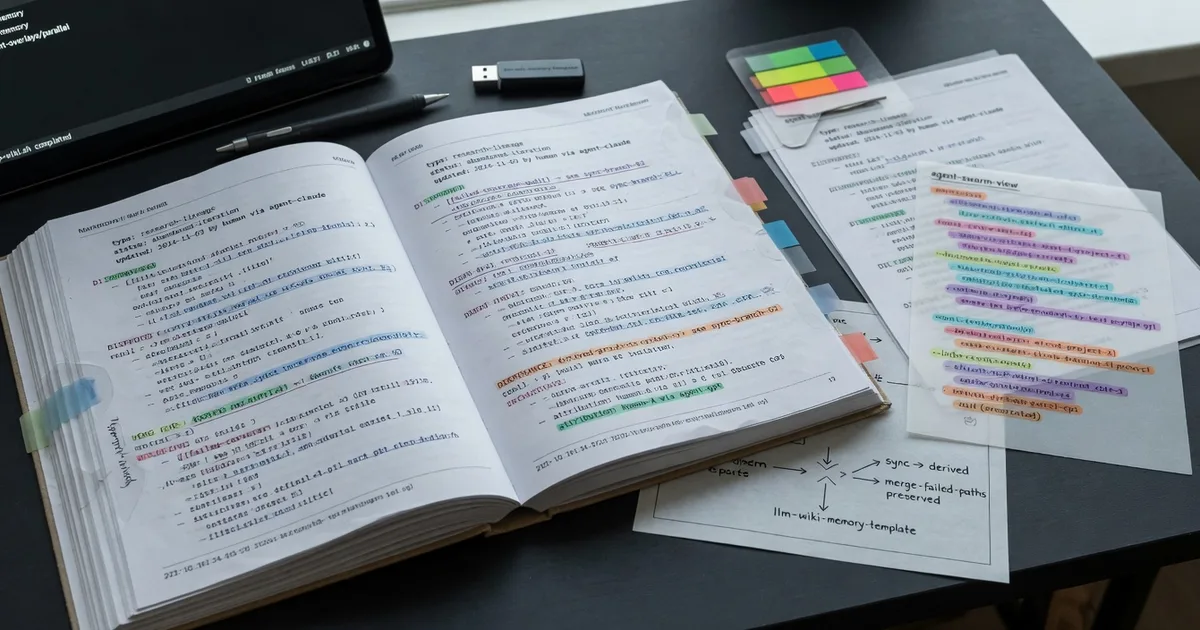
Research projects, educational efforts, and adjacent knowledge work accumulate findings, decisions, and reasoning that future collaborators rarely recover. The parts most useful to that work, including dead ends and walked-back claims, are routinely excluded from publications and shared code; future researchers re-attempt the same failures because no record survives. LLM coding agents are common participants but hold no persistent memory across sessions, and retrieval-augmented generation over raw sources does not compound. The llm-wiki pattern (Karpathy, 2026; tonbi, 2026) addresses this by inserting an LLM-maintained, interlinked wiki between raw sources and the agent. We present llm-wiki-memory-template, a reusable, agent-aware instantiation, and argue it is a substrate for heterogeneous collaborative knowledge work along three axes (multi-human, multi-AI-agent, multi-domain) with each axis supported by a distinct architectural element of the template ({\S}4). The wiki is append-only by convention, which preserves what did not work alongside what did, addressing a negative-result loss problem that publications and code-sharing structurally cannot solve. Three deployed case studies and one design report cover the axes individually: a solo research lineage that preserves abandoned iterations; a two-author project whose retroactive audit revised two prior experiments' claimed 20-of-20 coverage down to 14 and 12 evidence-based answers, then to 18 and 18 after a fix, with the failure path preserved across the artifact; an in-progress multi-agent deployment reported as a design; and a cross-domain educational variant. We name failure-path preservation, agent honesty, and appropriation as cross-cutting sociotechnical properties of the artifact, not only of its technical mechanisms.
Summary
The article presents llm-wiki-memory-template as a reusable substrate that gives LLM agents durable, shared memory across sessions, users, and projects. Current LLM coding assistants lose context between interactions, while standard retrieval-augmented generation simply re-indexes raw material without building cumulative structure. As a result, dead ends, revised claims, and negative outcomes disappear from publications and code repositories, forcing later researchers to repeat the same unproductive paths.
The template operationalizes the llm-wiki pattern by placing an LLM-maintained, interlinked set of Markdown pages between source material and any participating agent. Pages carry typed frontmatter and cross-references that the agent itself updates. An append-only convention keeps every prior version and failed branch visible, so the record of what did not work survives alongside the final result. A one-command bootstrap script scaffolds the wiki, installs agent-specific overlays, and configures attribution logging that records every edit as “by <human> via <agent>.”
Three architectural elements address distinct collaboration axes. Parallel overlays let multiple agents share a single agent-agnostic core. A sync mechanism supports derived projects while preserving provenance. Discipline and verification gates catch agents that present projections as measured facts. The authors frame these mechanisms as boundary infrastructure that supports multi-human, multi-agent, and multi-domain work without requiring simultaneous three-axis deployment.
Case studies illustrate the approach in practice: a solo research lineage that retains abandoned iterations, a two-author audit that corrected overstated coverage figures while keeping the correction trail, and an in-progress multi-agent deployment. Across these examples the template produces three sociotechnical properties—failure-path preservation, agent honesty through explicit attribution, and appropriation by different communities—rather than relying solely on its technical mechanisms.
Why it matters
This research is highly relevant for Dutch AI researchers and engineering teams as it provides an actionable, open-source framework for improving LLM agent collaboration and memory. Its emphasis on transparent provenance, agent honesty, and preserving failure paths strongly aligns with the Netherlands' strategic focus on ethical and accountable AI development.