Harnessing agent memory to build lifelong AI partners for materials scientists
06:00 · August 13, 2026 · arXiv cs.AI RSS
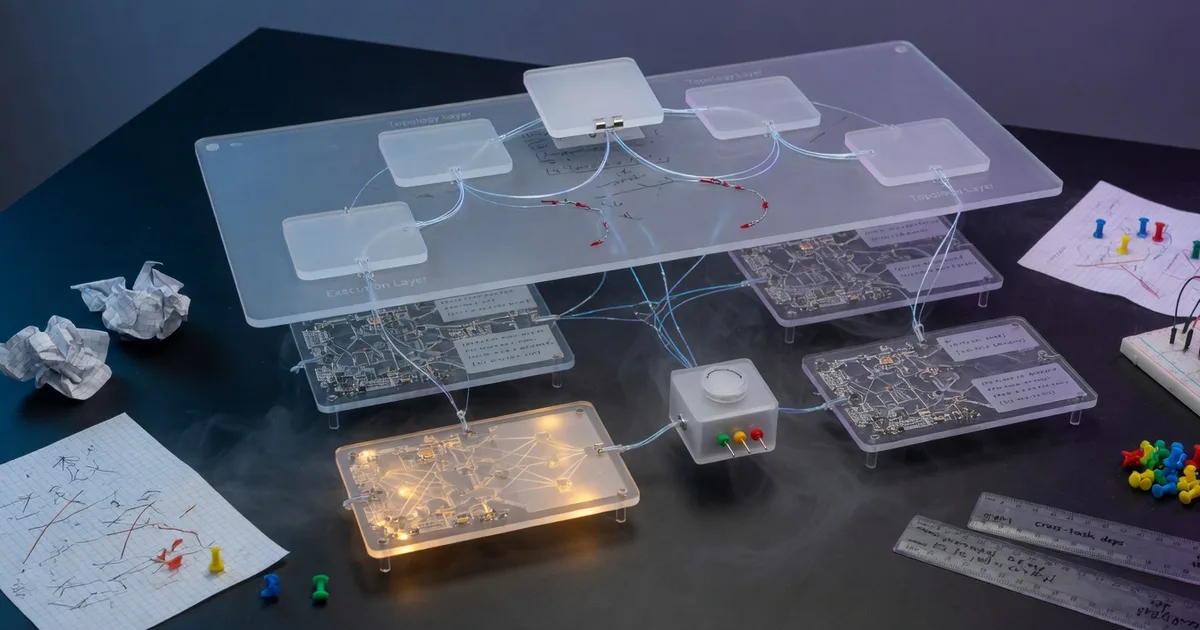
Materials research advances through accumulated experience - scripts that work, protocols that are trusted, warnings attached to failed calculations or experiments, and judgement that links a new question to an old result. This experience is essential for reproducibility and knowledge transfer, yet it is usually fragmented across notebooks, repositories, job logs and individual memory, and it is rarely portable across artificial-intelligence agents. Here we argue that a lifelong AI partner for materials science can be designed around persistent memory rather than around a particular agent implementation. We introduce a self-evolving memory framework that stores scientific experience as inspectable facts and executable skills, so that observations, failure boundaries, protocols and validation checks can be retrieved, revised and migrated across models. We evaluate the idea in three computational settings that expose different layers of materials-research competence. In 49 real-world materials-tool-use questions comprising 138 executable subtasks, memory nearly doubles GPT-5.2 task success without model-parameter updates. In elemental-solid equation-of-state calculations, memory converts a wavefunction-initialization failure into a pre-execution guardrail, improving outcomes from 22/1/4 to 25/2/0 Correct/Partial/Error and avoiding 92% of repeated errors. In 13 practical material simulation workflows, remembered skills and failure facts halve the aggregate trace burden (tokens) and reduce tool calls by over a factor of two by the third round, while preserving physically meaningful outputs in band-gap, phonon, vacancy and work-function analyses. These results show that agent memory can serve as a durable scientific asset; a portable, self-improving record of materials-research experience that outlives any single model or agent stack.
Summary
Materials research depends on accumulated operational knowledge—working scripts, trusted protocols, documented failure modes and the judgement that connects a new query to prior results—yet this experience typically remains scattered across notebooks, repositories and personal recollection, with little portability between AI agents. The paper argues that durable progress requires shifting the design focus from any single agent implementation to a persistent, self-evolving memory layer that can outlive individual models or frameworks.
The proposed framework stores scientific experience in two complementary, human-readable forms. Facts capture observations, boundary conditions, warnings and interpretations, while skills encode reusable procedures such as relaxation-then-DFPT workflows or equation-of-state fitting scripts. Both artefacts carry provenance information, remain editable, and can be retrieved or revised independently of the underlying language model, allowing knowledge to migrate across agent stacks without parameter updates.
Three evaluation settings demonstrate the practical value of this separation. Across 49 real-world materials-tool-use questions that together comprise 138 executable subtasks, the addition of memory nearly doubles task success for GPT-5.2. In elemental-solid equation-of-state calculations, memory converts a recurring wavefunction-initialisation failure into a pre-execution guardrail, raising outcomes from 22/1/4 to 25/2/0 (Correct/Partial/Error) and eliminating 92 % of repeated errors. In 13 practical simulation workflows covering band-gap, phonon, vacancy and work-function analyses, retained skills and failure facts halve aggregate token usage and more than halve the number of tool calls by the third iteration while preserving physically meaningful results.
Taken together, the results indicate that agent memory can function as a durable scientific asset: a portable, inspectable record of materials-research experience that continues to improve and transfer even as foundation models and orchestration frameworks evolve.
Why it matters
This research is highly relevant for Dutch AI researchers and high-tech materials enterprises looking to deploy autonomous AI agents for R&D. The proposed model-agnostic memory framework addresses critical challenges in AI reproducibility and workflow efficiency, offering actionable methodologies for advanced scientific computing.