
Risk Is Not the Target: A Monotonic Framework for Evaluating Wildfire Operational Risk Signals
06:00 · July 27, 2026 · arXiv cs.AI RSS
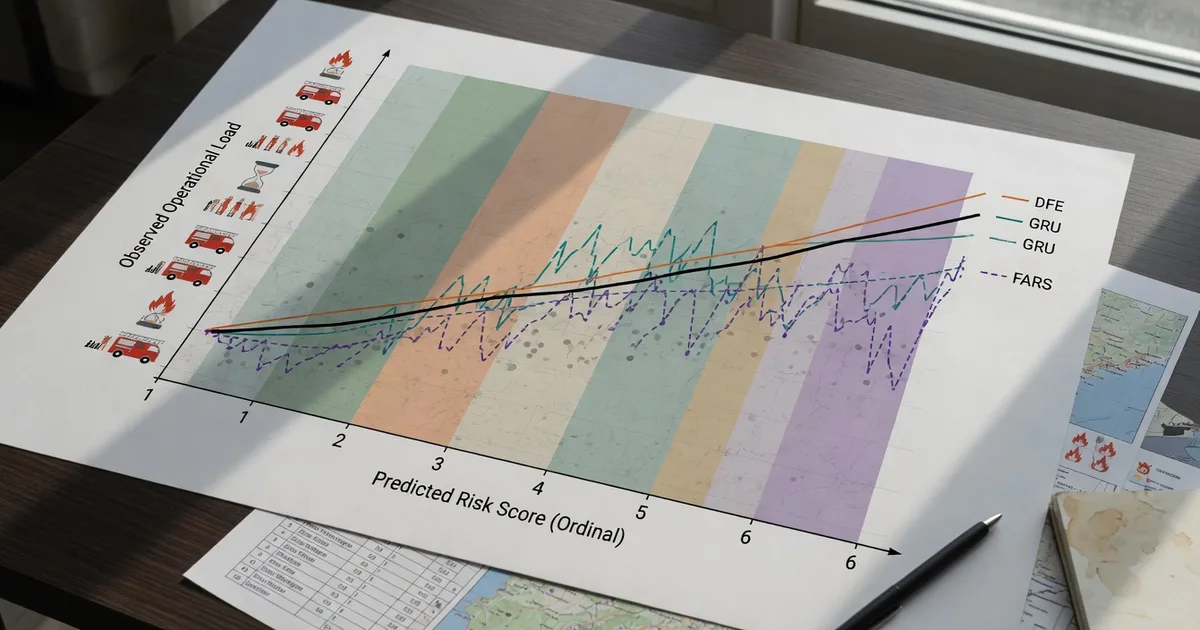
Evaluating wildfire risk systems using standard machine-learning metrics such as F1-score or IoU is fundamentally flawed: these metrics assess event prediction accuracy, not the operational coherence of a continuous risk signal. This work proposes a novel monotonic evaluation framework that measures whether increases in a predicted risk score consistently correspond to increases in observed operational load, such as number of fires, intervention time, and deployed resources. Moreover, we compare three structurally different approaches on the French Alpes-Maritimes department: the expert-based DFE index, GRU- based predictive models, and FARS, a hybrid multi-agent system combining predictive AI with LLM-based reasoning. Experimental results reveal that the DFE, despite poor classification metrics, exhibits the most balanced monotonic behavior across the full risk scale. GRU models achieve strong local monotonicity but fail to produce well-distributed risk levels. FARS inherits and reveals the structural limitations of upstream signals rather than correcting them. The central finding is a paradigm shift: a good risk model does not predict fires accurately, but one whose ordinal scale meaningfully explains operational dynamics, as proved in this paper. Code of the monotonic framework is available on github.
Summary
Evaluating wildfire risk systems with conventional machine-learning metrics such as F1-score or IoU is structurally mismatched to the task, because these measures assess discrete event prediction rather than the coherence of a continuous risk signal with operational demands. The authors therefore introduce a monotonic evaluation framework that tests whether successive increases in a predicted risk score are accompanied by corresponding increases in observed operational load, measured through daily counts of fires, total intervention time, and the number of firefighting units deployed.
The framework is applied to the Alpes-Maritimes department in France, partitioned into six meteorological zones that reflect contrasting vegetation and population patterns. Three structurally different approaches are compared on data spanning 2017–2023: the expert-derived DFE index, GRU-based predictive models trained on meteorological and land-cover features, and FARS, a hybrid multi-agent architecture that combines predictive models with LLM-based reasoning. Operational targets are retained in their continuous form for evaluation, while models themselves produce ordinal risk levels.
Results show that the DFE index, despite weak classification performance, maintains the most consistent monotonic relationship across the entire risk scale. GRU models achieve strong local monotonicity within limited score ranges yet produce poorly distributed risk levels overall. FARS largely inherits and exposes the distributional shortcomings of its upstream signals rather than mitigating them. The central claim is that an effective operational risk model is one whose ordinal scale reliably tracks changes in real-world resource pressure, not one that merely classifies discrete ignition events.
Why it matters
This research is highly relevant for Dutch AI researchers focusing on operational risk, climate adaptation, and emergency response. The proposed monotonic evaluation framework and the insights into hybrid LLM-predictive architectures can be directly adapted to other risk domains critical to the Netherlands, such as flood management and infrastructure monitoring.
