AI News selected for Professionals and Decision Makers
Primary Research Stream

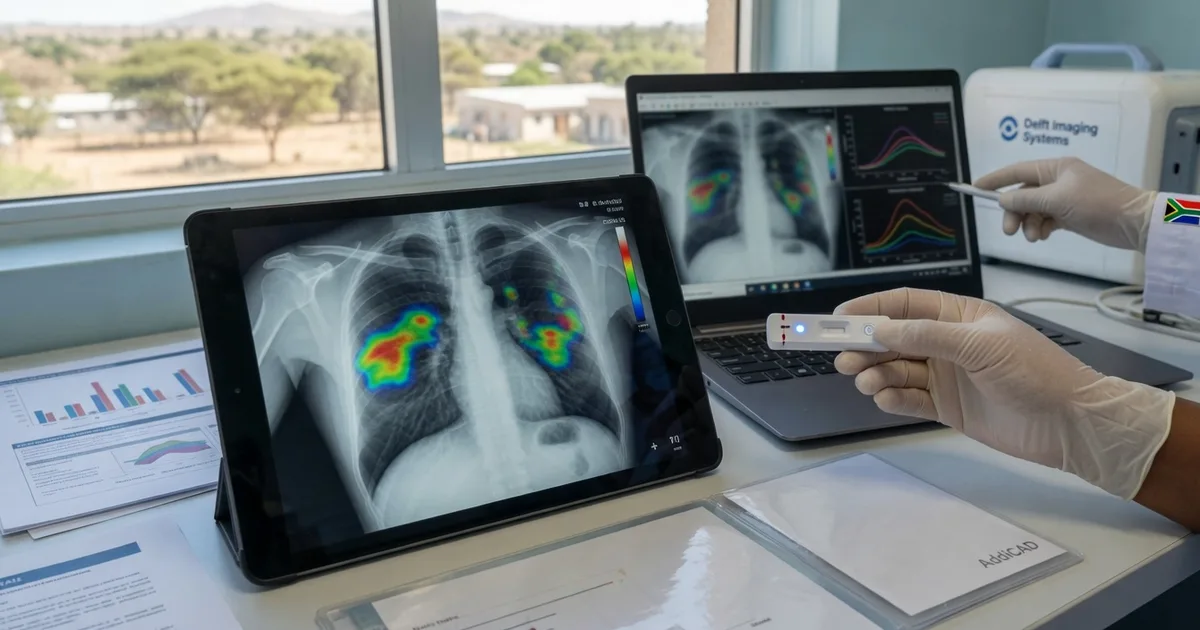
New research project aims to transform tuberculosis diagnosis with AI-powered technology

13:37 · July 27, 2026 · RSS APP - AI Primary Research
New research project aims to transform tuberculosis diagnosis with AI-powered technology

Despite being preventable and curable, tuberculosis continues to place a significant burden on healthcare systems in low-resource settings in South Africa.

Summary

An international research consortium has launched the AddiCAD project to develop a non-sputum diagnostic approach for tuberculosis that integrates AI-based chest X-ray analysis with a fingerstick biomarker assay. Coordinated by Stellenbosch University and funded with R46 million from the Global Health EDCTP3 programme, the initiative brings together partners from South Africa, Namibia, the Netherlands, Germany, the United Kingdom and The Gambia, including Delft Imaging Systems.

The core technical contribution is the fusion of CAD4TB, an established AI model that detects radiographic signs of tuberculosis on digital chest X-rays, with a blood-based test that quantifies the host immune response to infection. Early data indicate that this multimodal combination yields a 20 percent gain in specificity relative to CAD4TB alone, while preserving sensitivity. The improvement is intended to lower false-positive rates that currently lead to unnecessary follow-up testing in high-burden, resource-constrained environments.

Over the coming years the consortium will finalise a companion biosensor and mobile application, then conduct a clinical validation study enrolling approximately 1 000 adults with presumptive tuberculosis across sites in South Africa, Namibia and The Gambia. The work also includes engagement with regulators, health-care providers and implementation partners to prepare for eventual scale-up in settings where laboratory infrastructure and sputum collection remain practical barriers to timely diagnosis.

Why it matters

This article highlights the active participation of a Dutch AI company (Delft Imaging Systems) in a major EU-funded global health research initiative. It offers researchers insights into multimodal AI diagnostic models combining imaging and biomarkers.

More in this beat
AddiCADai-diagnosticsCAD4TBchest-x-raymedical-aituberculosis
FedPref: Federated Preference Learning for Structured Radiology Report Extraction

06:00 · August 19, 2026

FedPref: Federated Preference Learning for Structured Radiology Report Extraction

Strong actionability for Dutch/EU hospitals under GDPR constraints; directly addresses privacy-preserving collaboration on medical data with unequal distributions, high technical depth, novelty in combining federated learning with preference optimization, and full reproducibility via GitHub.

Relevance 82 · Audience 90

ClinLens: Towards Long-Horizon Coding Agents for Longitudinal Multimodal Clinical Data Science

06:00 · July 30, 2026

ClinLens: Towards Long-Horizon Coding Agents for Longitudinal Multimodal Clinical Data Science

This research is highly relevant for Dutch AI researchers and clinical data scientists developing healthcare LLMs, as it provides a rigorous benchmark for evaluating the actual correctness of multimodal AI agents. This aligns with the Netherlands' strong emphasis on transparent, reliable, and ethically sound AI deployment in medical settings, especially under the EU AI Act.

Relevance 85 · Audience 95

Large Language Models in Mental Health: A Systematic Review of Applications, Innovations, and Ethical Challenges

06:00 · August 20, 2026

Large Language Models in Mental Health: A Systematic Review of Applications, Innovations, and Ethical Challenges

The review directly aligns with the Dutch AI market's strong emphasis on ethical, transparent AI and its robust HealthTech sector. It provides researchers with a comprehensive overview of state-of-the-art multimodal techniques and regulatory frameworks necessary for deploying AI in sensitive domains like mental health under EU standards.

Relevance 85 · Audience 90

How Compliant is Sepsis Treatment? An Expert-Guided Neuro-symbolic Pipeline for Generating Clinical Compliance Insights

06:00 · August 17, 2026

How Compliant is Sepsis Treatment? An Expert-Guided Neuro-symbolic Pipeline for Generating Clinical Compliance Insights

The paper's focus on transparent, neuro-symbolic AI directly aligns with the Dutch and EU emphasis on trustworthy and explainable AI in safety-critical domains like healthcare. Dutch AI researchers and medical centers can leverage this hybrid methodology to develop compliant clinical decision-support systems that adhere to strict EU regulations.

Relevance 85 · Audience 95

From Continuous Predictors to Clinical Thresholds: Early Evidence on Performance Trade-offs of Guideline-Based Categorisation for Ischaemic Stroke Outcome Prediction

06:00 · August 7, 2026

From Continuous Predictors to Clinical Thresholds: Early Evidence on Performance Trade-offs of Guideline-Based Categorisation for Ischaemic Stroke Outcome Prediction

The article is highly relevant for researchers focusing on Explainable AI (XAI) and clinical decision support systems. It provides empirical evidence on how to bridge the gap between technical model explanations and clinical reasoning, aligning well with the Dutch and EU focus on transparent, trustworthy AI in healthcare.

Relevance 75 · Audience 90

Improving Fable 5's biology safeguards

02:00 · August 7, 2026

Improving Fable 5's biology safeguards

This update is crucial for product teams building health-tech or educational applications using Anthropic's models, as it directly impacts query routing, user experience, and fallback rates. It also provides valuable insights into implementing ethical AI safeguards and managing dual-use risks, aligning with the Dutch AI market's focus on responsible AI.

Relevance 85 · Audience 90

H+ Embedding: Harmonizing Global and Token-Level Retrieval with Context-Dependent Phrases

06:00 · August 4, 2026

H+ Embedding: Harmonizing Global and Token-Level Retrieval with Context-Dependent Phrases

This research is highly relevant for Dutch AI researchers and engineers building Retrieval-Augmented Generation (RAG) systems, particularly in the healthcare and scientific sectors. It offers a mathematically rigorous, cost-effective methodology to improve domain-specific search without the massive storage overhead of traditional token-level models.

Relevance 85 · Audience 95

Marking the Wrong Symptoms: Evaluating LLM Watermarks in Medical Texts

06:00 · July 24, 2026

Marking the Wrong Symptoms: Evaluating LLM Watermarks in Medical Texts

Highly actionable for Dutch healthcare AI teams and regulators: demonstrates that generic benchmarks mask clinically critical failures and recommends domain-specific evaluation plus answer-only watermarking for reasoning models. Aligns with Netherlands' focus on ethical, transparent AI deployment under EU rules.

Relevance 78 · Audience 85

Real-world evidence and AI: How EHR data is reshaping drug development decisions

16:59 · July 22, 2026

Real-world evidence and AI: How EHR data is reshaping drug development decisions

This article is highly relevant for Dutch AI researchers in healthcare and pharma, as it details the European Medicines Agency's (EMA) DARWIN EU network and regulatory stances on AI-extracted data. It provides actionable insights into deploying transformer-based NLP models for EHR mining within the EU regulatory context.

Relevance 75 · Audience 80

Cura 1T: Specialized Model for Agentic Healthcare

06:00 · July 20, 2026

Cura 1T: Specialized Model for Agentic Healthcare

This research is highly relevant for Dutch AI researchers and healthcare institutions developing specialized clinical models. The data-centric, self-evolving training methodology offers a transparent and rigorous approach to building reliable healthcare AI, aligning with EU regulatory standards for clinical deployment.

Relevance 85 · Audience 95