AI News selected for Professionals and Decision Makers
Primary Research Stream

Energy Efficiency of Locally Deployed LLMs: A Preliminary Quantitative GPU Power Benchmark on Consumer Hardware

06:00 · August 4, 2026 · arXiv cs.AI RSS
Energy Efficiency of Locally Deployed LLMs: A Preliminary Quantitative GPU Power Benchmark on Consumer Hardware

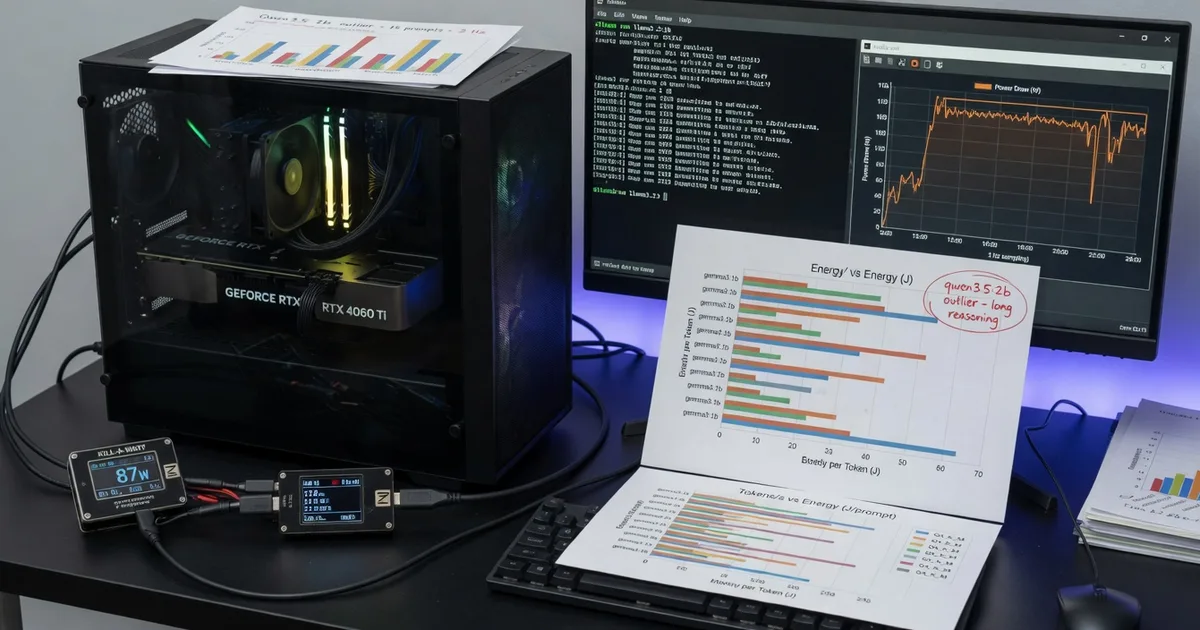
The local deployment of large language models (LLMs) is gaining traction due to privacy concerns and the desire for on-premise inference. However, the energy costs on consumer hardware remain poorly characterized, as most benchmarks focus solely on accuracy. This paper presents a reproducible, hardware-level energy benchmark of nine open-source LLMs (1B to 7B parameters) executed on a single consumer GPU (RTX 4060Ti 16GB). Using the Ollama inference engine, GPU power draw was sampled at 2Hz via nvidia-smi across a fixed prompt set. We evaluate mean/peak power, total energy per prompt (J/prompt), energy per output token (J/token), and throughput (tok/s). Our findings suggest that factors beyond raw parameter count, including model architecture and quantization strategy, drive energy efficiency. Specifically, gemma3:1b and llama3.2:1b achieve the lowest energy cost (0.56 J/token and 0.65 J/token) and the highest throughput (>170 tok/s). In contrast, the 7B-Mistral model consumes up to 4.4x more energy per token than the most efficient model. Notably, qwen3.5:2b exhibits anomalously high per-prompt energy due to extended internal reasoning, highlighting the need to distinguish between token generation modes in efficiency metrics.

Summary

A recent arXiv preprint examines the energy consumption of local LLM inference on consumer-grade hardware, an area that has received less attention than training costs or cloud-scale deployments. The authors ran nine open-source models ranging from 1B to 7B parameters on an RTX 4060 Ti 16 GB GPU under the Ollama runtime, sampling power draw at 2 Hz through nvidia-smi while executing a fixed set of 15 prompts that varied in length and reasoning demand. They recorded mean and peak power, energy per prompt, energy per generated token, and throughput, producing a reproducible measurement harness and openly available dataset.

Results show that energy efficiency is not determined solely by parameter count. Model architecture and the quantization scheme supplied by Ollama exert stronger influence. The smallest models, gemma3:1b and llama3.2:1b, delivered the lowest energy figures at 0.56 J/token and 0.65 J/token respectively, while sustaining throughput above 170 tokens per second. In contrast, the 7B Mistral variant required up to 4.4 times more energy per token than the most efficient model under identical conditions.

One notable outlier was qwen3.5:2b, whose per-prompt energy consumption rose sharply because of extended internal reasoning traces that increased output length without a corresponding gain in external token count. The study therefore distinguishes between token-generation modes when interpreting efficiency metrics and underscores the practical value of architecture-aware model selection for sustained local use.

Why it matters

Directly actionable for Dutch researchers and SMEs deploying local LLMs, aligning with EU sustainability goals, privacy-driven on-premise inference, and Green AI priorities in the Netherlands.
More in this beat
energy-efficiencygemmagpu-utilizationllama-3llm-inferenceMistralollamaqwen
Enhancing LLMs with Context-Specific Knowledge for Mitigating Misinformation in SMEs: A RAG-based Modeling and Analysis

06:00 · August 4, 2026

Enhancing LLMs with Context-Specific Knowledge for Mitigating Misinformation in SMEs: A RAG-based Modeling and Analysis

The research directly addresses the challenge of deploying trustworthy and hallucination-free AI in SMEs, a major focus of the Dutch AI ecosystem. The comparative analysis of RAG methodologies offers actionable insights for Dutch researchers and developers building compliant, reliable AI solutions aligned with EU ethical standards.

Relevance 75 · Audience 85

FLOPs vs Real Work: The Importance of Replication in AI Efficiency Assessment

06:00 · August 18, 2026

FLOPs vs Real Work: The Importance of Replication in AI Efficiency Assessment

Directly relevant for Dutch AI researchers and advanced practitioners working on Green AI, model optimization, and reproducible efficiency metrics; authors are local, findings address EU energy concerns, and results are actionable for accurate cost assessment on modern GPUs.

Relevance 85 · Audience 90

Same Cluster, 33 Points More Utilization: What Changed Was the Order

21:46 · August 17, 2026

Same Cluster, 33 Points More Utilization: What Changed Was the Order

Directly addresses production GPU orchestration challenges (contention, reservations, contiguous blocks, churn) with quantitative benchmarks and implementation details relevant to ML engineers running mixed training/inference workloads on shared hardware.

Relevance 78 · Audience 85

Forecasting Side Effects of Activation Steering

06:00 · August 13, 2026

Forecasting Side Effects of Activation Steering

Directly addresses ethical and safe LLM deployment central to Dutch/EU AI priorities; the forecasting method is actionable for researchers auditing steering interventions on open models.

Relevance 65 · Audience 88

Making Knowledge Distillation Cheap Enough to Run at Scale

12:05 · August 10, 2026

Making Knowledge Distillation Cheap Enough to Run at Scale

Directly addresses ML Engineer pain points in LLM distillation: VRAM constraints, distributed vs single-GPU setups, and loss implementation efficiency with concrete metrics and code. Actionable for Dutch teams iterating on model compression under compute limits.

Relevance 85 · Audience 90

Request-Level Energy Attribution for Batched LLM Serving

06:00 · August 4, 2026

Request-Level Energy Attribution for Batched LLM Serving

Directly actionable for Dutch AI teams optimizing sustainable LLM inference under EU energy-reporting rules; provides measured fairness baselines and reproducible protocols relevant to ethical AI and data-center efficiency goals.

Relevance 82 · Audience 88

Smaller, faster, safer: running Kimi and GLM at scale

15:00 · August 3, 2026

Smaller, faster, safer: running Kimi and GLM at scale

Provides actionable security measures (integrity checks) and efficiency techniques applicable to Dutch AI teams running inference workloads, with direct relevance to secure multi-user GPU serving.

Relevance 65 · Audience 70

GPU Management: Why Idle GPUs Are the New Grounded Aircraft

17:09 · July 30, 2026

GPU Management: Why Idle GPUs Are the New Grounded Aircraft

It addresses critical MLOps and production challenges faced by ML Engineers, specifically GPU utilization, workload scheduling, and compute cost optimization. For Dutch enterprises and SMEs scaling AI, mastering these orchestration strategies is essential to remain cost-effective without relying on massive hardware budgets.

Relevance 75 · Audience 85

The Hard Decision Layer: Evidence for Committed Inference in Transformers

06:00 · July 27, 2026

The Hard Decision Layer: Evidence for Committed Inference in Transformers

This research is highly relevant for AI researchers and engineers focusing on mechanistic interpretability and model efficiency. The discovery of the HDL provides actionable insights for optimizing LLM inference through layer pruning, aligning well with the Dutch and EU focus on transparent, explainable, and computationally efficient (Green) AI.

Relevance 85 · Audience 95

Hugging Face and Cerebras bring Gemma 4 to real-time voice AI

02:00 · July 1, 2026

Hugging Face and Cerebras bring Gemma 4 to real-time voice AI

This article is highly relevant for ML Engineers as it provides a practical, open-source architecture for solving critical latency bottlenecks in real-time voice AI. Dutch AI teams can directly implement this modular stack using the provided repositories to build responsive conversational agents and embodied AI solutions.

Relevance 80 · Audience 90

Run a vLLM Server on HF Jobs in One Command

02:00 · June 26, 2026

Run a vLLM Server on HF Jobs in One Command

Directly actionable for ML engineers needing quick, production-adjacent model serving setups with explicit handling of VRAM constraints, distributed GPU configs, and pay-per-second costs; relevant for Dutch teams using HF tooling.

Relevance 72 · Audience 88