AI News selected for Professionals and Decision Makers
Hands On Model Tooling And Research Updates

Master Agent Architecture: Unifying Harness, Loop, and Graph Engineering

21:39 · August 2, 2026 · X (Twitter)
Master Agent Architecture: Unifying Harness, Loop, and Graph Engineering

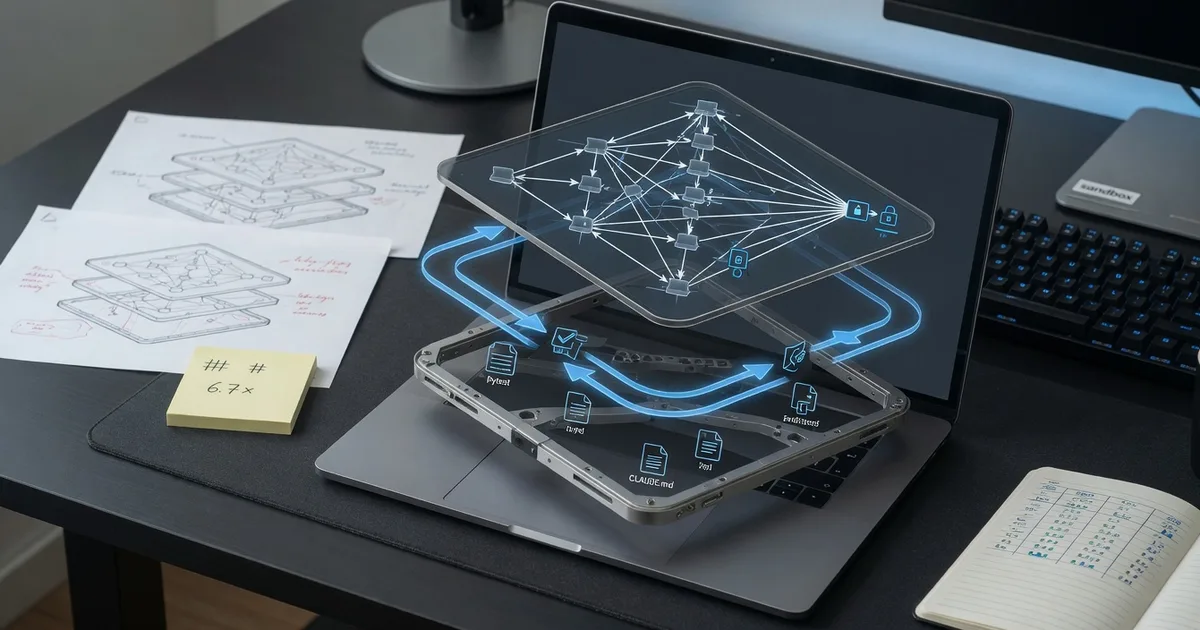
Technical thread detailing a three-layer architecture (Harness, Loop, Graph) for building reliable LLM agents that produce verified code changes instead of fragile demos. Includes concrete Python implementations for state hashing, evidence-gated loops, and parallel fan-out graphs plus performance benchmarks.

Summary

The post by @marfinxx presents a unified Master Agent Architecture that combines three structural layers—Harness, Loop, and Graph Engineering—into a single production system for LLM-based coding agents. The author argues that most teams fail by treating these layers as separate or competing approaches, resulting in either expensive retry loops, overly complex graphs, or repeated prompt rewriting without addressing the underlying environment.

Key technical content includes a 7-file harness structure with CLAUDE.md rules, state-hashing Python code to avoid redundant file reads, deterministic evidence loops that require pytest and linter passes rather than model confidence, and asyncio-based parallel fan-out graphs with synchronization gates. The thread also supplies an adversarial red-team verifier node and a performance table showing 6.7× faster execution, 80% lower token spend, and near-elimination of hallucinations compared with single-prompt intern-style usage.

For Dutch and EU AI practitioners the material is directly usable: the patterns address real pain points in scaling reliable agents inside regulated or cost-sensitive environments. The emphasis on sandboxed harnesses, deterministic verification, and concurrency control aligns with European priorities around trustworthy AI and efficient resource use, offering a concrete blueprint that teams can implement without relying on vendor-specific platforms.

Why it matters

Provides actionable engineering patterns for production AI agents that Dutch and EU developers can directly apply to reduce token costs and hallucination rates in agentic workflows.


More in this beat
agentic-workflowsclaude-mdcoding-agentshallucinationsharness-engineeringllm-agentsred-teaming
Build your own vulnerability harness

19:59 · June 18, 2026

Build your own vulnerability harness

Directly actionable for Dutch security teams building or adapting AI security pipelines; addresses core security risks of AI agents in vulnerability discovery and offers concrete mitigation patterns relevant under EU contexts.

Relevance 85 · Audience 90

Building a C compiler with a team of parallel Claudes

01:00 · February 5, 2026

Building a C compiler with a team of parallel Claudes

Directly demonstrates actionable agent-team workflows, test harness patterns, and parallelism techniques that Product Teams and Builders can adapt for complex software projects using current Claude APIs.

Relevance 85 · Audience 90

FraudBench: Stress-Testing Policy-Grounded Banking Agents Against Adaptive Fraud

06:00 · August 20, 2026

FraudBench: Stress-Testing Policy-Grounded Banking Agents Against Adaptive Fraud

This research is highly relevant for Dutch AI researchers and the strong local fintech and banking sector exploring customer-facing LLM agents. It provides a rigorous, reproducible framework to test agent compliance and security against fraud, aligning with strict EU financial and AI regulations.

Relevance 85 · Audience 95

The Claude Code Guide For Startups

02:00 · August 20, 2026

The Claude Code Guide For Startups

This article is highly relevant for product teams and builders as it offers actionable strategies and technical tips for integrating agentic coding into the SDLC. Dutch AI practitioners can apply these insights to scale development efficiently while maintaining governance and compliance through robust evaluation frameworks.

Relevance 85 · Audience 95

Cloud Agents and Cursor Harness Improvements

02:00 · August 19, 2026

Cloud Agents and Cursor Harness Improvements

This update is highly relevant for product teams and builders as it introduces autonomous AI agents into the software development lifecycle, automating PR management, CI/CD fixes, and testing. Dutch AI practitioners can leverage these tools to significantly accelerate development, though they should evaluate the data privacy implications of cloud-based subagents.

Relevance 85 · Audience 95

Cloud Agents Start 3x Faster with Builds

02:00 · August 13, 2026

Cloud Agents Start 3x Faster with Builds

This update is highly relevant for AI product teams and builders as it significantly reduces latency in AI-assisted development workflows. Dutch AI practitioners using Cursor will benefit from faster agent boot times and more resilient development environments.

Relevance 85 · Audience 95

Introducing Grok 4.6

02:00 · August 12, 2026

Introducing Grok 4.6

This update is highly relevant for product teams and builders as it introduces a powerful new model for agentic coding and rapid application prototyping. Dutch AI practitioners can leverage Grok 4.6 via Cursor or APIs to accelerate software development and build complex, multi-step AI agents.

Relevance 85 · Audience 95