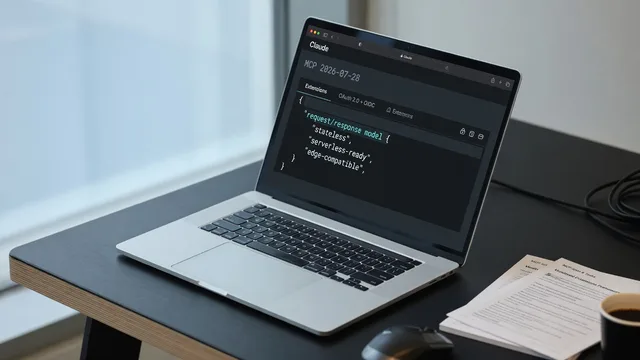
Introducing advanced tool use on the Claude Developer Platform
01:00 · November 24, 2025 · Antropic Engineering Blog

We’ve added three new beta features that let Claude discover, learn, and execute tools dynamically. Here’s how they work.
Summary
Anthropic has released three beta features on the Claude Developer Platform to support more scalable tool use in agent workflows. Tool Search Tool, Programmatic Tool Calling, and Tool Use Examples address common bottlenecks when agents must interact with large libraries of tools, such as token overhead from loading every definition upfront and errors in tool selection or parameter choice.
The Tool Search Tool allows deferred loading of tool definitions. Developers mark tools with defer_loading: true, so Claude initially sees only a search interface plus a small set of always-available tools. When needed, Claude queries for relevant tools by name or description, and only matching definitions are expanded into context. Internal tests showed an 85 percent reduction in token usage for a five-server MCP setup and accuracy gains on large tool libraries, with Opus 4 rising from 49 percent to 74 percent and Opus 4.5 from 79.5 percent to 88.1 percent.
Programmatic Tool Calling lets Claude generate Python code that orchestrates multiple tools inside a sandboxed code execution environment. Instead of returning every intermediate result to the model, the code processes data locally and only the final output enters Claude’s context. This approach reduces token consumption for tasks involving loops, conditionals, or large datasets, as demonstrated by an expense-budget example that shrank context from roughly 200 KB of raw records to about 1 KB of results.
Tool Use Examples supplement JSON schemas by embedding concrete call samples directly in tool definitions. These examples convey conventions such as when to supply optional parameters or which parameter combinations are typical, improving accuracy on complex invocations. Internal testing recorded an increase from 72 percent to 90 percent on parameter-handling benchmarks.
The three features are designed to be combined selectively according to the dominant constraint in a given workflow. They are available through the beta header on the Claude API, with documentation covering implementation patterns for MCP servers and custom search backends.
Why it matters
Directly actionable for Product Teams and Builders with concrete code examples, API patterns, and workflow optimizations for dynamic tool orchestration. Addresses context management, accuracy, and scalability—core concerns for AI agent development.