Household Movement Detection in Mixed-Format Occupancy Data Using LLM-Based Entity Resolution
06:00 · July 27, 2026 · arXiv cs.AI RSS
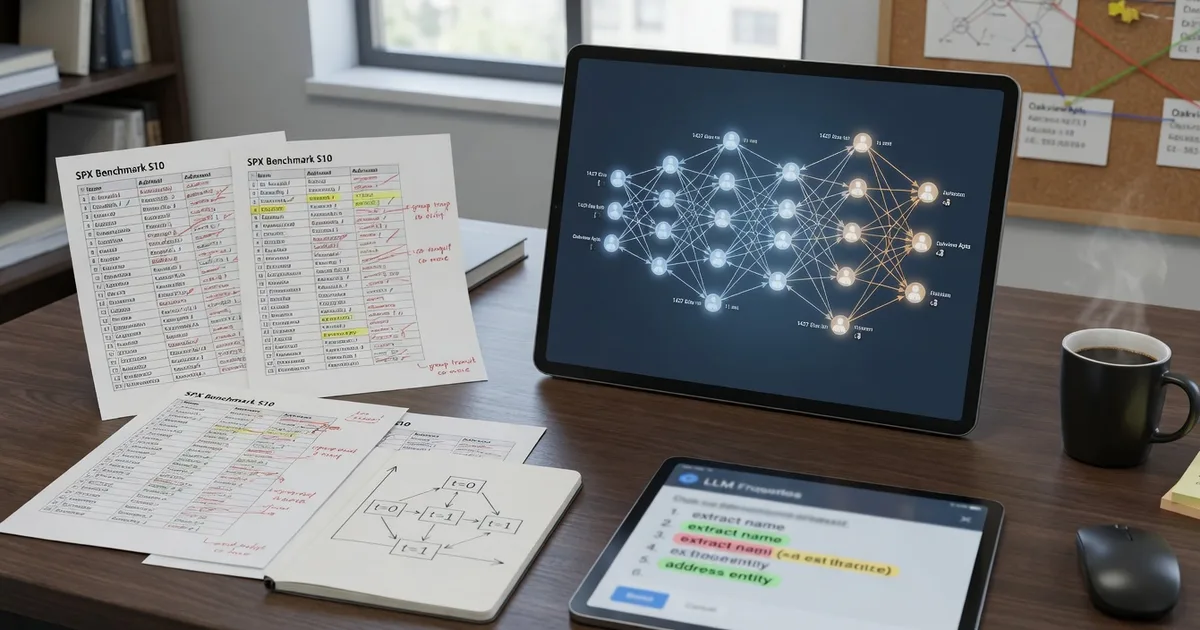
Entity resolution (ER) typically relies on pairwise similarity comparisons between records, which limits its ability to capture indirect relationships present in demographic occupancy data. An important indirect pattern arises from household movement, where multiple individuals relocate together across addresses, but detecting such patterns is difficult due to mixed-format records, noise, duplication, and the absence of stable identifiers. This paper proposes an AI-enhanced framework for detecting indirect entity links associated with household movement in unstandardized name-address data. The approach integrates prompt-based large language model (LLM) named entity recognition for extracting personal names and addresses without extensive preprocessing, semantic text embeddings for robust similarity computation, and graph-based reasoning to infer group-level movement patterns. Experimental evaluation on SPX benchmark datasets (S8-S12) generated using the Synthetic Occupancy Generator demonstrates that incorporating indirect household movement evidence improves recall by 8-15% while maintaining high precision, yielding F1-score gains of 6-8% over a strong pairwise baseline.
Summary
Entity resolution systems have long relied on direct pairwise comparisons of records, an approach that struggles to surface indirect relationships in demographic occupancy data. Household movement represents one such pattern: when multiple individuals relocate together from one address to another, the shared transition can link records even when names or addresses appear in inconsistent formats, contain noise, or lack stable identifiers. Traditional methods often miss these group-level signals because they depend on rigid string matching or require extensive preprocessing that breaks down on heterogeneous inputs.
The proposed framework addresses this limitation by combining three components. Prompt-based large language models perform named entity recognition to extract personal names and addresses directly from unstandardized records, reducing the need for manual standardization. Semantic text embeddings then compute similarity scores that remain robust under spelling variation and format differences. Finally, graph-based reasoning traverses the resulting connections to identify collective movement patterns, treating household transitions as transitive evidence that links individuals who co-occur at successive addresses.
Evaluation was conducted on synthetic SPX benchmark datasets (S8–S12) produced by the Synthetic Occupancy Generator. When household-movement evidence was incorporated, recall rose between 8 and 15 percent while precision remained high, producing F1-score improvements of 6 to 8 percent relative to a strong pairwise baseline. The results indicate that graph-level inference over semantically enriched extractions can recover links that pairwise methods systematically overlook in noisy occupancy data.
Why it matters
The methodology is highly actionable for Dutch AI researchers and data scientists working with administrative registries, census data, or customer databases. Its focus on handling noisy data without explicit identifiers aligns well with EU GDPR constraints, offering a robust approach for privacy-preserving entity resolution in public and private sectors.