FrED: External Data Influence Estimation via Domain Knowledge Graph Grounding
06:00 · July 27, 2026 · arXiv cs.AI RSS

The rapid deployment of generative AI has amplified the critical need for Training Data Attribution to ensure transparency and accountability. However, current parametric approaches require computationally prohibitive access to model weights, while similarity-based methods ignore deep structural context. We propose a novel probabilistic framework that operates entirely in a black-box setting. Our method fuses continuous feature similarities with discrete, domain-specific Knowledge Graphs (KGs). This approach ensures the attribution is grounded in structural reality, explicitly rewarding highly specific historical samples while preventing generic background data from dominating the results. We evaluate our framework across two distinct domains where linking outputs to data and domain context is inherently complex: abstract artistic image synthesis and high-dimensional physical weather forecasting. Extensive benchmarking demonstrates the robust efficacy of our approach. In the artistic domain, it achieves a strong Linear Datamodeling Score that exceeds standard black-box similarity baselines, while closing much of the gap to gradient-based estimators. We additionally present a cross-domain feasibility case study in environmental forecasting, where we use domain KGs to retrieve physically consistent historical analogs for regional flood forecasts, improving geographic localisation over a latent-only baseline. Operating entirely without internal model access, our approach provides an efficient, interpretable mechanism for post-hoc influence analysis and domain-grounded retrieval.
Summary
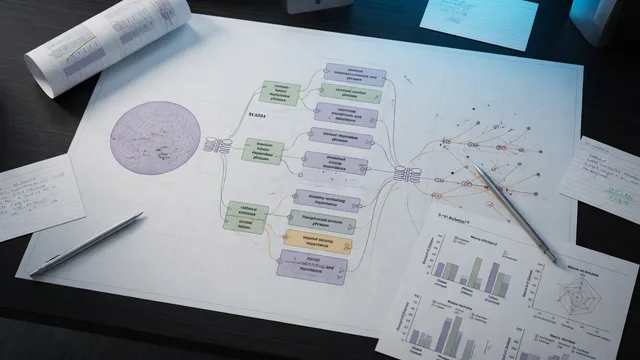
FrED offers a probabilistic framework for training data attribution that works without any access to model weights or internal gradients. It combines continuous latent feature similarities, derived from embeddings of model outputs and training samples, with discrete structural signals drawn from domain-specific knowledge graphs. This fusion applies an asymmetric boosting mechanism that privileges historically specific and contextually relevant samples while down-weighting generic background data that would otherwise dominate purely similarity-based scores.
The method was tested in two domains where tracing outputs to training data is especially difficult. On the ArtBench dataset for abstract artistic image synthesis, FrED records Linear Datamodeling Scores that surpass standard black-box embedding baselines and narrow much of the gap to gradient-based estimators such as D-TRAK. A separate feasibility study in environmental forecasting uses meteorological knowledge graphs to retrieve physically consistent historical analogs for regional flood predictions, yielding improved geographic localisation compared with latent-only retrieval.
By grounding attribution in both statistical proximity and explicit domain structure, FrED supplies an efficient, post-hoc audit trail that supports transparency and accountability requirements in generative systems. The approach remains fully observational, relying solely on the relationship between outputs and external data, and therefore scales to large foundation models where weight access is restricted or impractical.
Why it matters
Directly supports EU AI Act transparency requirements and Dutch ethical AI priorities. Black-box design enables practical adoption by Dutch SMEs and researchers. Novel KG-grounding approach offers actionable, interpretable influence analysis for high-stakes domains.