AI News selected for Professionals and Decision Makers
Primary Research Stream

Context Graphs for Proactive Enterprise Agents

06:00 · July 11, 2026 · arXiv cs.AI RSS

Context Graphs for Proactive Enterprise Agents

Retrieval-Augmented Generation (RAG) and agentic frameworks have advanced enterprise AI considerably, yet agents remain fundamentally reactive: they wait for a human query before acting. This paper argues that genuine enterprise productivity gains require proactive agents: systems that surface relevant, actionable information to workers before they ask. We propose the Context Graph, a live relational data structure that models enterprise entities, their relationships, and state transitions over time. Built on this graph, we define a Delta Detection Engine that continuously monitors state changes, a Proactivity Scorer that ranks candidate insights by urgency, relevance, and persona-fit, and a Surfacing Layer powered by an LLM that delivers ranked notifications with grounded explanations. We formalize each component, derive a unified Proactivity Score function, and provide a complete end-to-end Python implementation using NetworkX and the Anthropic Claude API. Evaluation across three generic enterprise case studies (contract lifecycle management, engineering incident response, and sales pipeline hygiene) demonstrates that context-graph-driven proactivity achieves Precision@5 of 0.83, a false positive rate of 0.11, and reduces mean time to surface from 47 minutes (reactive baseline) to under 30 second.

Summary

This arXiv paper addresses the architectural limits of current enterprise AI agents, which remain reactive because they require an explicit user query before retrieving or acting on information. The authors argue that meaningful productivity gains depend on systems that can monitor enterprise state continuously and surface time-sensitive signals—such as an expiring contract or a stalled deal—without waiting for human initiation.

To enable this behavior, the work introduces the Context Graph, a directed, attributed, time-stamped multigraph that represents enterprise entities as nodes and their relationships as edges. Each node carries mandatory properties including a unique identifier, type, current state, timestamps, owner, and domain metadata, while edges are labeled with semantic relation types and weights. State changes on the graph are recorded as delta events that capture the entity, change type, old and new values, and logical clock, forming an immutable event log.

Three layered components operate on this structure. A Delta Detection Engine evaluates registered threshold rules against incoming deltas to identify candidate insights. A Proactivity Scorer then ranks those candidates according to a unified function that incorporates urgency, relevance, persona fit, and confidence. Finally, a Surfacing Layer uses an LLM to generate grounded natural-language notifications, applying deduplication and cooldown before delivery.

The paper supplies formal definitions for the graph schema and delta model, derives the Proactivity Score function, and includes a complete Python implementation built on NetworkX for graph operations and the Anthropic Claude API for notification generation. Evaluation on three representative scenarios—contract lifecycle management, engineering incident response, and sales pipeline hygiene—reports Precision@5 of 0.83, a false-positive rate of 0.11, and a reduction in mean time to surface from 47 minutes under a reactive baseline to under 30 seconds. The presentation targets researchers seeking reproducible technical detail rather than production deployment guidance.

Why it matters

High technical depth, novel proactive architecture, and complete reproducible implementation make it directly actionable for Dutch AI researchers and advanced enterprise practitioners developing agent systems.

More in this beat
ai-agentsanthropicclaudeknowledge-graphsllm-agentsretrieval-augmented-generation
Scaling Managed Agents: Decoupling the brain from the hands

02:00 · April 8, 2026

Scaling Managed Agents: Decoupling the brain from the hands

Highly actionable for Product Teams and Builders implementing agent workflows with Claude, including code-level interface patterns, security mitigations, and performance gains like reduced TTFT. Directly addresses model updates, harness evolution, and production observability.

Relevance 80 · Audience 85

Harness design for long-running application development

01:00 · March 24, 2026

Harness design for long-running application development

This article provides highly actionable architectural patterns for product teams and builders developing autonomous AI agents. It offers concrete solutions to common LLM limitations like context degradation and self-evaluation bias, which are critical for Dutch AI engineering teams building robust, long-running applications.

Relevance 85 · Audience 95

Building a C compiler with a team of parallel Claudes

01:00 · February 5, 2026

Building a C compiler with a team of parallel Claudes

Directly demonstrates actionable agent-team workflows, test harness patterns, and parallelism techniques that Product Teams and Builders can adapt for complex software projects using current Claude APIs.

Relevance 85 · Audience 90

Effective harnesses for long-running agents

01:00 · November 26, 2025

Effective harnesses for long-running agents

Highly actionable for Product Teams and Builders with concrete implementation guidance, exact model references (Opus 4.5), and workflow strategies directly applicable to agent development and observability.

Relevance 82 · Audience 88

Equipping agents for the real world with Agent Skills

02:00 · October 16, 2025

Equipping agents for the real world with Agent Skills

Directly actionable for Product Teams and Builders: provides concrete implementation patterns, evaluation guidelines, and code patterns for building specialized agents. Addresses lifecycle, observability via progressive loading, and risks like malicious skills.

Relevance 78 · Audience 85

How monday.com transformed its platform into an agent-first product where humans and agents collaborate

02:00 · August 20, 2026

How monday.com transformed its platform into an agent-first product where humans and agents collaborate

This case study is highly relevant for product teams and builders as it provides a strategic blueprint for transitioning from superficial AI features to a native, agent-first architecture. It offers actionable insights into integrating LLMs like Claude into core workflows, which is highly applicable for Dutch SaaS companies and AI practitioners looking to drive sustained user engagement.

Relevance 75 · Audience 90

Turning conversation into knowledge: how Slack builds human-agent teams

02:00 · August 19, 2026

Turning conversation into knowledge: how Slack builds human-agent teams

This article provides actionable organizational strategies for product teams looking to integrate AI agents into their daily workflows. While it lacks specific Dutch market data or deep technical code, the best practices for AI adoption, context sharing, and productivity measurement are highly applicable to Dutch SMEs and enterprise product builders.

Relevance 65 · Audience 85

Claude Tag now reads even more of the room

02:00 · August 13, 2026

Claude Tag now reads even more of the room

This update is highly relevant for product teams and builders as it demonstrates advanced context-aware AI integration within daily collaboration tools like Slack. Dutch AI practitioners and SMEs can leverage this to streamline engineering workflows and improve team productivity without incurring extra usage limits.

Relevance 85 · Audience 95

Bringing MCP 2026-07-28 to Claude

02:00 · July 28, 2026

Bringing MCP 2026-07-28 to Claude

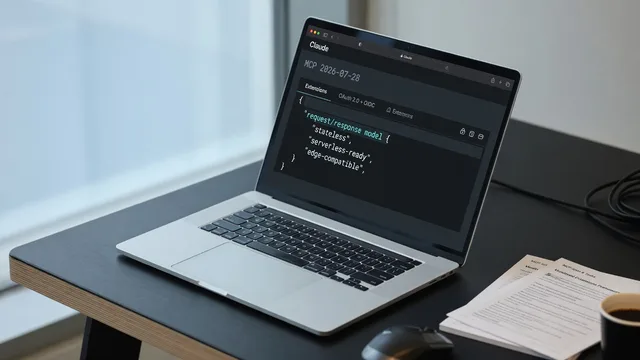
This update is highly relevant for product teams and builders as it fundamentally changes how MCP servers are deployed and secured. The shift to a stateless architecture and enterprise-grade authorization directly supports scalable, compliant AI agent integrations crucial for Dutch enterprises.

Relevance 85 · Audience 95