Spectral Flow Certificates for Depth-Aware Long-Range Propagation in Graph Neural Networks
06:00 · July 27, 2026 · arXiv cs.AI RSS
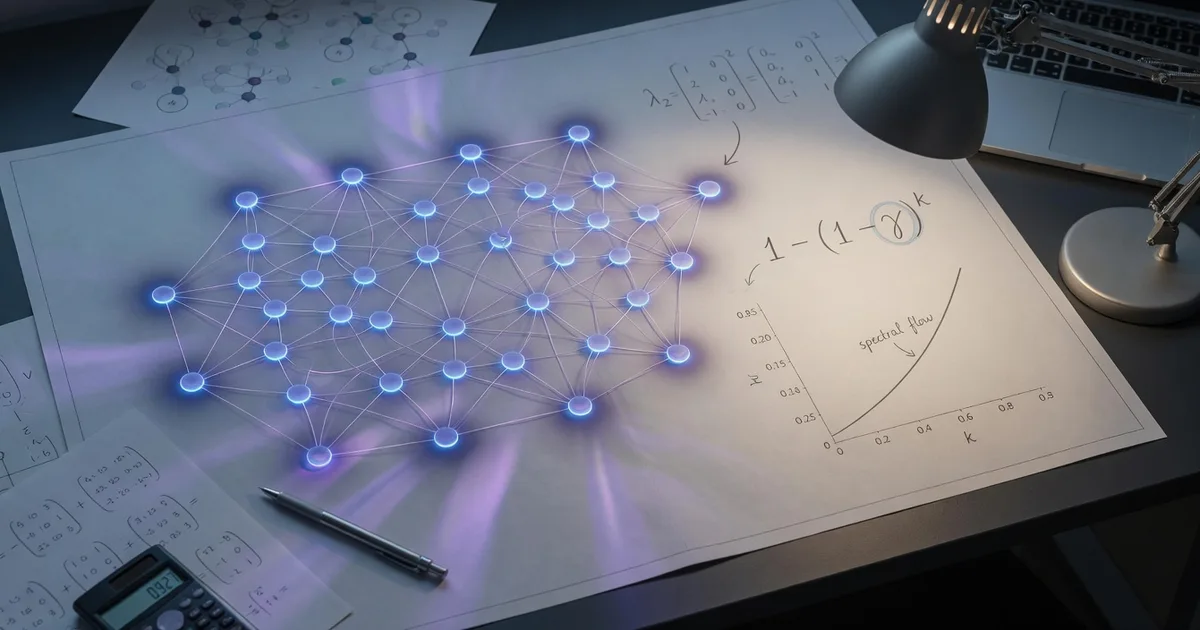
Graph Neural Networks propagate information through local message passing, but the graph topologies themselves can silently prevent any amount of training from solving long-range tasks. When we deploy GNNs on new graphs, there is currently no inexpensive way to know, before training begins, whether the graphs' structures will allow information to travel far enough between distant nodes. We address this gap by proposing Spectral Flow Certificates (SFCs), single scalars computed from the graphs' normalised Laplacians in seconds, requiring no model training and no labelled data. An SFC fuses a graph's algebraic connectivity with the chosen message-passing depth into one number that measures how much of the critical spectral bottleneck can be traversed within the available depth budget. Unlike raw spectral gaps, which are static and depth-agnostic, SFCs adapt as the number of layers increases and therefore carry strictly more diagnostic information when depths vary. Compared with classical structural statistics such as average effective resistance and graph diameter, SFCs explain more than twice as much variance in trained GNN long-range accuracy. Across twenty-five synthetic graph families spanning paths, cycles, grids, regular graphs, and random graphs, SFCs predict trained accuracy before any gradients are computed, achieving explanatory power above ninety percent at all tested depths. The same predictive relationships hold on one hundred fifty real molecular graph topologies drawn from three independent benchmark datasets, confirming that the findings are not artefacts of their synthetic construction. Taken together, these results show that a single eigenvalue computation is sufficient to flag topology-limited graphs before committing to expensive training pipelines, providing a principled first filter for GNN deployments.
Summary
Graph Neural Networks rely on repeated local aggregation to build node representations, yet many real-world topologies contain bottlenecks that prevent signals from reaching distant nodes within a fixed number of layers. When this occurs, no amount of training can recover the missing long-range dependencies, a limitation commonly termed over-squashing. Spectral Flow Certificates address the resulting diagnostic gap by supplying a single scalar that can be evaluated before any model is trained.
The certificate is obtained from the second-smallest eigenvalue γ of the normalised Laplacian, which quantifies algebraic connectivity. This value is combined with the intended message-passing depth k through the closed-form expression 1 − (1 − γ)^k. The resulting quantity measures the fraction of the spectral bottleneck that can be traversed within the chosen depth budget. Because the expression grows monotonically with both γ and k, it supplies strictly more information than the static spectral gap whenever layer count varies.
Empirical tests demonstrate that the scalar explains more than twice the variance in downstream accuracy compared with classical measures such as average effective resistance or graph diameter. On twenty-five families of synthetic graphs the coefficient of determination exceeds 0.9 at every tested depth; the same relationship holds across one hundred fifty molecular graphs drawn from three independent benchmarks. Computation requires only a single partial eigendecomposition and therefore serves as an inexpensive filter that flags topology-limited instances before expensive training pipelines are invoked.
Why it matters
High technical depth and novelty make it directly usable by Dutch AI researchers working on GNNs for molecular, network, or relational data; the pre-training diagnostic is actionable for practitioners evaluating deployment feasibility.