Personalization, Personas, and Forecasting in Value Alignment
06:00 · July 29, 2026 · arXiv cs.AI RSS
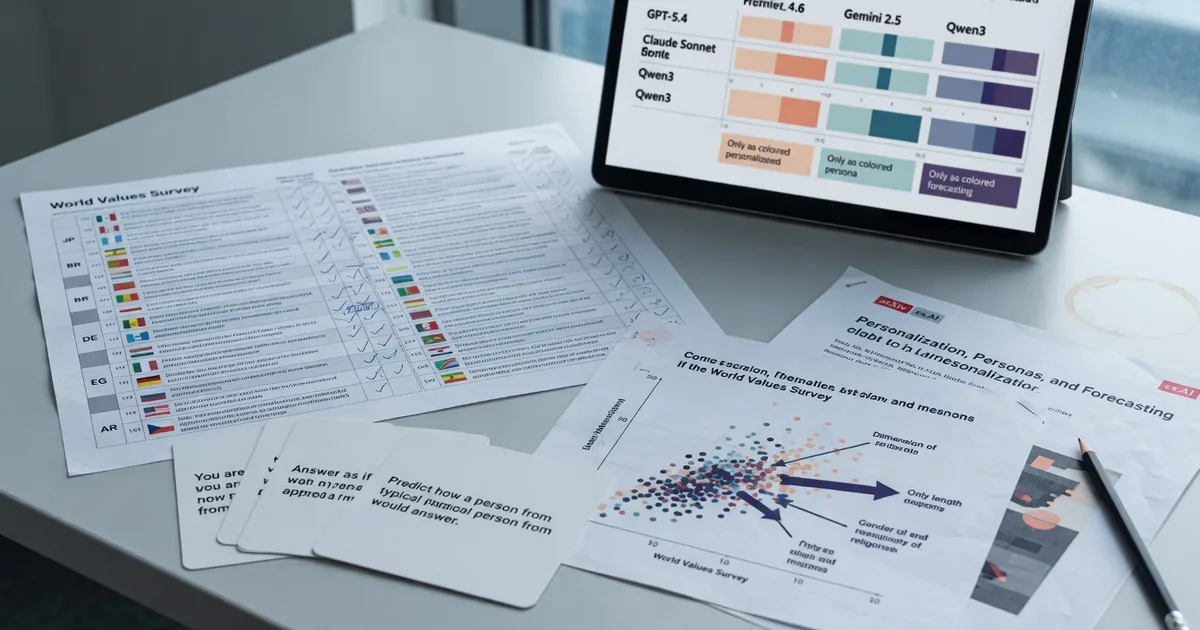
LLM behavior may be conditioned by human identity in several ways: they may be asked to adapt to users, role-play populations, or forecast how people would answer value-laden questions. We test whether these framings are interchangeable using the World Values Survey (WVS). We evaluate GPT-5.4, Claude Sonnet 4.6, Gemini 2.5 Flash, and Qwen3-235B on 101 WVS-derived questions across 13 language-country slices, comparing a language-only baseline with user-country, persona-country, and third-person prompts. Across 21,008 model-response rows, prompt framing is a first-order determinant of cultural alignment: country cues often shift answers substantially, but not all shifts move toward matched human response distributions. Third-person forecasting yields the strongest directional alignment for three of the four hosted models, while personalization and role-play are weaker or less stable. Alignment gains concentrate on salient value dimensions such as religiosity, gender roles, and work-oriented material values, whereas institutional trust and democracy-related questions remain difficult. These results show that prompt framing is not a cosmetic choice in cultural value elicitation; it changes both model behavior and measured alignment.
Summary
This study examines whether three common ways of conditioning large language models on human identity—personalization to a user, role-play as a persona, and third-person forecasting—produce equivalent effects on cultural value alignment. The authors ground their comparison in 101 questions drawn from the World Values Survey and evaluate four frontier models (GPT-5.4, Claude Sonnet 4.6, Gemini 2.5 Flash, and Qwen3-235B) across 13 language-country combinations, generating more than 21,000 individual responses.
Four prompt conditions were tested against a language-only baseline: a statement that the user is from the target country, an instruction to answer as if the model itself were from that country, and a request to predict how a person from that country would respond. Country-specific cues reliably shifted model answers relative to the baseline, yet the direction and magnitude of those shifts varied markedly by framing. Third-person forecasting produced the clearest movement toward the empirical human response distributions for three of the four models, while personalization and persona prompts yielded smaller or less consistent gains.
Alignment improvements were concentrated on dimensions with high social salience, such as religiosity, gender roles, and materialist work values. Questions concerning institutional trust and democratic norms proved more resistant to prompt-based adjustment. The results indicate that prompt framing functions as a first-order variable in cultural elicitation tasks rather than a neutral implementation detail, and that the three identity-conditioning approaches are not interchangeable for measurement or deployment purposes.
Why it matters
The article provides critical insights into LLM cultural alignment and bias mitigation, which is highly relevant for Dutch AI researchers and enterprises striving to comply with EU ethical AI standards. Understanding how prompt framing impacts value elicitation is essential for developing transparent, localized, and culturally aware AI systems in the Netherlands.