OpenClaw and Ollama in Agentic AI: Toward Fully Autonomous and Scalable AI Agent Systems
06:00 · August 3, 2026 · arXiv cs.AI RSS
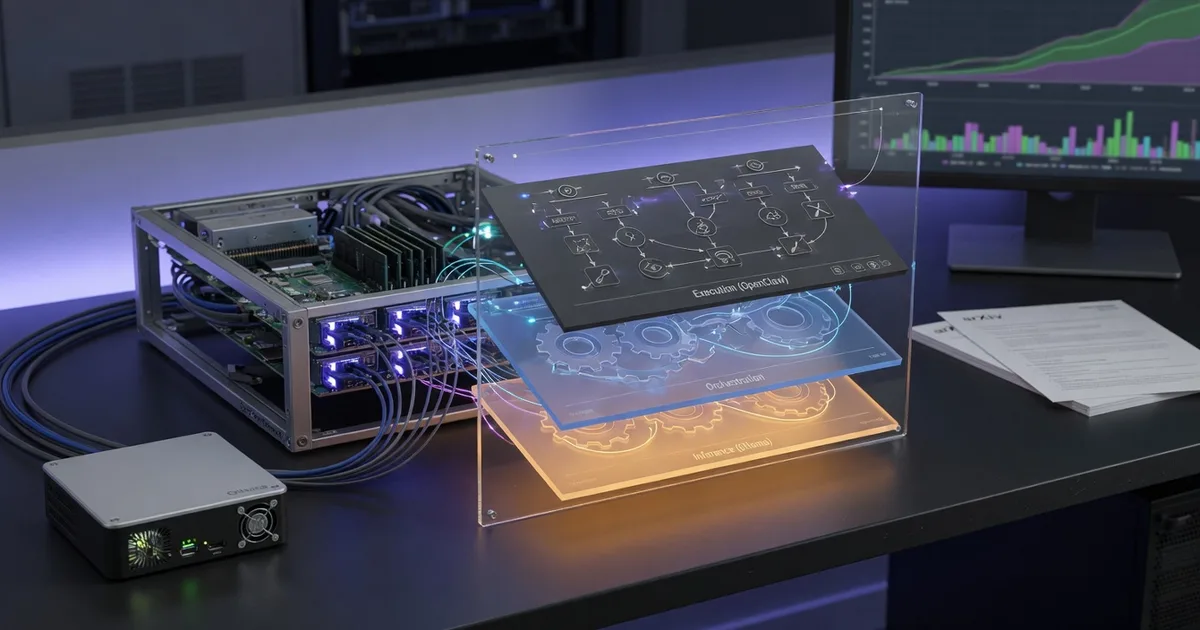
The rapid transition from reactive large language models (LLMs) to persistent, action-capable systems has exposed critical gaps in the architectural understanding of Agentic AI, particularly in separating inference, orchestration, and execution layers for autonomous AI agents. Despite recent advances, unified frameworks for designing and evaluating full-stack agentic systems remain limited. This paper presents a comprehensive, layered architecture for Agentic AI, outlining the evolution from reactive LLM interfaces to persistent, goal-driven autonomous AI agents with memory, planning, and continuous execution. We analyze OpenClaw and Ollama as a full-stack Agentic AI system, where Ollama serves as the LLM inference layer and OpenClaw enables agent runtime orchestration, integrating reasoning, tool use, and action execution. A prototype experimental validation of the OpenClaw-Ollama architecture demonstrates that capabilities such as persistent memory, tool utilization, and adaptive decision-making emerge from system-level integration rather than standalone models, with performance improving consistently as architectural complexity increases. The study further examines challenges in scalability, security, privacy, governance, and evaluation of agentic systems, highlighting the need for robust benchmarking and system-level design. Future directions include scalable multi-agent architectures, distributed autonomous systems, and human-aware Agentic AI frameworks for responsible deployment. Overall, this work establishes a unified architectural foundation for Agentic AI, validates the effectiveness of full-stack autonomous AI agents, and provides a roadmap for building scalable, secure, and trustworthy agentic systems. All models, code, and datasets are publicly released to support reproducibility and benchmarking.
Summary
The paper outlines a layered architecture for Agentic AI that separates LLM inference, agent orchestration, and execution into distinct but integrated components. Ollama supplies the inference layer by enabling efficient local model execution, while OpenClaw provides the runtime layer that embeds models into persistent loops for planning, memory management, tool invocation, and continuous action. This separation addresses the shift from reactive LLM interfaces, which respond only to isolated prompts, toward systems that maintain state, pursue long-horizon goals, and adapt through repeated observation-action cycles.
Empirical tests of the combined OpenClaw-Ollama stack show that capabilities such as persistent memory and reliable tool use arise from the overall system design rather than from model weights alone. Performance on benchmark tasks improved steadily as the architecture incorporated additional layers for memory hierarchy, scheduling, and governance, confirming a monotonic relationship between structural complexity and autonomous behavior. The authors release the prototype code, models, and datasets to support reproducible evaluation.
The work also examines operational constraints that accompany such systems. Local inference improves data sovereignty and reduces latency, yet multi-agent deployments introduce new requirements for access control, auditability, and coordinated decision-making across distributed components. The paper identifies gaps in current benchmarking practices and calls for evaluation metrics that capture long-term reliability, security posture, and alignment with human oversight rather than isolated task accuracy. Future extensions discussed include scalable multi-agent coordination and frameworks that embed explicit human-in-the-loop constraints.
Why it matters
The research is highly relevant for Dutch AI practitioners as it provides a reproducible, privacy-preserving framework using local inference that aligns with strict EU data sovereignty and governance standards. It offers actionable architectural blueprints for researchers building trustworthy, scalable autonomous agents.