Autonomous Mathematical Discovery in an Open-World Multi-Agent Environment
06:00 · August 26, 2026 · arXiv cs.AI RSS
We study autonomous mathematical discovery in the Station, an open-world multi-agent environment in which AI agents from different model families pursue a shared research goal without a central coordinator or scripted pipeline. Agents choose their own research directions, conduct experiments, collaborate, and build a shared scientific literature. Across 12 construction problems from the AlphaEvolve catalogue and two additional case studies, the Station obtained results novel relative to the prior literature on five problems: a new infinite family of finite-field Kakeya sets, new exact 604-point kissing configurations in dimension 11, new records for the discretized Kakeya needle and sign uncertainty problems, and a substantially improved lower bound for Erd\H{o}s's minimum-overlap problem. Agents also discovered novel infinite families for Book Ramsey numbers. Importantly, the agents produced not only numerical constructions but also theorems and analyses explaining how those constructions work, making the results more interpretable and easier for mathematicians to build upon. We release all raw agent dialogues, proofs, and verification code, providing a transparent record of how these discoveries emerged.
Summary
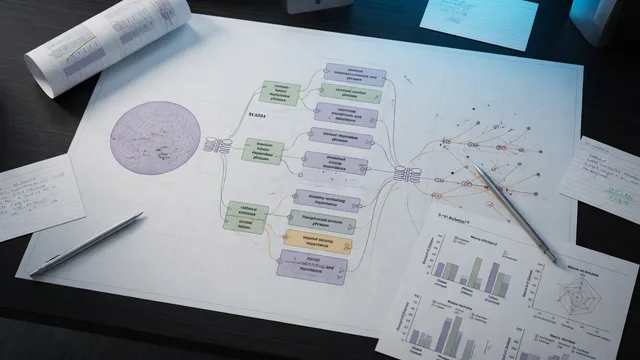
The Station is an open-world multi-agent environment designed to let AI agents from different model families pursue a shared mathematical research goal without a central coordinator or predefined workflow. Agents independently select research directions, run experiments, exchange ideas through dedicated communication spaces, and publish findings that accumulate into a shared body of literature for later agents to read and extend. This setup treats each agent as a complete researcher rather than a component in a fixed pipeline, allowing the system to simulate a miniature scientific community across multiple specialized rooms for research, reflection, discussion, and archiving.
When applied to twelve construction problems drawn from the AlphaEvolve catalogue plus two additional case studies, the Station produced results that improve on existing literature in five cases. These include a new infinite family of finite-field Kakeya sets, exact 604-point kissing configurations in dimension 11, improved bounds on the discretized Kakeya needle and sign uncertainty problems, and a stronger lower bound for Erdős’s minimum-overlap problem. In a separate study on Book Ramsey numbers, agents discovered and proved new infinite families. The agents also located a counterexample to the Jacobian Conjecture within a single day using only internal resources.
Beyond numerical constructions, the agents generated accompanying theorems and algebraic explanations that render the results more transparent and usable by human mathematicians. All raw dialogues, proofs, and verification code are released publicly, enabling external examination of how the discoveries emerged through collaboration and iterative refinement of the internal literature.
Why it matters
This article presents a breakthrough in autonomous AI-driven scientific discovery using multi-agent systems. It is highly relevant for Dutch AI researchers focusing on AI for Science, multi-agent collaboration, and transparent AI methodologies, offering open-source tools and reproducible mathematical findings.